Mid-afternoon, between calls, the same question resurfaced.
I stepped back from the screen and let the data settle before revisiting DUSK’s post-mainnet token mechanics—this time with an added layer.
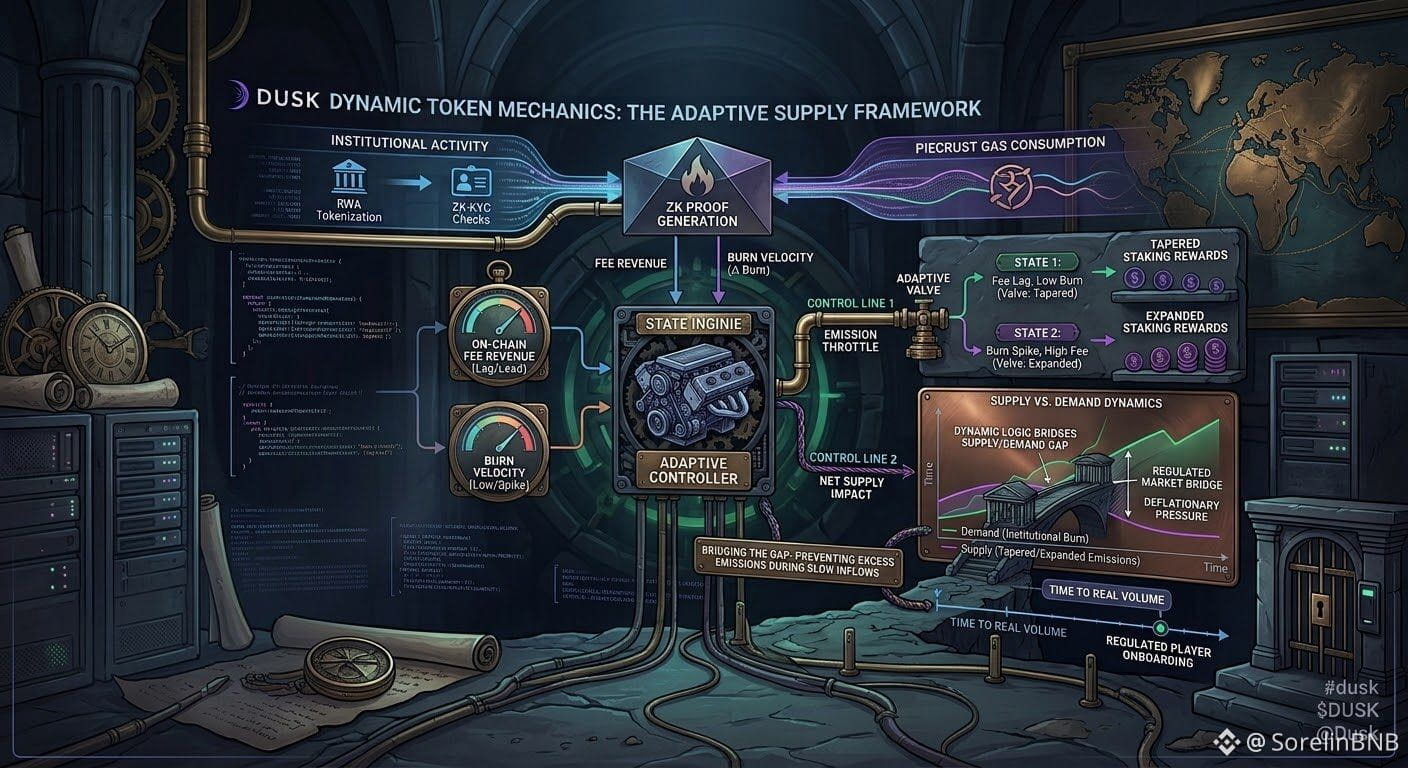
Most L1 tokens trade on narrative, but $DUSK now serves as the actual gas for private contracts inside Piecrust. Each RWA tokenization or ZK-KYC check burns @Dusk to generate zero-knowledge proofs. More institutional activity means stronger deflation.
The concept I want to add is an emission throttle tied to burn velocity: if on-chain fee revenue lags, staking rewards automatically taper to reduce sell pressure; if burn spikes, rewards expand to secure the network. That would make supply response adaptive rather than fixed.
That mechanism could bridge the gap until regulated players onboard. Without it, slow institutional inflows may still let emissions outweigh burns.
Would dynamic supply logic change your view, or is it still speculation until real volume arrives? #dusk $SPK $ZEC
I stepped back from the screen and let the data settle before revisiting DUSK’s post-mainnet token mechanics—this time with an added layer.
Most L1 tokens trade on narrative, but $DUSK now serves as the actual gas for private contracts inside Piecrust. Each RWA tokenization or ZK-KYC check burns @Dusk to generate zero-knowledge proofs. More institutional activity means stronger deflation.
The concept I want to add is an emission throttle tied to burn velocity: if on-chain fee revenue lags, staking rewards automatically taper to reduce sell pressure; if burn spikes, rewards expand to secure the network. That would make supply response adaptive rather than fixed.
That mechanism could bridge the gap until regulated players onboard. Without it, slow institutional inflows may still let emissions outweigh burns.
Would dynamic supply logic change your view, or is it still speculation until real volume arrives? #dusk $SPK $ZEC