#dusk $DUSK @Dusk Last night I went to look into what mechanism Dusk-issued securities actually use to force compliance. I originally thought this part should be off-chain—some kind of registry system that performs eligibility checks before a transfer, which is how most tokenized-asset platforms operate. But the rules are simply not off-chain.
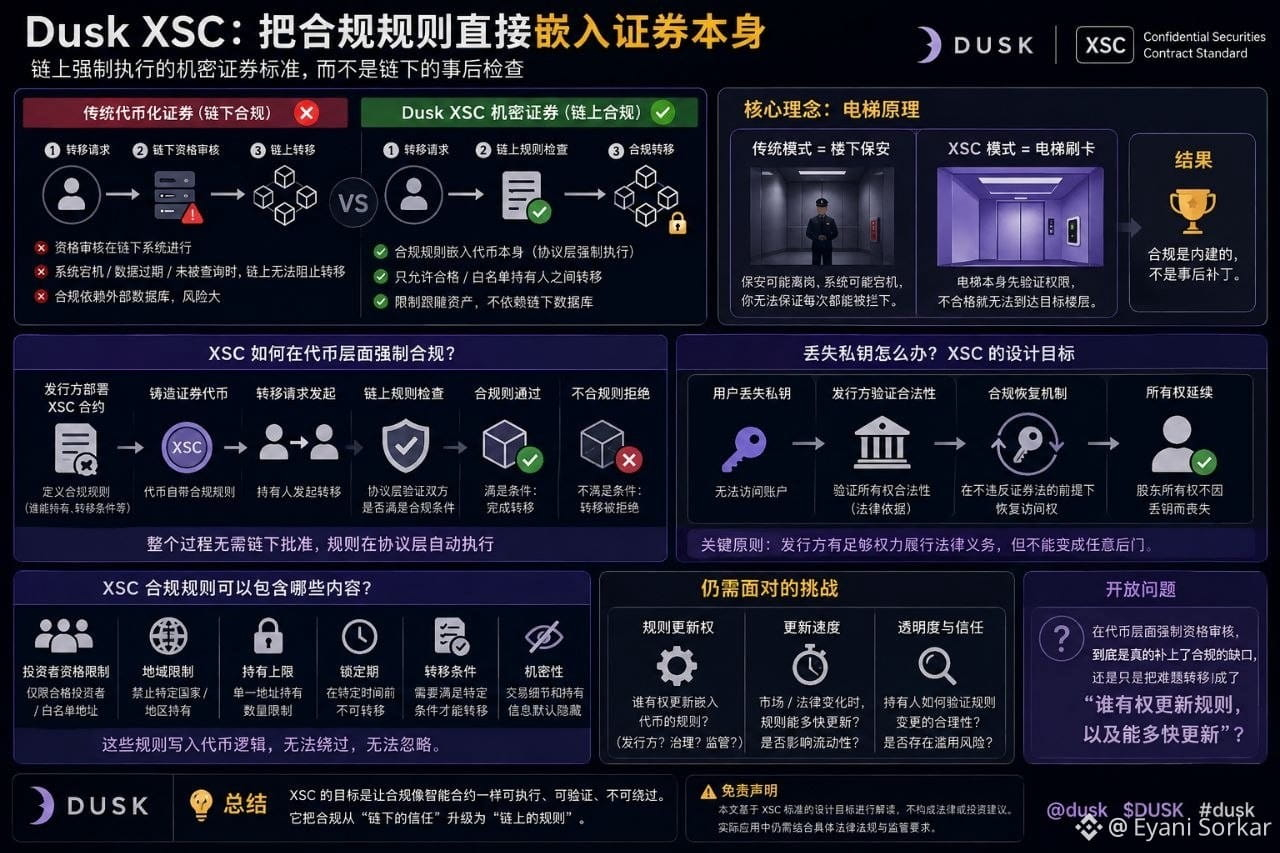
XSC, the confidential securities contract standard of Dusk, lets the issuer embed the compliance conditions directly into the token itself. A security can be programmed so it can only be transferred between eligible, whitelisted holders; that check is completed at the protocol layer, not by adding an approval step afterward. The limitation follows the asset, rather than relying on some database elsewhere to track who is qualified to hold it.
This is different from the failure mode I expected. Most of the “compliance” tokenization schemes I’ve read have a loophole: the token transfers on-chain, but the real eligibility verification happens in an off-chain system that the blockchain cannot verify. If that system goes down, the data expires, or it simply isn’t queried, nothing on-chain can stop that transfer.
There’s a detail in the design that really caught my attention—this standard also has to handle cases where a private key is lost, and it must not violate the issuer’s legal obligations. If a shareholder loses access, securities law still says they won’t lose ownership just because they can’t access it. XSC needs to give the issuer enough control to carry out that obligation, but that control can’t become a backdoor that undermines the premise of “on-chain enforceability rules.”
It reminds me of a building where the elevator itself validates your card before opening the door, rather than relying on a guard downstairs who might just happen to be off shift.
To be clear, what I read is the design goal claimed by this standard—I haven’t actually seen a real shareholder registry hit a boundary case. I haven’t seen real-world examples of what happens with actual lost keys or changes in jurisdiction for assets that are truly regulated.
I’m still thinking about it: at the token layer, enforcing eligibility—does it really close the compliance gap, or does it just shift the hard problem to “who has the right to update the rule embedded in the token, and how quickly that update can be made”?
@Dusk $DUSK #dusk #BinanceSquareFamily
XSC, the confidential securities contract standard of Dusk, lets the issuer embed the compliance conditions directly into the token itself. A security can be programmed so it can only be transferred between eligible, whitelisted holders; that check is completed at the protocol layer, not by adding an approval step afterward. The limitation follows the asset, rather than relying on some database elsewhere to track who is qualified to hold it.
This is different from the failure mode I expected. Most of the “compliance” tokenization schemes I’ve read have a loophole: the token transfers on-chain, but the real eligibility verification happens in an off-chain system that the blockchain cannot verify. If that system goes down, the data expires, or it simply isn’t queried, nothing on-chain can stop that transfer.
There’s a detail in the design that really caught my attention—this standard also has to handle cases where a private key is lost, and it must not violate the issuer’s legal obligations. If a shareholder loses access, securities law still says they won’t lose ownership just because they can’t access it. XSC needs to give the issuer enough control to carry out that obligation, but that control can’t become a backdoor that undermines the premise of “on-chain enforceability rules.”
It reminds me of a building where the elevator itself validates your card before opening the door, rather than relying on a guard downstairs who might just happen to be off shift.
To be clear, what I read is the design goal claimed by this standard—I haven’t actually seen a real shareholder registry hit a boundary case. I haven’t seen real-world examples of what happens with actual lost keys or changes in jurisdiction for assets that are truly regulated.
I’m still thinking about it: at the token layer, enforcing eligibility—does it really close the compliance gap, or does it just shift the hard problem to “who has the right to update the rule embedded in the token, and how quickly that update can be made”?
@Dusk $DUSK #dusk #BinanceSquareFamily