@Dusk I’ve been looking at Dusk’s cross-chain reach as a capital-routing problem rather than a connectivity metric.
Supporting many destinations can expand where an asset is technically usable, but it can also change where liquidity wants to live.Once trading and settlement extend beyond the home chain, investors start optimizing for depth, execution quality and counterparty access not for where the asset was originally issued.
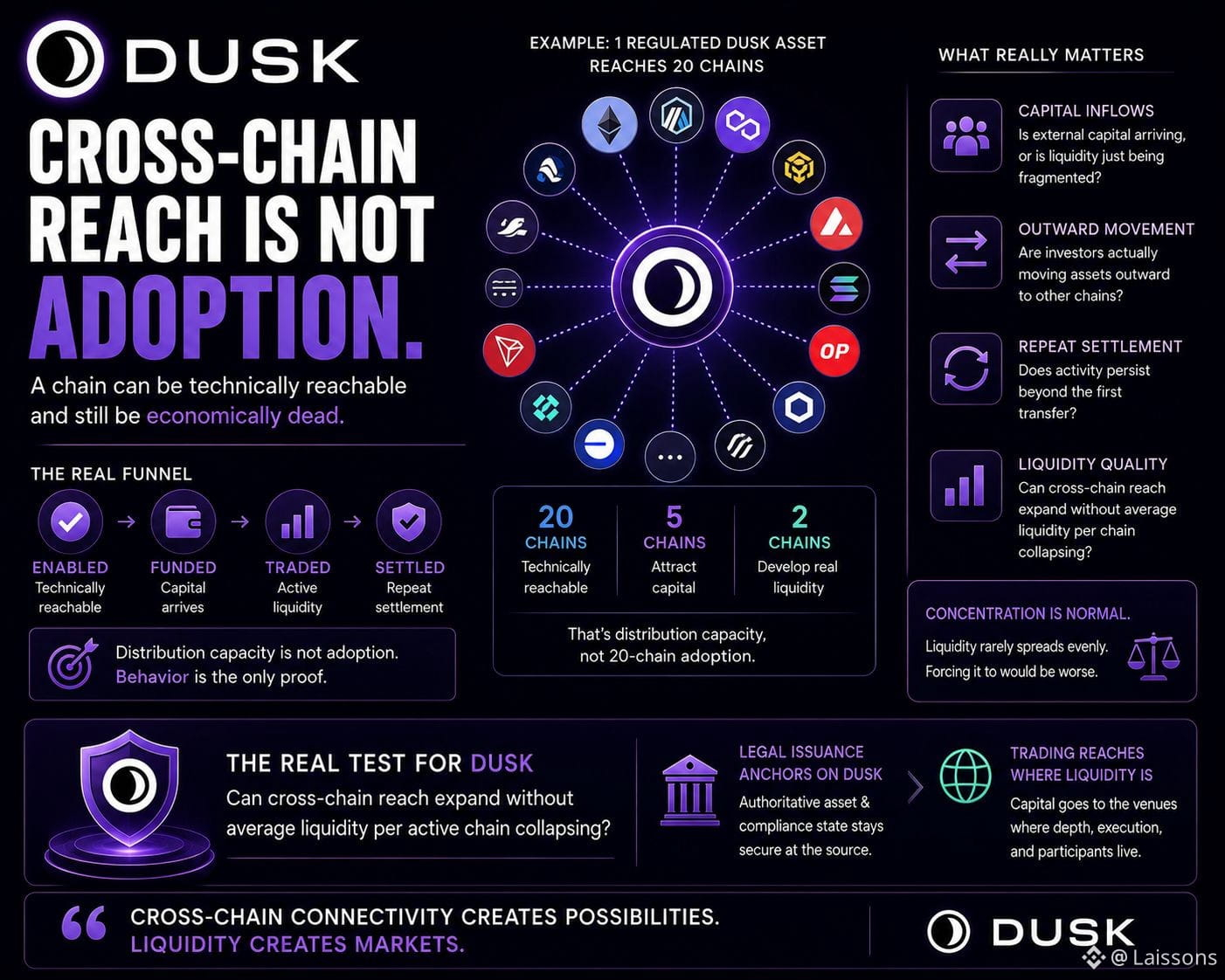
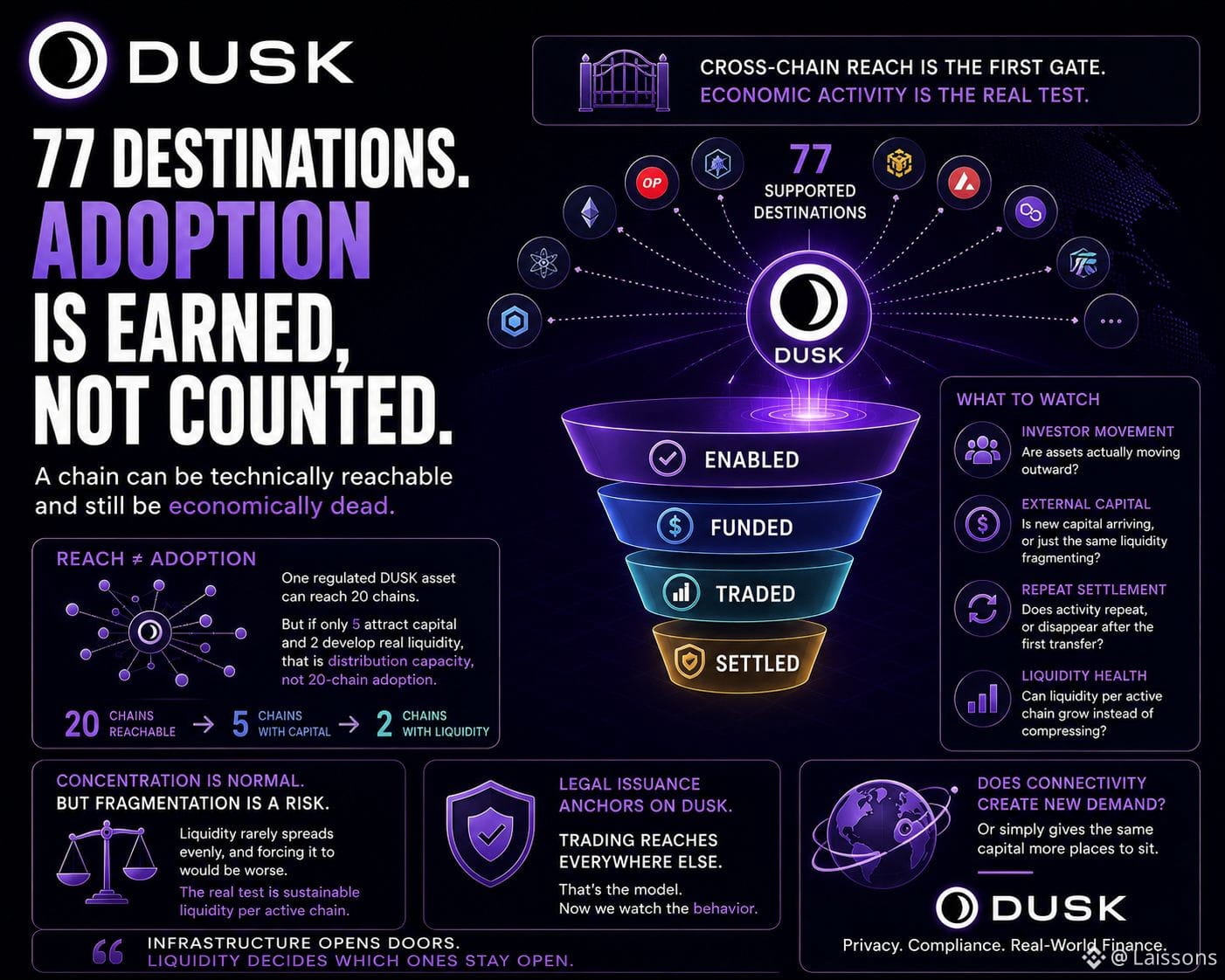
That makes the composition of cross-chain activity more important than the number of connected networks.
Connectivity creates options; liquidity decides where capital stays.
For Dusk, I’d want to see whether cross-chain movement is bringing genuinely new participants into regulated assets or simply distributing existing liquidity across more venues. The latter can make the ecosystem look broader while making execution worse at the margin.
There is also a positive scenario. If Dusk can keep authoritative asset and compliance state anchored while allowing liquidity to reach the venues where investors already operate, the chain could function as a coordination layer rather than trying to capture every trade locally.
The weakness is fragmentation. More destinations mean more bridges, liquidity pools and operational dependencies to monitor.
So I’d track capital inflows, repeat settlement, liquidity depth per active venue and the share of volume coming from external participants.
That should reveal whether Dusk’s connectivity is expanding the market or simply spreading it thinner.
#dusk @Dusk $DUSK
Supporting many destinations can expand where an asset is technically usable, but it can also change where liquidity wants to live.Once trading and settlement extend beyond the home chain, investors start optimizing for depth, execution quality and counterparty access not for where the asset was originally issued.
That makes the composition of cross-chain activity more important than the number of connected networks.
Connectivity creates options; liquidity decides where capital stays.
For Dusk, I’d want to see whether cross-chain movement is bringing genuinely new participants into regulated assets or simply distributing existing liquidity across more venues. The latter can make the ecosystem look broader while making execution worse at the margin.
There is also a positive scenario. If Dusk can keep authoritative asset and compliance state anchored while allowing liquidity to reach the venues where investors already operate, the chain could function as a coordination layer rather than trying to capture every trade locally.
The weakness is fragmentation. More destinations mean more bridges, liquidity pools and operational dependencies to monitor.
So I’d track capital inflows, repeat settlement, liquidity depth per active venue and the share of volume coming from external participants.
That should reveal whether Dusk’s connectivity is expanding the market or simply spreading it thinner.
#dusk @Dusk $DUSK