

Many people who enter the crypto world actually don’t really understand the basics—like on-chain private keys and public keys, the major public chains, exchanges, and wallets, and how they relate to each other. I also spent a long time not being sure how they connect. Today, it’s the weekend with nothing much to do, so I’ll use a simple and intuitive analogy to explain and popularize it:
Private keys and public keys are actually just long strings of characters. In simple terms: private key = bank account password, public key = bank card number. The major public chains = different banks (for example, the Bitcoin chain = China Bank, the Ethereum chain = Industrial and Commercial Bank, BSC Binance Chain = Construction Bank). Exchanges = money changers for asset swapping. Wallets are divided into hot wallets and cold wallets. The difference is whether they are connected to the internet. If they exist on networked devices like phones or computers, they are hot wallets. If they are stored on offline hardware devices that need to “handshake” with the outside world using QR codes or Bluetooth, then you must press the signing action on that hardware to transfer assets. A wallet like the keyPal wallet sold by TP Wallet is a cold wallet.
I. Private Keys and Public Keys
Private key x is an irreversible encryption algorithm to derive the public key (the public key is the wallet address). There is a one-to-one correspondence between private keys and public keys—meaning one private key corresponds to one public key. If you know the private key, you know the public key. But since the encryption algorithm is irreversible, you cannot derive the private key from the public key. In other words, each wallet address has exactly one unique private key corresponding to it. For example, the BSC wallet corresponds to one private key; the Bitcoin wallet corresponds to one private key. So for example, after converting a Binance wallet into a private-key wallet, you will see many private keys: there are private keys for the BSC chain wallet, private keys for the Ethereum chain wallet, and private keys for the Bitcoin wallet. Copy these private keys and import them into something like TP Wallet; then you restore the corresponding chain wallet addresses and can see the assets stored in the wallets of those chains.
II. Exchange, Deposit, Withdrawal, and Transfer
An exchange is like a large money-changer. When you open an account at an exchange, the exchange automatically sets up accounts for you on major public chains (meaning it gives you wallet addresses on each chain; a wallet address is your public key; the corresponding private key is managed by the exchange). This is like you go to this money-changer to open an account, and the money-changer automatically opens the bank cards for you at each bank. For example, a Bitcoin wallet address equals a China bank card number; an Ethereum chain wallet address equals an Industrial and Commercial bank card number; a BSC/Binance chain wallet address equals a Construction bank card number. Each of these card numbers corresponds to a unique password—that’s the private key. The magic of blockchains is that whoever has this private-key “password” owns the assets in the wallet. So it’s like if you know the card password, the assets in that card are yours. Then people ask: if it’s a password, can computers crack it? In practice, the possibility is almost infinitely close to 0. This isn’t like a 6-digit bank card password. A private key has 2^256 possibilities, i.e., 10^77. The world’s most powerful supercomputer can do about 10^18 calculations per second. What does that mean? In one second, counting 10 quadrillion (1000 trillion) is only 10^15. Brute-forcing and cracking this would take about 10^77 ÷ 10^18 = 10^59 seconds, which is 10^51 years. Even from the Big Bang to now is only about 10^10 years, so it’s 10^41 times longer than the Big Bang. Therefore, to crack it you’d first need to rent the most advanced supercomputer, then set a small goal—live for 10^41 more years than the Big Bang. Also, all wallet addresses are on-chain, and the chain is publicly transparent. So as long as you copy this wallet address into something like TP’s watch wallet, you can see how many assets are in that wallet. It’s like knowing a bank card number tells you how much money is in that card. These wallet addresses are executed on-chain, meaning only when you deposit or transfer do you involve the blockchain. Normally, trading and asset swaps happen inside this money-changer. For each trade, the money-changer charges a certain buy/sell trading fee. This is the exchange’s source of profit. So the exchange is centralized, while the blockchain is decentralized. The exchange itself has its own local database server. The database records each user’s asset information—just like the money-changer has a bookkeeping system. The database looks like the following table:

It manages the subsequent data items according to each user’s unique ID. For example, when user 1 makes a transaction, currently there are 200 USDT and 5 BNB. If they want to use USDT to buy BNB, assuming BNB costs 100 U per coin, after buying 1 coin, the database record’s USDT becomes 100 U and the BNB amount becomes 6. Another example: when user 1 transfers and tops up from OY (via Ouyi) to Binance through the TRON (Tron) network, the whole process is actually like a bank transfer. First you choose which bank/network you are transferring to (i.e., the public chain), then enter the “account number” (the public key, i.e., the wallet address), then enter the transfer amount, for example 200 yuan (USDT 200), and finally enter the transfer password (the private key). This completes the transfer process. It’s just that instead of the raw key, the system uses something like a fingerprint or a numeric password; the system maps the key to the fingerprint. When user 1’s 200 USDT arrives in Binance’s TRON wallet, the exchange scans the wallet and sees the asset increase, then it transfers user 1’s USDT from their TRON wallet to the exchange’s own hot wallet (like the money-changer counter). At the same time, the exchange’s local database ledger’s USDT balance increases by 200. Once all users’ USDT accounts are consolidated into this hot wallet, at intervals the funds are moved into a cold wallet (like the money-changer’s safe). The withdrawal process is similar: when the hot wallet doesn’t have enough funds, part of the funds is pulled out from the cold wallet.
That is, the user platform account created by the exchange, which acts as the function for managing all users’ on-chain wallets and private keys. Here’s the problem: one user has multiple private keys, and with hundreds of millions of users, the number of private keys to manage is undoubtedly enormous and easy to lose. This is exactly the early exchange private-key management model. Modern exchanges introduce HD hierarchical deterministic (hierarchical layering) technology, using a tree-like path to manage private keys, as shown below:
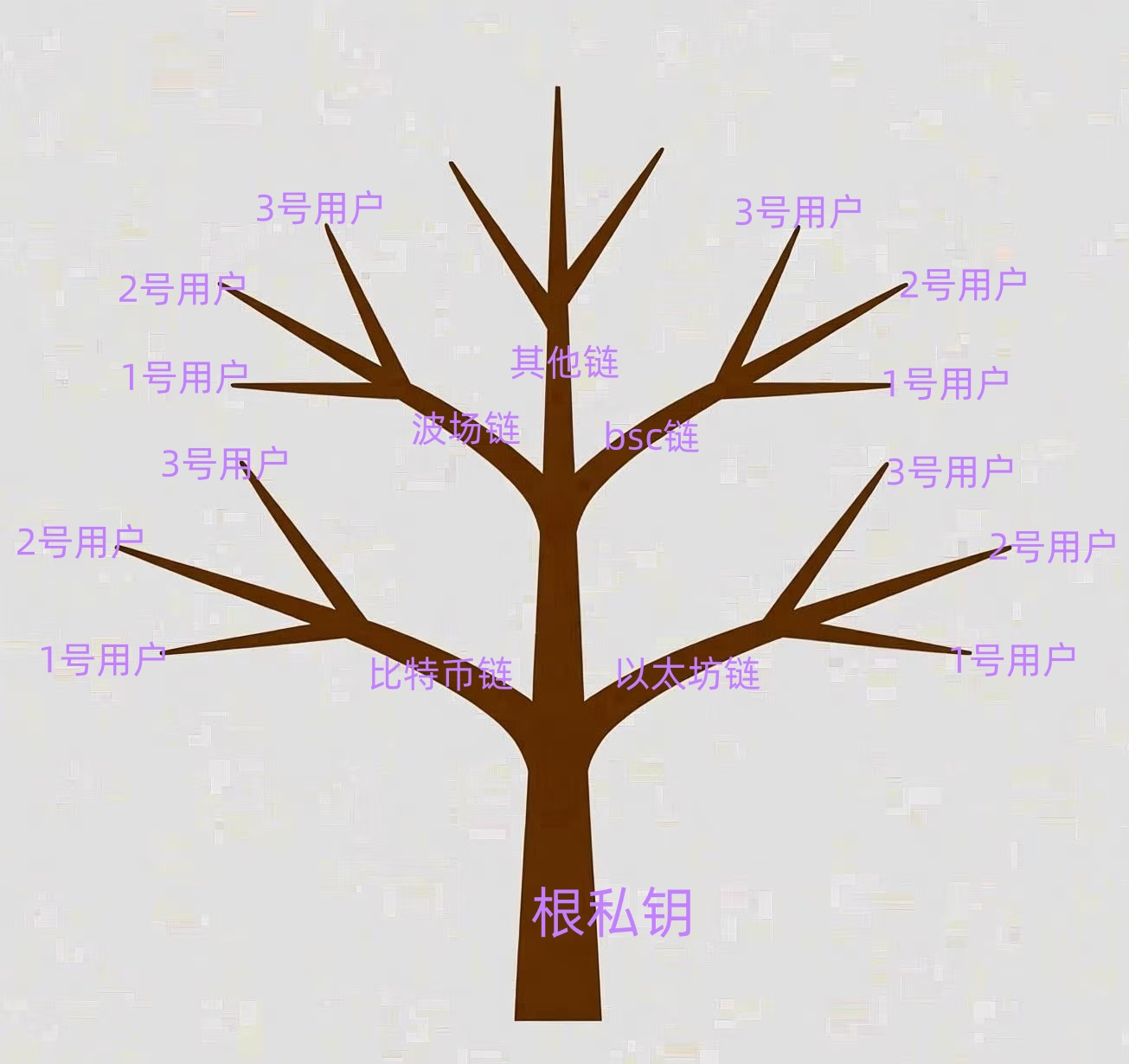
The exchange generates the end (terminal) private key using the form of root private key + public chain protocol number + user sequence number. The private key then generates the wallet address. With this approach, you only need to remember one root private key; knowing it means you can know all users’ private keys and wallet addresses. For example, root private key + public chain protocol m/44'/XX'/0'/0/ + user sequence number is used to generate the private key for that chain, where XX=0 is the Bitcoin chain and XX=60 is the BSC and Ethereum chains. Since they are both EVM chains, the private keys and public-key wallet addresses generated by these two public chains are actually the same. This is like the user having a Construction Bank account and an Industrial and Commercial Bank account with the same card number—except the assets are held in two different banks. XX=195 is the TRON chain. For example, CZ is the exchange’s employee #1 and He Yi is employee #2. When He Yi opens an account on Binance, on the Bitcoin chain it generates a Bitcoin private key using root private key + m/44'/0'/0'/0/2. This private key then generates the public key, i.e., He Yi’s Bitcoin wallet. Meanwhile, on the BSC chain it also generates a BSC chain private key using root private key + m/44'/60'/0'/0/2; that private key generates the public key, i.e., He Yi’s BSC wallet. So managing one root private key effectively manages all wallets of the exchange. The same idea applies to cold wallets: generate this root private key from a mnemonic phrase; after importing the root private key, you obtain that user’s assets across all chains.