
Major update on U.S.-Iran developments on August 23: Munir’s visit to Iran may handle multiple lines of business. Iran being invited to participate (the Makkah Common Defense Agreement) could change the Middle East landscape!
There isn’t much news today about the U.S. and Iran, but what there is matters. Let’s go through it in chronological order. I believe this is a major turning point in the situation between the U.S. and Iran:
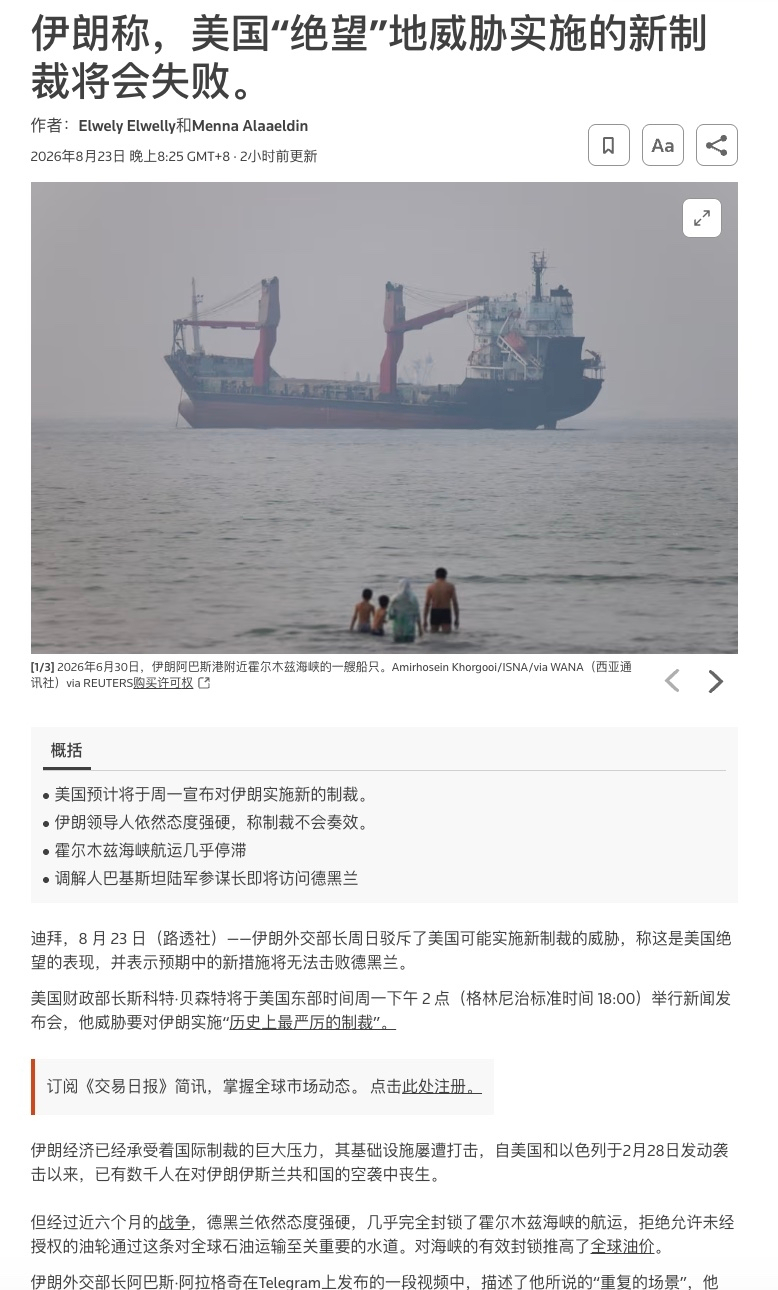
1, The Iranian foreign minister, Amir-Abdollahian, said that the United States’ so-called “most severe economic sanctions in history” is a helpless choice made after its existing strategy has failed. He added that Iran has not closed the door to negotiations and hopes Washington will engage in talks in a respectful manner. In fact, this is a signal to the outside world—Iran does not accept submission-based negotiations; it only accepts negotiations under conditions of respect
2. Pakistan’s Army Chief of Staff Munir will travel to Tehran next Monday. Munir is Pakistan’s top representative in mediation talks with the U.S. His trip to Tehran means Pakistan will return to being a focus of U.S.-Iran mediation.
I think this visit by Munir to Tehran is, in addition to three issues,
a. Mediation between the United States and Iran—this is the main task.
b. Regarding U.S. economic sanctions, jointly discuss response strategies. It is also about exerting pressure on the U.S. through diplomatic means, hoping to delay the economic sanctions.
c. Discuss with Iran matters related to joining (the Makkah Joint Defense Pact).
3, Senior Iranian officials said that Iran has been invited to join (the Makkah Joint Defense Pact). This is a region-wide security framework agreement for Middle Eastern countries. The main countries are currently Saudi Arabia, Turkey, and Pakistan. Once Iran joins, the hostile relationship between Iran and Saudi Arabia will move into a period of easing. At the same time, it also means a shift in the future direction of Middle East trends: with the United States withdrawing, the Middle East will establish a new security framework. This is very important for the direction of Middle East trends.
Summary of this phase:
I think today is a very important turning point. Munir’s trip to Tehran, coinciding with the time when the United States announced its sanctions package and when Iran was invited to join (the Makkah Joint Defense Pact), is undoubtedly placing some pressure on the U.S. sanctions plan. New sanctions could cause the Middle East to rapidly band together and accelerate de-Americanization.
The key is (the Makkah Joint Defense Pact). Members include U.S.-traditional Middle East allies (Saudi Arabia), NATO members (Turkey), and nuclear states that maintain strategic balance between China and the U.S. (Pakistan). The pact was established on August 7, 2026. The agreement is very simple: any armed attack by any of the three member states on any one of the other two countries will be regarded as a joint attack on the three countries.
So once Iran joins, the structure of this pact will become more diverse and more complex. It has every ability to become a new framework for Middle Eastern order. The U.S. will no longer be able to attack Iran at will. Moreover, among the member states, multiple countries have good relations with the United States. Iran’s entry can help member states coordinate U.S.-Iran relations.#美加贸易谈判破裂加拿大誓言反制
So next, if on Monday the United States issues a new TACO sanctions agreement against Iran, then I think it’s a positive signal. If Iran truly joins this framework, the U.S. would have grounds to withdraw troops and lift blockades in a face-saving manner, and Iran could also take a step back accordingly, bringing the two countries back to the negotiating table!