Everyone talks about Dusk's privacy tech. Almost nobody talks about how a block actually travels across the network.
I went looking, and found something called Kadcast.
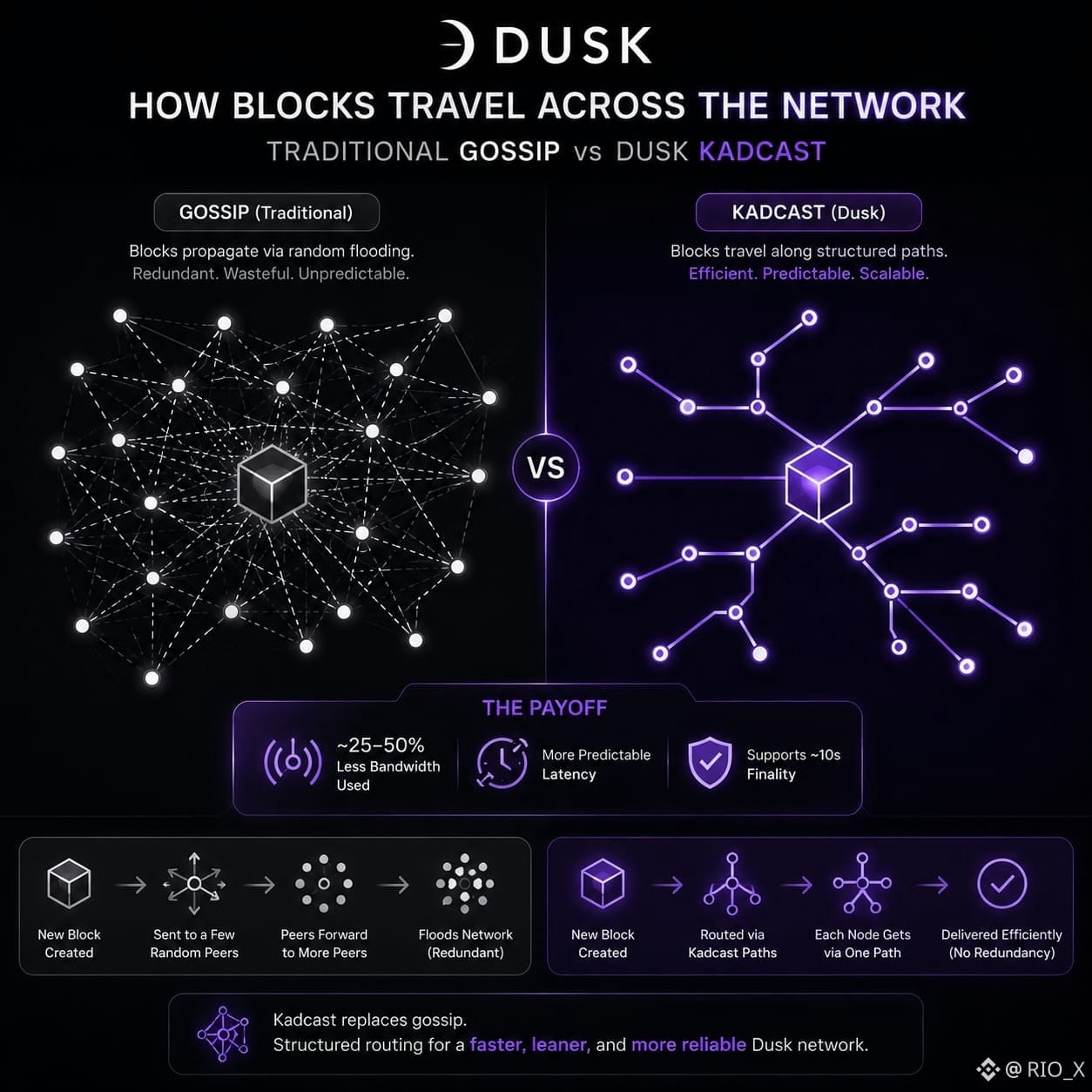
Most blockchains Bitcoin, Ethereum included— spread new blocks through "gossip." A node tells a few peers, those peers tell a few more, and it floods outward. Simple, but wasteful. The same data gets sent to the same nodes over and over.
Dusk replaced that entirely. $TUT
Kadcast routes messages along structured paths instead, based on a well-known peer-to-peer technique originally built for file-sharing networks. Every node has a clear, defined path to reach every other node no random flooding.
The payoff: roughly 25 to 50% less bandwidth used, and more predictable latency, according to Dusk's own published research. $TRUMP
That's not just a nice efficiency stat. Remember the 10-second finality I wrote about last time? None of that works if votes and blocks can't move across the network fast and predictably. Kadcast is the quiet piece making that possible.
Limitation I noticed: most of the detailed technical writeups on Kadcast's real-world performance are a couple years old now. Would like to see fresher benchmarks from mainnet, not just the original research.
Anyone know of newer data on this?
@Dusk $DUSK
#dusk
I went looking, and found something called Kadcast.
Most blockchains Bitcoin, Ethereum included— spread new blocks through "gossip." A node tells a few peers, those peers tell a few more, and it floods outward. Simple, but wasteful. The same data gets sent to the same nodes over and over.
Dusk replaced that entirely. $TUT
Kadcast routes messages along structured paths instead, based on a well-known peer-to-peer technique originally built for file-sharing networks. Every node has a clear, defined path to reach every other node no random flooding.
The payoff: roughly 25 to 50% less bandwidth used, and more predictable latency, according to Dusk's own published research. $TRUMP
That's not just a nice efficiency stat. Remember the 10-second finality I wrote about last time? None of that works if votes and blocks can't move across the network fast and predictably. Kadcast is the quiet piece making that possible.
Limitation I noticed: most of the detailed technical writeups on Kadcast's real-world performance are a couple years old now. Would like to see fresher benchmarks from mainnet, not just the original research.
Anyone know of newer data on this?
@Dusk $DUSK
#dusk