
橙子Joyce
254 Posts

橙子Joyce
 Square Verified+
价值投资者:以十年为单位投资美股及BTC.ETH.BNB.SOL.推特X:@Joyce88ai

SOL Holder
Frequent Trader
8.7 Years
738 Following
32.4K+ Followers
40.1K+ Liked
Posts
All
Quotes
Videos
Live
PINNED
PINNED
At the beginning of September 2026, the U.S. Securities and Exchange Commission (SEC) has recently issued a series of rule proposal announcements related to crypto assets/blockchain. The latest is a proposal to modernize the Transfer Agent rules, published on September 1, 2026. This is another related development following the August 18 proposal under “Regulation Crypto Assets.”
New proposal: Transfer Agent Rules Modernization (September 1, 2026)
The SEC proposes a comprehensive update to the Transfer Agent rules, which have seen little substantive revision since the late 1970s and early 1980s. Transfer agents maintain security ownership records, handle transfers, dividends, and other corporate actions, and are a key link in the clearing and settlement system.
The proposal explicitly mentions the need to accommodate electronic records, blockchain recordkeeping, paperless securities, and tokenized securities. Chair Paul Atkins said the rules should reflect the real-world operations by which transfer agents currently use electronic communications and blockchain technologies for securities issuance and share transfers. Market participants are exploring onchain transfer agents, tokenized fund administration, and cross-chain interoperability.
This is the SEC’s first comprehensive proposal specifically for the issuance of crypto assets, building on interpretive guidance issued in March 2026. It establishes a tailored issuance framework for “covered investment contracts”—that is, investment contracts that may be attached to non-securities crypto assets.
The comment period runs until October 20, 2026.
Both proposals are part of the SEC’s current approach in the digital asset space: to provide clear, actionable rules and reduce reliance on enforcement alone to define the law, while market-structure legislation at the congressional level (such as the CLARITY Act) continues to advance. For now, both are only proposals, and the final rules may be modified based on public comments.
Very exciting—an even broader and deeper outlook for the cryptocurrency market! Strongly bullish $BTC , $BNB
$ETH
New proposal: Transfer Agent Rules Modernization (September 1, 2026)
The SEC proposes a comprehensive update to the Transfer Agent rules, which have seen little substantive revision since the late 1970s and early 1980s. Transfer agents maintain security ownership records, handle transfers, dividends, and other corporate actions, and are a key link in the clearing and settlement system.
The proposal explicitly mentions the need to accommodate electronic records, blockchain recordkeeping, paperless securities, and tokenized securities. Chair Paul Atkins said the rules should reflect the real-world operations by which transfer agents currently use electronic communications and blockchain technologies for securities issuance and share transfers. Market participants are exploring onchain transfer agents, tokenized fund administration, and cross-chain interoperability.
This is the SEC’s first comprehensive proposal specifically for the issuance of crypto assets, building on interpretive guidance issued in March 2026. It establishes a tailored issuance framework for “covered investment contracts”—that is, investment contracts that may be attached to non-securities crypto assets.
The comment period runs until October 20, 2026.
Both proposals are part of the SEC’s current approach in the digital asset space: to provide clear, actionable rules and reduce reliance on enforcement alone to define the law, while market-structure legislation at the congressional level (such as the CLARITY Act) continues to advance. For now, both are only proposals, and the final rules may be modified based on public comments.
Very exciting—an even broader and deeper outlook for the cryptocurrency market! Strongly bullish $BTC , $BNB
$ETH

圣克斯Lucky1688
·
--
#ARB up 30% boosted by Robinhood chain revenue
🧧🔥🧧🔥🧧🔥 Robinhood Chain is not a typical DApp deployed on Arbitrum One; it is a standalone chain built with the Arbitrum Platform. The official disclosure is explicit: these chains will route 10% of net revenue back into the Arbitrum ecosystem. Follow me—answer 1 to take the $SOL红包.🧧🔥🧧🔥🧧🔥
🧧🔥🧧🔥🧧🔥 Robinhood Chain is not a typical DApp deployed on Arbitrum One; it is a standalone chain built with the Arbitrum Platform. The official disclosure is explicit: these chains will route 10% of net revenue back into the Arbitrum ecosystem. Follow me—answer 1 to take the $SOL红包.🧧🔥🧧🔥🧧🔥



生蚝哥Oyster
·
--
Good morning☀️
In a new day, keep your rhythm and don’t let market fluctuations disrupt your mindset.
Opportunities always go to those who are prepared. Wishing everyone positions at ease, steady gains, and peace and everything going smoothly.
In a new day, keep your rhythm and don’t let market fluctuations disrupt your mindset.
Opportunities always go to those who are prepared. Wishing everyone positions at ease, steady gains, and peace and everything going smoothly.


路人1688luren
·
--
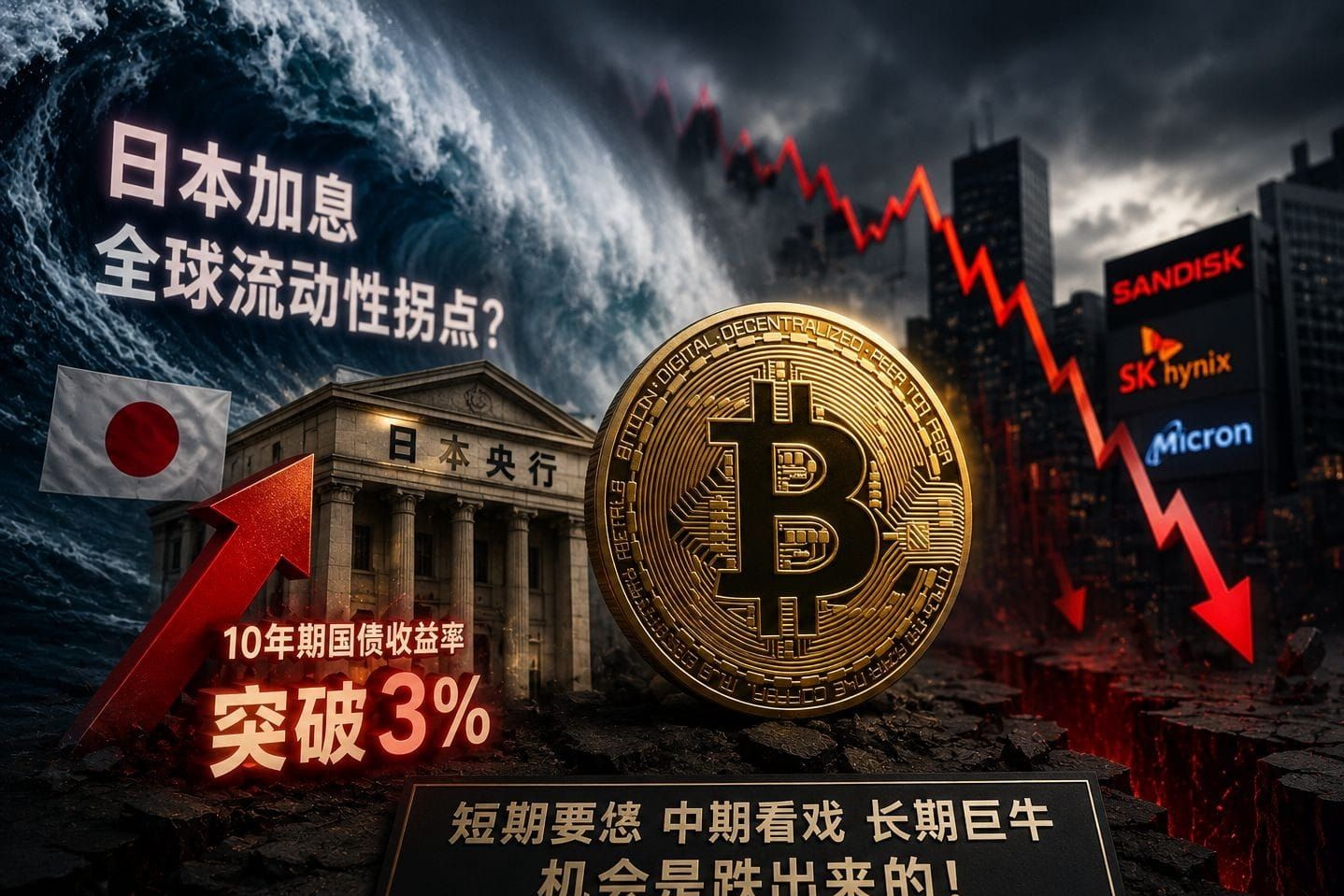
#日本10年期国债收益率首触3% Japan Hikes Rates—Is the US stock and crypto world doomed? Don’t panic. The world’s mightiest “money-printing machine” is about to be shut down! Japan’s 10-year government bond yield has surged past 3%—this is not a small matter. Over the past several decades, global investors have been borrowing near-free yen to buy US stocks, buy tech stocks, and buy Bitcoin. Now, this “free lunch” is over.
My take is: be cautious in the short term, watch in the medium term, and expect a monster rally long term. When Japan hikes rates, the first to take a hit are the high-valuation US tech stocks and the highly volatile crypto market. Money flows back to Japan, and as a high-risk “global liquidity barometer,” Bitcoin may, just like in August 2024, be hit with a panic sell-off that creates a dip first—panic, and you lose. This is the real test of the “digital gold” narrative. The more traditional currencies are printed, the more debased they become; Bitcoin’s fixed monetary policy makes it feel even more precious. Every time a macro liquidity shock triggers a crash, it’s a discounted entry ticket for long-term believers. Don’t let short-term swings scare you—keep your eyes on the big pie. Opportunities are created by the drop! Want to know where the dip-buying signal is this time?
$SKHYNIX $BNB #日本10年期国债收益率首触3%
My take is: be cautious in the short term, watch in the medium term, and expect a monster rally long term. When Japan hikes rates, the first to take a hit are the high-valuation US tech stocks and the highly volatile crypto market. Money flows back to Japan, and as a high-risk “global liquidity barometer,” Bitcoin may, just like in August 2024, be hit with a panic sell-off that creates a dip first—panic, and you lose. This is the real test of the “digital gold” narrative. The more traditional currencies are printed, the more debased they become; Bitcoin’s fixed monetary policy makes it feel even more precious. Every time a macro liquidity shock triggers a crash, it’s a discounted entry ticket for long-term believers. Don’t let short-term swings scare you—keep your eyes on the big pie. Opportunities are created by the drop! Want to know where the dip-buying signal is this time?
$SKHYNIX $BNB #日本10年期国债收益率首触3%


FG发发发
·
--
Overnight, the U.S. stock market index swung and weakened. U.S. Treasury yields rebounded, weighing on growth stocks, while the storage sector showed a clear split.
After climbing to highs, Micron and Western Digital ran into profit-taking, with notable intraday volatility. Although the long-term demand thesis for AI servers driving HBM and high-end storage has not been broken, the fundamentals remain intact—original manufacturers’ price hikes and long-term contract (LTA) orders are still in place. However, following a prior round of sharp gains, the sector’s valuation has already reached a relatively high level, and capital has started to become cautious.
The market is currently in a sensitive window in September, and macro data as well as the Fed’s remarks will amplify sector volatility. Many investors are choosing to lock in gains. In the near term, the focus is more on a range-bound “shakeout” to digest the previous rally’s accumulated positions.
At this point, it’s not advisable to blindly chase higher prices. You may trim positions modestly on strength to control risk. Going forward, the key focus should be on the original manufacturers’ shipment guidance and AI server order data. Wait for a pullback to stabilize before looking for opportunities.#ARB上涨30%受Robinhood链收入推动
After climbing to highs, Micron and Western Digital ran into profit-taking, with notable intraday volatility. Although the long-term demand thesis for AI servers driving HBM and high-end storage has not been broken, the fundamentals remain intact—original manufacturers’ price hikes and long-term contract (LTA) orders are still in place. However, following a prior round of sharp gains, the sector’s valuation has already reached a relatively high level, and capital has started to become cautious.
The market is currently in a sensitive window in September, and macro data as well as the Fed’s remarks will amplify sector volatility. Many investors are choosing to lock in gains. In the near term, the focus is more on a range-bound “shakeout” to digest the previous rally’s accumulated positions.
At this point, it’s not advisable to blindly chase higher prices. You may trim positions modestly on strength to control risk. Going forward, the key focus should be on the original manufacturers’ shipment guidance and AI server order data. Wait for a pullback to stabilize before looking for opportunities.#ARB上涨30%受Robinhood链收入推动


520龙行天下
·
--
Market conditions change rapidly, and hotspots come and go in rotation ✨ Don’t let the noise of the chart drag you along—avoid impulsive all-in moves. Understand the logic of capital, manage risk, and patiently wait for your own trading window. Trading is a long-term practice: stay grounded, maintain a calm mindset, and make choices with discipline. In life, you don’t have to rush to be first at everything—stay indifferent to gains and losses and keep your own rhythm. Slow down, settle your mind, and silently accumulate value. Wishing your account stays green with every step forward; may you carry strength in your heart and walk toward the sun. Peace and smooth sailing—may everything be worth looking forward to 💰


正乾商学--四条2
·
--
🧧🧧🧧Thank you for your support and likes🎁🎁🎁
Ten years of crypto trading experience:
The first lesson of trading isn’t making money—it’s learning not to be eliminated by the market.
The market’s greatest enemy isn’t volatility, but the self without rules.
For those who don’t have a trading system, they search for answers in the market; for those who do have a trading system, they execute their plan.
#SEC拟修订规则纳入区块链与代币化证券
#G20声明关注数字资产吁负责任创新
#日本10年期国债收益率首触3%
Ten years of crypto trading experience:
The first lesson of trading isn’t making money—it’s learning not to be eliminated by the market.
The market’s greatest enemy isn’t volatility, but the self without rules.
For those who don’t have a trading system, they search for answers in the market; for those who do have a trading system, they execute their plan.
#SEC拟修订规则纳入区块链与代币化证券
#G20声明关注数字资产吁负责任创新
#日本10年期国债收益率首触3%


叮噹-Doraemon
·
--
What is ‘smart money’ buying? Tracking Cathie Wood: adds more than 450,000 shares to Block’s position, trimming some AI and genomics holdings
August 31, 2026 (Monday). The three major U.S. stock indexes closed lower across the board. The S&P 500 fell 0.33% to 7,686.14 points, the Nasdaq declined 0.12% to 26,370.89 points, and the Dow dropped the most by 0.70%, closing at 53,185.90 points. On the last trading day of the month, overall market sentiment was cautious, with capital rotating in a cyclical pattern.
On the day, Cathie Wood, known as “Jie,” increased exposure against the trend in areas such as financial technology, aerospace, and precision medicine. Meanwhile, she reduced positions in multiple AI applications and genomics-related targets. Overall, this reflected a strategic intention of “rotating holdings and adjusting the portfolio structure.”
Buying direction: focus on the long-term disruptive potential of financial technology, aerospace, and gene editing
On the day, Cathie Wood, known as “Jie,” increased exposure against the trend in areas such as financial technology, aerospace, and precision medicine. Meanwhile, she reduced positions in multiple AI applications and genomics-related targets. Overall, this reflected a strategic intention of “rotating holdings and adjusting the portfolio structure.”
Buying direction: focus on the long-term disruptive potential of financial technology, aerospace, and gene editing


加密之王1688
·
--
September 2, 04:00 — Crypto market real-time news in the early hours
I. Market Quick Updates
1. Major coins broadly fall and probe lower
As of 04:00, the global crypto total market cap is $2.58 trillion, down 2.76% over the past 24 hours. Bitcoin is trading at $76,939, down 2.63% in 24 hours, with an intraday low touching the $77,060 level; Ethereum breaks below the $2,400 integer mark and is now at $2,398, down 2.4% over 24 hours; major coins such as SOL, XRP, and BNB also slide in sync by 2%-3%.
2. Ongoing contract deleveraging
In the past 24 hours, the total net liquidation across the entire network is about $239 million; long liquidations account for as much as 82.9%. In just 60 minutes, more than $100 million in positions were liquidated in a concentrated sweep. Bitcoin futures open interest is 109.6K, the long/short ratio is 1.23, and the funding rate remains positive at 0.0052%. Selling pressure is mainly driven by spot position closures, with no extreme negative funding rates observed.
II. Industry Headliners
1. 21 international banks jointly announce stablecoin issuance
Goldman Sachs, Bank of America, Citibank, Deutsche Bank, UBS, and 21 other top global financial institutions jointly announced on the evening of September 1 that they will establish a joint venture. The plan is to launch a USD-denominated stablecoin in the first half of 2027, and to expand long-term into G7 currencies such as the euro. It will cover scenarios including cross-border payments and institutional settlement—an important milestone for traditional finance entering the crypto space.
2. Ethereum ETF sees net inflows for 11 consecutive days
U.S. spot Ethereum ETFs recorded a daily net inflow of $87.68 million. BlackRock’s ETHA contributed $59.94 million. Institutional capital continues to build positions in Ethereum at lower levels, and the net inflow trend has now extended for 11 trading days.
III. On-chain & Ecosystem Developments
1. Institutional “whale” continues to accumulate ETH
On-chain monitoring data shows that a certain institutional address has again withdrawn 5,100 ETH from OKX (about $12.3 million). Since August 29, this whale has accumulated over 42,000 ETH across three addresses, indicating that the institution’s offline accumulation actions are ongoing.
2. DeFi security incidents keep coming
The Injective protocol suspended operations for about 4 hours due to a binary options vulnerability; stolen assets are estimated at about $4.9 million. In the Solana ecosystem, the AMM protocol Aquifer was attacked, with losses of approximately $2.5 million. In the Sui ecosystem, the DeFi protocol Full Sail announced it is stopping operations due to oracle-related issues.
I. Market Quick Updates
1. Major coins broadly fall and probe lower
As of 04:00, the global crypto total market cap is $2.58 trillion, down 2.76% over the past 24 hours. Bitcoin is trading at $76,939, down 2.63% in 24 hours, with an intraday low touching the $77,060 level; Ethereum breaks below the $2,400 integer mark and is now at $2,398, down 2.4% over 24 hours; major coins such as SOL, XRP, and BNB also slide in sync by 2%-3%.
2. Ongoing contract deleveraging
In the past 24 hours, the total net liquidation across the entire network is about $239 million; long liquidations account for as much as 82.9%. In just 60 minutes, more than $100 million in positions were liquidated in a concentrated sweep. Bitcoin futures open interest is 109.6K, the long/short ratio is 1.23, and the funding rate remains positive at 0.0052%. Selling pressure is mainly driven by spot position closures, with no extreme negative funding rates observed.
II. Industry Headliners
1. 21 international banks jointly announce stablecoin issuance
Goldman Sachs, Bank of America, Citibank, Deutsche Bank, UBS, and 21 other top global financial institutions jointly announced on the evening of September 1 that they will establish a joint venture. The plan is to launch a USD-denominated stablecoin in the first half of 2027, and to expand long-term into G7 currencies such as the euro. It will cover scenarios including cross-border payments and institutional settlement—an important milestone for traditional finance entering the crypto space.
2. Ethereum ETF sees net inflows for 11 consecutive days
U.S. spot Ethereum ETFs recorded a daily net inflow of $87.68 million. BlackRock’s ETHA contributed $59.94 million. Institutional capital continues to build positions in Ethereum at lower levels, and the net inflow trend has now extended for 11 trading days.
III. On-chain & Ecosystem Developments
1. Institutional “whale” continues to accumulate ETH
On-chain monitoring data shows that a certain institutional address has again withdrawn 5,100 ETH from OKX (about $12.3 million). Since August 29, this whale has accumulated over 42,000 ETH across three addresses, indicating that the institution’s offline accumulation actions are ongoing.
2. DeFi security incidents keep coming
The Injective protocol suspended operations for about 4 hours due to a binary options vulnerability; stolen assets are estimated at about $4.9 million. In the Solana ecosystem, the AMM protocol Aquifer was attacked, with losses of approximately $2.5 million. In the Sui ecosystem, the DeFi protocol Full Sail announced it is stopping operations due to oracle-related issues.


花涧空
·
--
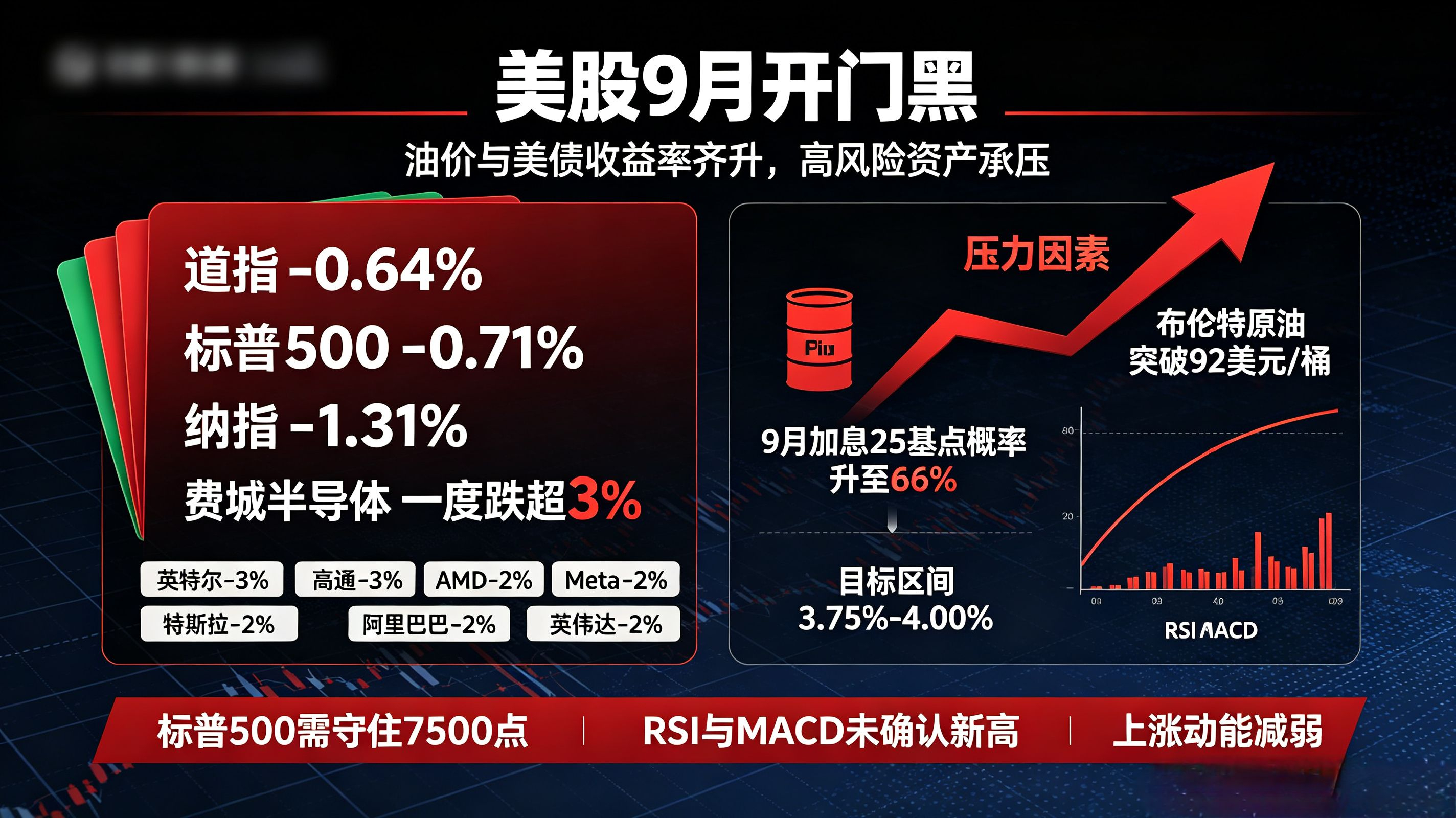
📢 US stocks see a “black opening” in September: oil prices and US Treasury yields rise together, putting pressure on high-risk assets
On September 1, the first trading day of the month, all three major US stock indexes opened lower. The Dow fell 0.64%, the S&P 500 dropped 0.71%, and the Nasdaq fell 1.31%. The Philadelphia Semiconductor Index once fell by more than 3%. Intel and Qualcomm both slid nearly 3%, while AMD and Meta fell more than 2%. Tesla, Alibaba, and Nvidia fell nearly 2%. $NVDAB $TSLAB
The core factor weighing on the market is that oil prices and global bond yields are moving higher in tandem. Brent crude broke through $92 per barrel during the session. With growing concerns about the situation in the Middle East and disruptions to shipping through the Strait of Hormuz, the market worries that energy prices and inflation will rise further, strengthening expectations for the Federal Reserve to raise rates. Currently, CME “FedWatch” shows the probability of a 25-basis-point rate hike in September to 3.75%-4.00% has risen to 66%.
Paul Ciana, a technical strategist at Bank of America, said that the upward breakout in the S&P 500 that began in August remains intact, but only if it holds above 7,500. Meanwhile, neither the RSI nor the MACD has confirmed the recent price highs, indicating that upside momentum is weakening. Ciana added that seasonal headwinds, election uncertainty, and rising front-end Treasury yields are presenting greater challenges to the market. Higher yields increase the risk that the stock market enters consolidation rather than accelerating higher.
Miller Tabak strategist Matt Maley also warned that the stock market had previously been able to ignore rising yields, but that doesn’t mean the pressure from high yields won’t eventually show up. JPMorgan believes that rising yields don’t necessarily become an insurmountable obstacle for a bull market, as they may reflect stronger momentum in economic activity.
On September 1, the first trading day of the month, all three major US stock indexes opened lower. The Dow fell 0.64%, the S&P 500 dropped 0.71%, and the Nasdaq fell 1.31%. The Philadelphia Semiconductor Index once fell by more than 3%. Intel and Qualcomm both slid nearly 3%, while AMD and Meta fell more than 2%. Tesla, Alibaba, and Nvidia fell nearly 2%. $NVDAB $TSLAB
The core factor weighing on the market is that oil prices and global bond yields are moving higher in tandem. Brent crude broke through $92 per barrel during the session. With growing concerns about the situation in the Middle East and disruptions to shipping through the Strait of Hormuz, the market worries that energy prices and inflation will rise further, strengthening expectations for the Federal Reserve to raise rates. Currently, CME “FedWatch” shows the probability of a 25-basis-point rate hike in September to 3.75%-4.00% has risen to 66%.
Paul Ciana, a technical strategist at Bank of America, said that the upward breakout in the S&P 500 that began in August remains intact, but only if it holds above 7,500. Meanwhile, neither the RSI nor the MACD has confirmed the recent price highs, indicating that upside momentum is weakening. Ciana added that seasonal headwinds, election uncertainty, and rising front-end Treasury yields are presenting greater challenges to the market. Higher yields increase the risk that the stock market enters consolidation rather than accelerating higher.
Miller Tabak strategist Matt Maley also warned that the stock market had previously been able to ignore rising yields, but that doesn’t mean the pressure from high yields won’t eventually show up. JPMorgan believes that rising yields don’t necessarily become an insurmountable obstacle for a bull market, as they may reflect stronger momentum in economic activity.

周周1688
·
--
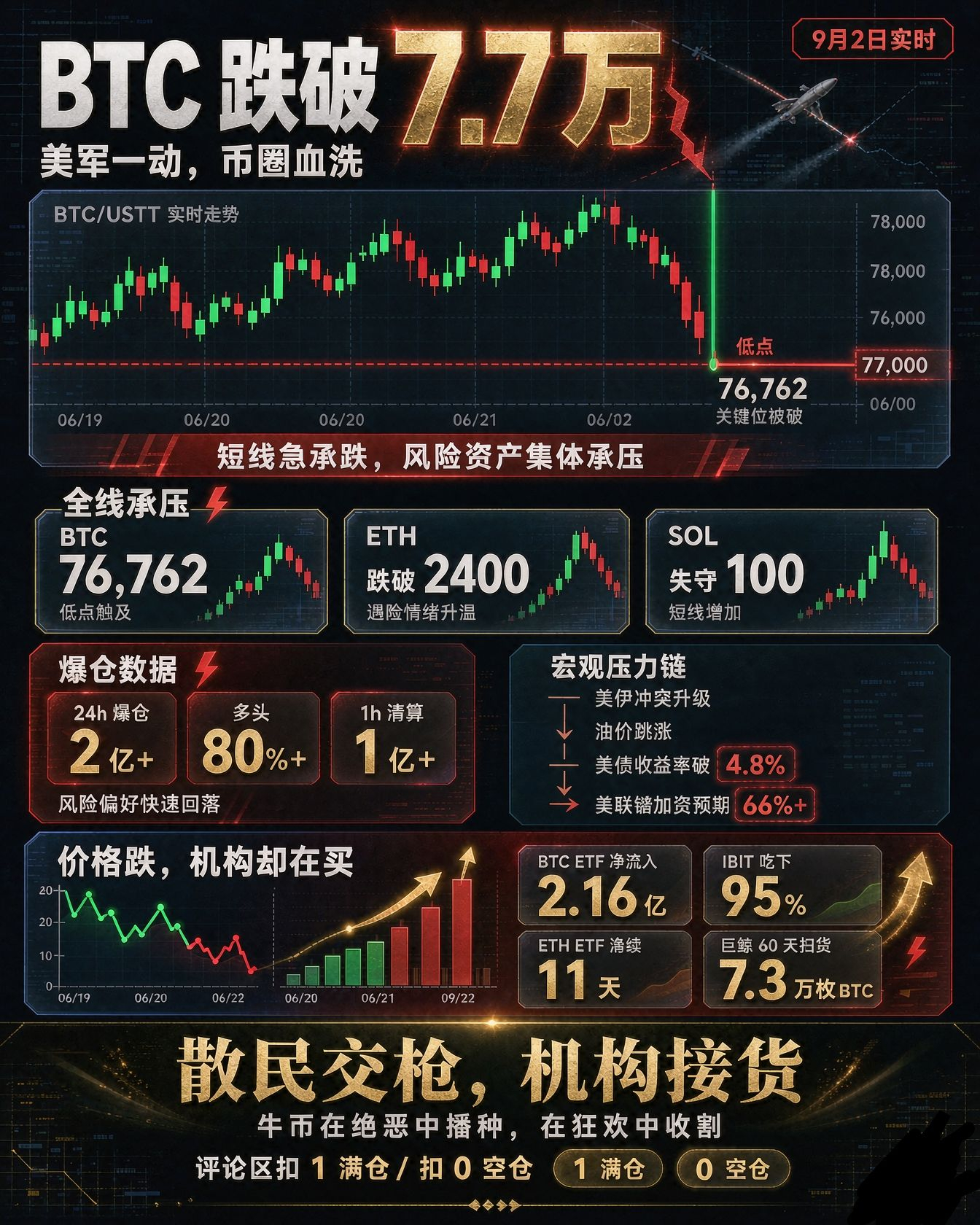
US military missile lands, BTC directly smashes through 77,000!
$BNB 🧧🧧
Do you think a 25% surge in August means the bull market is back? On September 1st, the first blade is cutting precisely full-position long holders.
As of September 2nd (live):
BTC hit a low of 76,762, ETH broke below 2,400, and SOL fell below 100;
In the past 24 hours, total liquidations across the entire network exceeded $200 million. Longs account for 80%+, and in one hour alone, more than $100 million was liquidated.
Escalation in the US-Iran conflict → oil prices jump → US Treasury yields break 4.8% → rate-hike expectations at the Fed spike to 66%+ — risk assets get hammered across the board.
But the most bizarre part isn’t the drop—it’s that while the price falls, institutions are buying:
Spot BTC ETF net inflows of $216 million in a single day; IBIT alone takes 95% of it;
ETH ETF has been drawing in funds for 11 straight days;
giant whales have scooped up 73,000 BTC over 60 days.
Retail hands in their guns—institutions take the deliveries. This isn’t a collapse; it’s turnover.
#1688家族family
#科威特美军基地发生爆炸
$BTC $SOL
$BNB 🧧🧧
Do you think a 25% surge in August means the bull market is back? On September 1st, the first blade is cutting precisely full-position long holders.
As of September 2nd (live):
BTC hit a low of 76,762, ETH broke below 2,400, and SOL fell below 100;
In the past 24 hours, total liquidations across the entire network exceeded $200 million. Longs account for 80%+, and in one hour alone, more than $100 million was liquidated.
Escalation in the US-Iran conflict → oil prices jump → US Treasury yields break 4.8% → rate-hike expectations at the Fed spike to 66%+ — risk assets get hammered across the board.
But the most bizarre part isn’t the drop—it’s that while the price falls, institutions are buying:
Spot BTC ETF net inflows of $216 million in a single day; IBIT alone takes 95% of it;
ETH ETF has been drawing in funds for 11 straight days;
giant whales have scooped up 73,000 BTC over 60 days.
Retail hands in their guns—institutions take the deliveries. This isn’t a collapse; it’s turnover.
#1688家族family
#科威特美军基地发生爆炸
$BTC $SOL
@心悦Joy provides a very objective analysis of gold prices! 👍👍

心悦Joy
·
--
BearishAfter international spot gold logged nearly a 10% gain in August, it suddenly reversed course. Market confidence that prices could continue to surge has clearly cooled, and bets on gold breaking through a key year-end level are also weakening—showing that the previously high-spirited optimism is starting to fade. The probability of gold reaching $5,000 per ounce before year-end is only slightly above 50%, while the probability of hitting $4,500 is almost certain. By contrast, the chance of challenging $6,000 has fallen to about 13%. More reflective of short-term sentiment is that for short-term contracts targeting gold to rise back to around $4,700, the current probability is already below one-third. In other words, after the strong rally in August, market participants are no longer broadly betting that gold can quickly reclaim the earlier highs. The cooling of optimism has occurred in tandem with gold’s own rapid pullback. International spot gold earlier climbed to around $4,697 per ounce, then slid consecutively. On Tuesday, it fell more than 2% to around $4,350 per ounce, pressured by rising U.S. Treasury yields and a jump in oil prices, and it also touched the lowest level since August 19.
The immediate catalyst came from a hawkish remark by Federal Reserve Chair Waller at the Jackson Hole conference. He emphasized that bringing inflation back to the 2% target is not fast enough and that the Fed “still has work to do.” After his remarks, markets quickly increased their bets on a rate hike in September; the relevant probability has now risen to about 66%, clearly higher than before his speech. This has changed the macro backdrop that had previously been most favorable for gold. Gold itself does not generate interest; if the market again expects rates to rise, the yield advantage of cash and bonds expands, increasing the opportunity cost of holding gold. Meanwhile, the yield on the U.S. 10-year Treasury note has risen to about 4.78%, further weighing on gold. Oil prices rising reinforces this pressure as well. After the U.S. and Iran once again engaged in military conflict, Brent crude rose above $91 per barrel. Higher energy prices may push inflation up and force the Fed to maintain a tighter monetary policy. The logic for long positions has not disappeared, but expectations of rapid upside have started to “cool.” An important driver of this gold rebound has been the “currency devaluation trade.” Concerns about the dollar’s purchasing power and sovereign-debt risk are being fueled by the U.S. budget deficit, expansion of government debt, and the Treasury’s plan to increase the scale of long-term Treasury bond buybacks, which has renewed safe-haven and hedging demand for gold.
$XAUT
The immediate catalyst came from a hawkish remark by Federal Reserve Chair Waller at the Jackson Hole conference. He emphasized that bringing inflation back to the 2% target is not fast enough and that the Fed “still has work to do.” After his remarks, markets quickly increased their bets on a rate hike in September; the relevant probability has now risen to about 66%, clearly higher than before his speech. This has changed the macro backdrop that had previously been most favorable for gold. Gold itself does not generate interest; if the market again expects rates to rise, the yield advantage of cash and bonds expands, increasing the opportunity cost of holding gold. Meanwhile, the yield on the U.S. 10-year Treasury note has risen to about 4.78%, further weighing on gold. Oil prices rising reinforces this pressure as well. After the U.S. and Iran once again engaged in military conflict, Brent crude rose above $91 per barrel. Higher energy prices may push inflation up and force the Fed to maintain a tighter monetary policy. The logic for long positions has not disappeared, but expectations of rapid upside have started to “cool.” An important driver of this gold rebound has been the “currency devaluation trade.” Concerns about the dollar’s purchasing power and sovereign-debt risk are being fueled by the U.S. budget deficit, expansion of government debt, and the Treasury’s plan to increase the scale of long-term Treasury bond buybacks, which has renewed safe-haven and hedging demand for gold.
$XAUT
·
--
🎙️ Binance becoming more prosperous, with more and more traditional finance professionals joining the crowd—let’s DCA into BNB together

End
02 h 19 m 35 s
7.5k
16

Bilverse
·
--
🧧 RED PACKET GIVEAWAY IS LIVE! 🧧
Crypto community, it’s time to spread some love! 🔥
I’m giving away crypto in RED PACKETS 🧧💰 to members of our community on Binance Square!
👇 Want to be part of it?
❤️ Like this post
💬 Comment “BNB”
🔁 Share/repost to your Binance Square community
👥 Follow so you don’t miss future red packet drop!
The more our community grows, the more fun these giveaways become. 🚀
Click here to DOUBLE your Rewards! 🧧🚀
Who’s ready to catch a red packet? 🧧👀
#RedPacketMission #Write2Earn #Bilverse #BNB #CryptoCommunity
Crypto community, it’s time to spread some love! 🔥
I’m giving away crypto in RED PACKETS 🧧💰 to members of our community on Binance Square!
👇 Want to be part of it?
❤️ Like this post
💬 Comment “BNB”
🔁 Share/repost to your Binance Square community
👥 Follow so you don’t miss future red packet drop!
The more our community grows, the more fun these giveaways become. 🚀
Click here to DOUBLE your Rewards! 🧧🚀
Who’s ready to catch a red packet? 🧧👀
#RedPacketMission #Write2Earn #Bilverse #BNB #CryptoCommunity


静心1688
·
--
💥 In virtue: the nature and conduct of all things that reveal themselves by conforming to the “Dao.”
#以太坊ETF连续11日净流入
#日本10年期国债收益率首触3%
#以太坊ETF连续11日净流入
#日本10年期国债收益率首触3%


远方1688BNB
·
--
Good fortune in the ninth month of the human world!
#DCA BTC DCA SoL DCA BNB to earn 10 million
#DCA BTC DCA SoL DCA BNB to earn 10 million




晚风Vesper_1688
·
--
☀️Good morning Wednesday—set off for the first half of your day as the morning light arrives🌤️。
On this trading path, what matters isn’t frequent entries, but inner discipline📊。
Yesterday’s gains and losses are all in the past—don’t let past results tie down today’s judgment🕊️。
Market opportunities keep coming, so there’s no need to rush to catch every flicker of movement✨。
Stay clear-headed, follow risk control, don’t follow the noise blindly, and stick to your own trading plan💎。
Slow down, steady your mind, and build strength step by step—time will eventually reward every bit of steadfast resolve🌿。
Investing involves risk; enter the market with caution。
#交易心理
#XRP两周上涨40%未平仓合约下降
#1688家族family
On this trading path, what matters isn’t frequent entries, but inner discipline📊。
Yesterday’s gains and losses are all in the past—don’t let past results tie down today’s judgment🕊️。
Market opportunities keep coming, so there’s no need to rush to catch every flicker of movement✨。
Stay clear-headed, follow risk control, don’t follow the noise blindly, and stick to your own trading plan💎。
Slow down, steady your mind, and build strength step by step—time will eventually reward every bit of steadfast resolve🌿。
Investing involves risk; enter the market with caution。
#交易心理
#XRP两周上涨40%未平仓合约下降
#1688家族family




阿婧1688
·
--
Only with knowledge can we gain awareness. Put it into practice: “know” and “do.” Follow me and let’s learn about cognition together.

Log in to explore more content