Recently watching Dusk, I found an easily overlooked problem: why hasn’t any institution yet moved financial assets to public chains at scale?
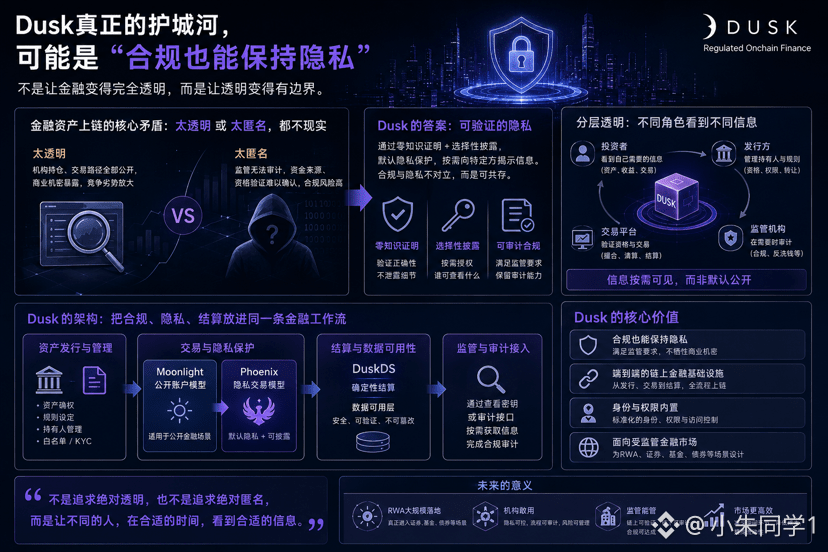
Many people’s first instinct is that performance is insufficient, liquidity is lacking, or regulation is unclear. But there’s another very practical issue—it's too transparent. If an institution puts everything—bonds, funds, holdings, and even trading paths—onto a public ledger, then any supposed “on-chain efficiency” benefits may not have even kicked in, while commercial secrets will be exposed first. So what financial institutions need is never absolute transparency, and never absolute anonymity either. What they need is verifiable privacy. This is also what I find particularly interesting about Dusk. It doesn’t frame privacy as something inherently at odds with regulation. Instead, through Phoenix’s private transactions, zero-knowledge proofs, and selective disclosure, transaction data can be kept confidential by default, while providing the relevant information when the issuer, auditor, or regulator needs it. (DOCS) In a way, this changes a very important logic: previously, public chains asked—“Should this transaction be made public?” Dusk is more like it asks—“This transaction: who should it be disclosed to?” I think that’s the answer institutions truly need. Because a mature financial market already has different levels of information permission. Dusk’s current architecture is built around this idea of “layered transparency”: Moonlight handles the public account model, while Phoenix handles private transactions—both ultimately settle on the same underlying settlement infrastructure. (DOCS)
So the more I think about it, the more I believe Dusk’s real moat may not be a single technical parameter. Instead, it’s trying to put privacy, compliance, identity, asset issuance, and settlement into the same financial workflow. If, in the future, RWA truly moves from “issuing a few tokens” into a stage where traditional financial assets like securities, funds, and bonds are massively tokenized and put on-chain, then what the market needs won’t be just a faster public chain. It will be a set of on-chain financial infrastructure that institutions are willing to use, regulators can govern, and the market doesn’t have to fully bare itself for. That might be the part of Dusk that’s truly worth watching long-term.
Not to make finance completely transparent, but to make transparency bounded.
#dusk $DUSK @Dusk
Many people’s first instinct is that performance is insufficient, liquidity is lacking, or regulation is unclear. But there’s another very practical issue—it's too transparent. If an institution puts everything—bonds, funds, holdings, and even trading paths—onto a public ledger, then any supposed “on-chain efficiency” benefits may not have even kicked in, while commercial secrets will be exposed first. So what financial institutions need is never absolute transparency, and never absolute anonymity either. What they need is verifiable privacy. This is also what I find particularly interesting about Dusk. It doesn’t frame privacy as something inherently at odds with regulation. Instead, through Phoenix’s private transactions, zero-knowledge proofs, and selective disclosure, transaction data can be kept confidential by default, while providing the relevant information when the issuer, auditor, or regulator needs it. (DOCS) In a way, this changes a very important logic: previously, public chains asked—“Should this transaction be made public?” Dusk is more like it asks—“This transaction: who should it be disclosed to?” I think that’s the answer institutions truly need. Because a mature financial market already has different levels of information permission. Dusk’s current architecture is built around this idea of “layered transparency”: Moonlight handles the public account model, while Phoenix handles private transactions—both ultimately settle on the same underlying settlement infrastructure. (DOCS)
So the more I think about it, the more I believe Dusk’s real moat may not be a single technical parameter. Instead, it’s trying to put privacy, compliance, identity, asset issuance, and settlement into the same financial workflow. If, in the future, RWA truly moves from “issuing a few tokens” into a stage where traditional financial assets like securities, funds, and bonds are massively tokenized and put on-chain, then what the market needs won’t be just a faster public chain. It will be a set of on-chain financial infrastructure that institutions are willing to use, regulators can govern, and the market doesn’t have to fully bare itself for. That might be the part of Dusk that’s truly worth watching long-term.
Not to make finance completely transparent, but to make transparency bounded.
#dusk $DUSK @Dusk