I used to think that block rewards are simply paid to the block producer—just one person gets it all. But once you dig into the exact breakdown, you realize the money behind it hides a carefully crafted incentive design: it’s not the case that whoever produces the block gets everything.
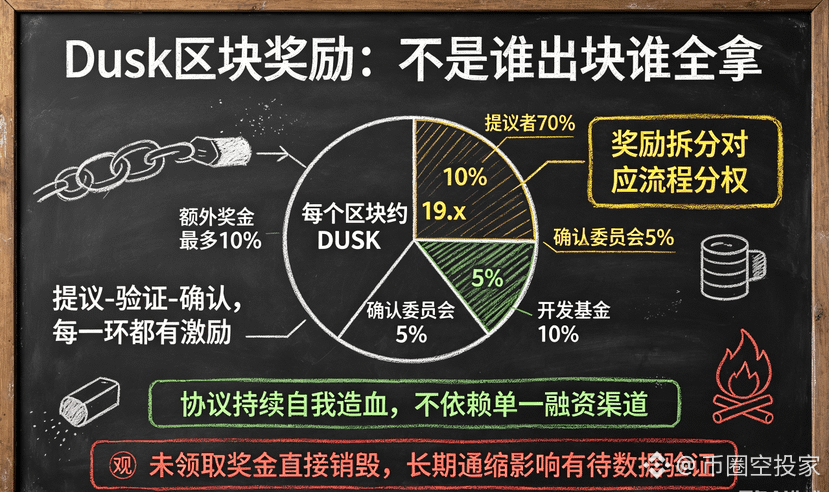
Each block rewards roughly a bit over 19 DUSK, which is split into several parts. Seventy percent goes to the node that proposed the block (the proposer), with up to an additional 10% bonus. The remaining portion is distributed to two rounds of voting committees—during the verification stage and the confirmation stage, each takes 5%. In addition, one extra 10% is set aside as a fixed transfer to the development fund. Any bonus that isn’t claimed is directly burned and does not remain in the system.
At first, I thought the idea of “the proposer gets the lion’s share” wasn’t particularly special. Then I understood the logic behind this split: for a block to truly take effect, it’s not just the proposer’s work—you also need two independent committees to vote and confirm it. By breaking the reward down among the participants of these steps, the system reinforces the entire “propose–verify–confirm” process economically, ensuring that every stage can’t be skipped—it’s not just going through the motions. If all rewards went only to the proposer, the committees involved in verification and confirmation might be less motivated to participate. The decentralization in the process is supported by decentralization in the rewards.
I also think the design of cutting 10% to the development fund is quite practical. The protocol itself needs ongoing maintenance and to support the ecosystem. If operations relied entirely on token sales or external financing, the system would become overly dependent in the long run. Taking a slice out of each block reward gives the protocol a steady, predictable self-sustaining “lifeblood” channel, so it doesn’t always have to look to market sentiment for funding.
That said, I noticed one detail: the portion of rewards that isn’t claimed is burned immediately rather than rolled over. In the short term, this acts like a small valve for continuous deflation. But over the long run, how large the burn volume really is—and how clearly it affects token economics—depends on numbers I don’t have enough detail on at the moment. I can’t estimate a reliable magnitude right now, so I’ll revisit this later when more data is available.
@Dusk #dusk $DUSK
Each block rewards roughly a bit over 19 DUSK, which is split into several parts. Seventy percent goes to the node that proposed the block (the proposer), with up to an additional 10% bonus. The remaining portion is distributed to two rounds of voting committees—during the verification stage and the confirmation stage, each takes 5%. In addition, one extra 10% is set aside as a fixed transfer to the development fund. Any bonus that isn’t claimed is directly burned and does not remain in the system.
At first, I thought the idea of “the proposer gets the lion’s share” wasn’t particularly special. Then I understood the logic behind this split: for a block to truly take effect, it’s not just the proposer’s work—you also need two independent committees to vote and confirm it. By breaking the reward down among the participants of these steps, the system reinforces the entire “propose–verify–confirm” process economically, ensuring that every stage can’t be skipped—it’s not just going through the motions. If all rewards went only to the proposer, the committees involved in verification and confirmation might be less motivated to participate. The decentralization in the process is supported by decentralization in the rewards.
I also think the design of cutting 10% to the development fund is quite practical. The protocol itself needs ongoing maintenance and to support the ecosystem. If operations relied entirely on token sales or external financing, the system would become overly dependent in the long run. Taking a slice out of each block reward gives the protocol a steady, predictable self-sustaining “lifeblood” channel, so it doesn’t always have to look to market sentiment for funding.
That said, I noticed one detail: the portion of rewards that isn’t claimed is burned immediately rather than rolled over. In the short term, this acts like a small valve for continuous deflation. But over the long run, how large the burn volume really is—and how clearly it affects token economics—depends on numbers I don’t have enough detail on at the moment. I can’t estimate a reliable magnitude right now, so I’ll revisit this later when more data is available.
@Dusk #dusk $DUSK