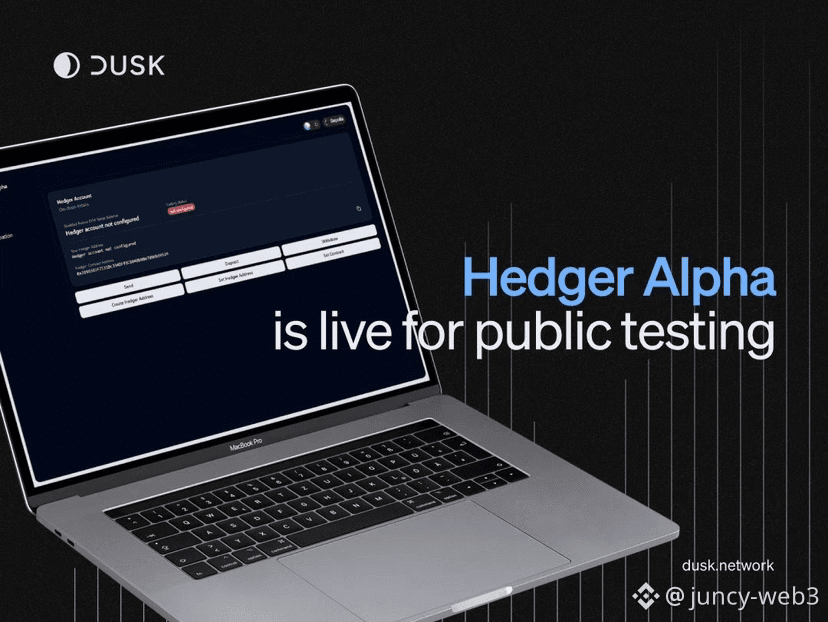
$ETH #dusk $DUSK Dusk packages privacy in a compliance-friendly shell. After running the node and syncing the network, I only trust it halfway.
I’ve been watching Dusk’s mainnet and testnet for a while, and I dug through its documentation as well. To be honest, it’s not the usual “general-purpose privacy chain” playbook. Instead, it brings the settlement of security tokens on-chain, and uses zero-knowledge proofs to hide both the transaction amount and the counterparty. This positioning is narrower than Oasis and Secret, and therefore harder to replace.
But when I actually got hands-on and ran a Dusk node, the experience wasn’t smooth. After syncing reaches a certain height, block fetching slows down. Test tokens are sometimes claimed slowly. In the browser, when you look up a transaction hash, the privacy fields are fully obfuscated into data you can’t verify. If you want to validate anything, you can only get a rough picture. Oasis’s TEE approach at least lets you quickly run through privacy computation examples, and Secret’s contract-level privacy is more open to developers. Dusk seals that layer away—trading composability for a stronger compliance narrative.
From an institutional perspective, Dusk is finding a balance between being regulator-friendly and preserving on-chain privacy. In practice, it’s paving the way for new entrants. Private nodes, whitelists, and discloseable audit reports—on general privacy chains, these capabilities are either incomplete or rely on plugins. Dusk moves them into the protocol layer. Right now, the ecosystem still lacks enough deployable issuance tooling, and most features remain limited to the testnet and promises in the documentation.
I don’t deny that Dusk’s direction has demand, but it hasn’t bypassed the verification barriers that privacy chains generally face. If anything, because of compliance requirements, it hides the data even deeper. People willing to pay for this kind of certainty are betting on financial infrastructure—not a short-term narrative.
@Dusk
I’ve been watching Dusk’s mainnet and testnet for a while, and I dug through its documentation as well. To be honest, it’s not the usual “general-purpose privacy chain” playbook. Instead, it brings the settlement of security tokens on-chain, and uses zero-knowledge proofs to hide both the transaction amount and the counterparty. This positioning is narrower than Oasis and Secret, and therefore harder to replace.
But when I actually got hands-on and ran a Dusk node, the experience wasn’t smooth. After syncing reaches a certain height, block fetching slows down. Test tokens are sometimes claimed slowly. In the browser, when you look up a transaction hash, the privacy fields are fully obfuscated into data you can’t verify. If you want to validate anything, you can only get a rough picture. Oasis’s TEE approach at least lets you quickly run through privacy computation examples, and Secret’s contract-level privacy is more open to developers. Dusk seals that layer away—trading composability for a stronger compliance narrative.
From an institutional perspective, Dusk is finding a balance between being regulator-friendly and preserving on-chain privacy. In practice, it’s paving the way for new entrants. Private nodes, whitelists, and discloseable audit reports—on general privacy chains, these capabilities are either incomplete or rely on plugins. Dusk moves them into the protocol layer. Right now, the ecosystem still lacks enough deployable issuance tooling, and most features remain limited to the testnet and promises in the documentation.
I don’t deny that Dusk’s direction has demand, but it hasn’t bypassed the verification barriers that privacy chains generally face. If anything, because of compliance requirements, it hides the data even deeper. People willing to pay for this kind of certainty are betting on financial infrastructure—not a short-term narrative.
@Dusk