

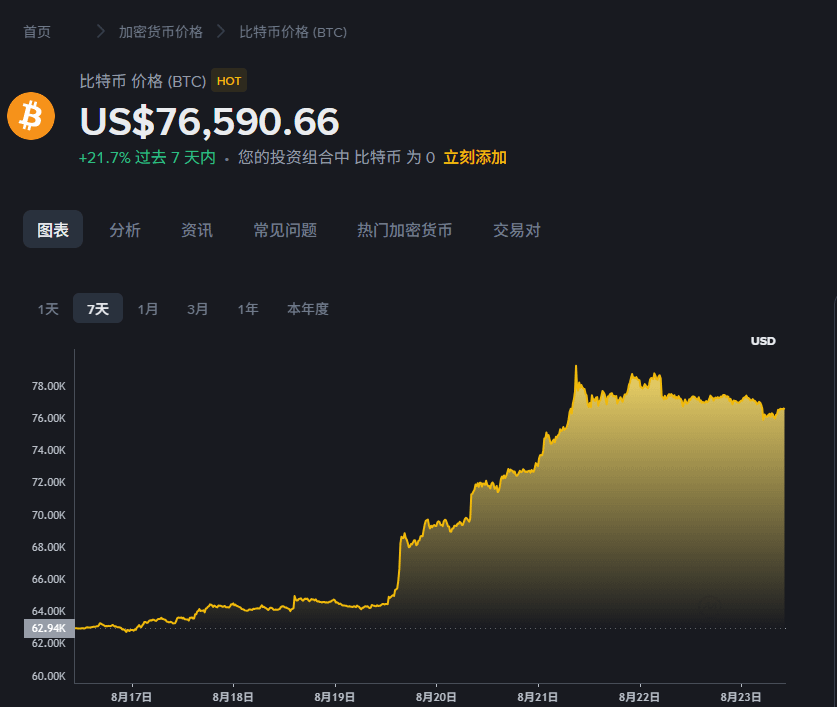
Body: To have BTC hold above and achieve an effective breakout of $80,000, it’s not enough to just be pushed up and briefly touch it off a single burst of news. It requires multiple conditions to resonate at the same time. If you simply squeeze the price up, it’s very easy to get knocked back down. Below are my thoughts 👇:
I. Macro liquidity (the most core major premise)
1. U.S. Treasury real yields continue to decline, and the U.S. dollar index weakens. Bitcoin is a non-yielding risk asset: the higher the Treasury yields, the higher the opportunity cost of holding Bitcoin.
The market needs further trading activity on expectations for a Fed rate cut; inflation data cannot rebound again. If inflation rises again, rate-cut expectations will be delayed, and the 80,000 level will face enormous pressure. In this recent rebound, a large part of it was risk appetite being repaired due to long-term Treasury yields falling.
2. Global risk markets must not see a black swan
U.S. stocks can’t see a sharp plunge, and geopolitical conflicts can’t escalate abruptly. Once the market enters full-on risk-off mode, funds will run first into the U.S. dollar and gold, and crypto will be sold off.
Second, institutional capital must take the baton (short squeezes only manage the short term)
In the recent upswing, the early driver was shorts getting squeezed and covering—passive buying. Once that impulse is used up, there’s no staying power, and it can’t truly hold the 80,000 level. To really sustain above 80,000, you need active spot buying to follow through:
1. U.S. spot Bitcoin ETFs continue to record steady net inflows
It can’t just be a single-day pulse of inflows. You need several consecutive days of positive inflows to digest the large amount of take-profit selling pressure in the 77,000–80,000 range. If ETFs quickly flip back to net outflows, the price is likely to surge and then fall back easily.
2. Giant whales and listed companies’ treasury holdings maintain net buying
Long-term holdings’ coin supply must not see large-scale selling. Long-term holders make up a very high proportion right now—this is the market’s foundation. If, near 80,000, giant whales dump in large batches and unload heavily, upside momentum will be directly blocked.
Third, there needs to be a tangible realization of positive regulatory developments—not just verbal expectations
The market already has an ‘expectation’ of U.S.-friendly regulation: statements from Trump, the CLARITY bill, new SEC rule proposals, and so on. But these are still only expectations—they haven’t truly been implemented and turned into law.
To break above 80,000 effectively, at least one of the following must happen:
(CLARITY clarity bill) A Congressional vote delivers real progress—not just calls and rhetoric;
The SEC issues clear, actionable crypto regulatory rules to eliminate the industry’s huge uncertainty.
If the bill’s progress is obstructed afterward, the previous policy premium will be rapidly unwound, weighing on the coin price.
4. Market conditions on the spot board and derivatives market
1. The effective closing price holds above 80,000, not just a wick that briefly touches it
80,000 is a strong psychological and technical resistance level. Here, a large amount of take-profit sell orders and options exercise pressure are piled up, with many algorithmic sell orders resting in the 78,000–80,000 range.
Just briefly touching 80,000 intraday doesn’t count as a breakout. You need a daily-candle level close that holds steadily above 80,000 to count as an effective breakout.
2. A healthy leverage structure—no疯狂 piling on long leverage
Before breaking through, if long positions in the futures market are wildly overcrowded and funding rates stay extremely hot, even if it breaks above 80,000, it’s very likely to trigger a chain reaction of long liquidations and cause a rapid pullback.
Ideal scenario: during the advance, leverage stays moderate—don’t let it get overly euphoric.
3. The pullback doesn’t break key support
Before the push toward 80,000 from the upside, pullbacks can’t effectively break below the key support zone of 72,000–73,500. Once that zone is lost, the logic for pushing up to 80,000 is directly broken.
5. On-chain fundamentals (post-halving supply and demand): after the fourth halving, Bitcoin’s daily new issuance has already dropped significantly. Supply contraction is a long-term underlying logic, but supply contraction doesn’t automatically mean prices will rise right away—it still requires demand to match.
Miners shouldn’t massively sell holdings in the 80,000 area;
On-chain transfers and spot demand are recovering steadily. Don’t let only derivatives be the thing people are speculating on.
On the flip side: what circumstances would prevent it from breaking 80,000 and instead trigger a direct pullback?1. The U.S. inflation data rebounds, pushing back expectations for rate cuts by a large margin;
2. ETF flows quickly return to sustained net outflows;
3. Regulatory tailwinds fall short—the bill fails to advance;
4. Overcrowded leverage among market longs triggers a widespread long-squeeze cascade;
5. A geopolitical ‘black swan’ occurs, and global risk appetite collapses all at once.
#ETH走势分析 #BTC走势分析