At first, I believed “real-world adoption” in crypto mostly meant putting traditional assets on a blockchain.
Reading Dusk made me look at it differently.
The interesting part, for me, is the layer underneath the asset: who is allowed to do what, what can remain private, and what still needs to be verifiable.
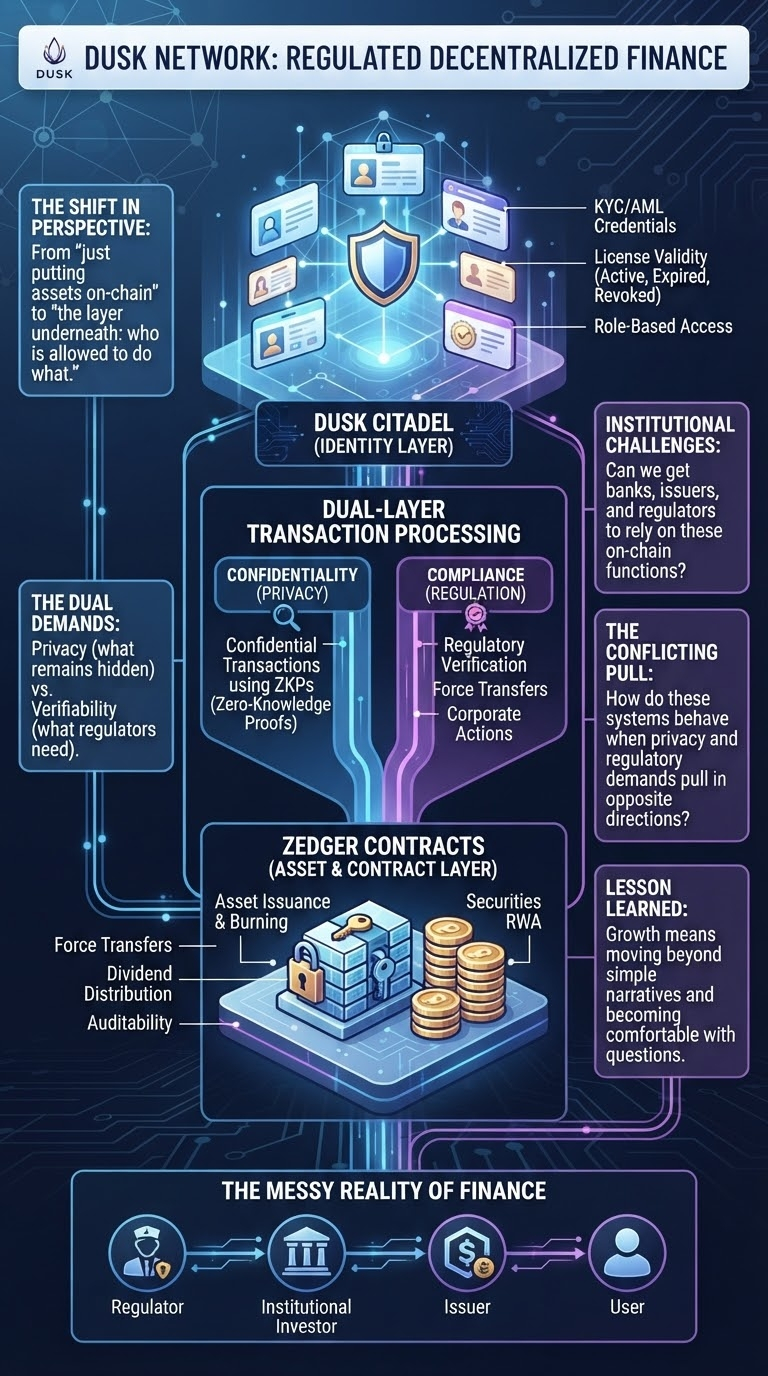
Dusk’s whitepaper describes Zedger contracts for securities and real-world assets, with features such as issuance, burning, corporate actions, force transfers, and auditability. It also describes Citadel as a license system that can track whether a license is valid, expired, renewed, or revoked.
That feels closer to the messy reality of finance than the usual “everything becomes a token” story.
But I’m not fully convinced yet. Technical support for these functions is one thing; getting institutions, regulators, issuers, and users to actually rely on them is another. I’m still curious about how these systems behave when privacy and regulatory demands pull in opposite directions.
That’s probably what I’m taking away from studying Dusk: the more I learn, the less interested I become in simple narratives.
Sometimes understanding a project means becoming comfortable with having more questions than answers.
@Dusk #dusk $DUSK
Reading Dusk made me look at it differently.
The interesting part, for me, is the layer underneath the asset: who is allowed to do what, what can remain private, and what still needs to be verifiable.
Dusk’s whitepaper describes Zedger contracts for securities and real-world assets, with features such as issuance, burning, corporate actions, force transfers, and auditability. It also describes Citadel as a license system that can track whether a license is valid, expired, renewed, or revoked.
That feels closer to the messy reality of finance than the usual “everything becomes a token” story.
But I’m not fully convinced yet. Technical support for these functions is one thing; getting institutions, regulators, issuers, and users to actually rely on them is another. I’m still curious about how these systems behave when privacy and regulatory demands pull in opposite directions.
That’s probably what I’m taking away from studying Dusk: the more I learn, the less interested I become in simple narratives.
Sometimes understanding a project means becoming comfortable with having more questions than answers.
@Dusk #dusk $DUSK