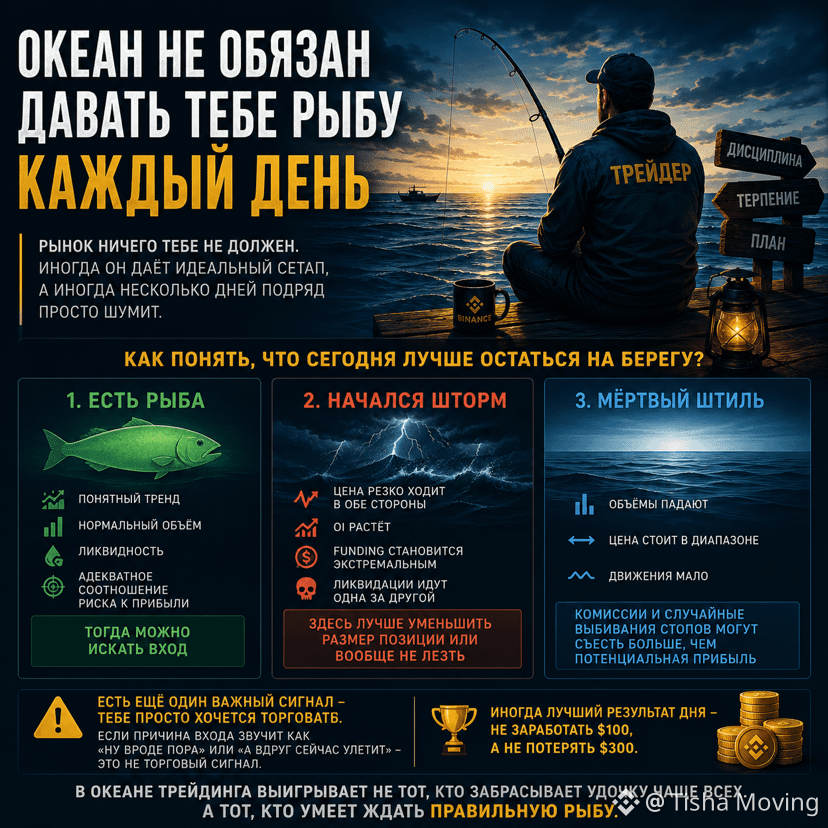
Part #5 🌊 The ocean doesn’t have to give you fish every day
The most expensive mistake a trader can make is thinking that you must open a trade every day.
The market owes you nothing. Sometimes it gives you a perfect setup, and sometimes it just turns into noise for several days in a row.
How do you know that today it’s better to stay ashore?
🐟 If there’s fish — a clear trend, a normal volume, liquidity, and an adequate risk-to-reward ratio — then you can look for an entry.
🌊 If a storm starts — the price swings sharply both ways, OI rises, funding becomes extreme, and liquidations happen one after another. In this case, it’s better to reduce the position size or not get involved at all.
🧊 Dead calm — volumes drop, the price stalls in a range, and there’s little movement. In this kind of situation, fees and random stop-outs can end up costing more than the potential profit.
And there’s one more important signal — you just want to trade.
If the reason for entering sounds like “well, I guess it’s time” or “what if it flies right now?” — that’s not a trading signal.
Sometimes the best outcome of the day isn’t making $100, but not losing $300.
In the ocean of trading, the winner isn’t the one who casts the fishing line the most often.
It’s the one who knows how to wait for the right fish. 🎣
The most expensive mistake a trader can make is thinking that you must open a trade every day.
The market owes you nothing. Sometimes it gives you a perfect setup, and sometimes it just turns into noise for several days in a row.
How do you know that today it’s better to stay ashore?
🐟 If there’s fish — a clear trend, a normal volume, liquidity, and an adequate risk-to-reward ratio — then you can look for an entry.
🌊 If a storm starts — the price swings sharply both ways, OI rises, funding becomes extreme, and liquidations happen one after another. In this case, it’s better to reduce the position size or not get involved at all.
🧊 Dead calm — volumes drop, the price stalls in a range, and there’s little movement. In this kind of situation, fees and random stop-outs can end up costing more than the potential profit.
And there’s one more important signal — you just want to trade.
If the reason for entering sounds like “well, I guess it’s time” or “what if it flies right now?” — that’s not a trading signal.
Sometimes the best outcome of the day isn’t making $100, but not losing $300.
In the ocean of trading, the winner isn’t the one who casts the fishing line the most often.
It’s the one who knows how to wait for the right fish. 🎣