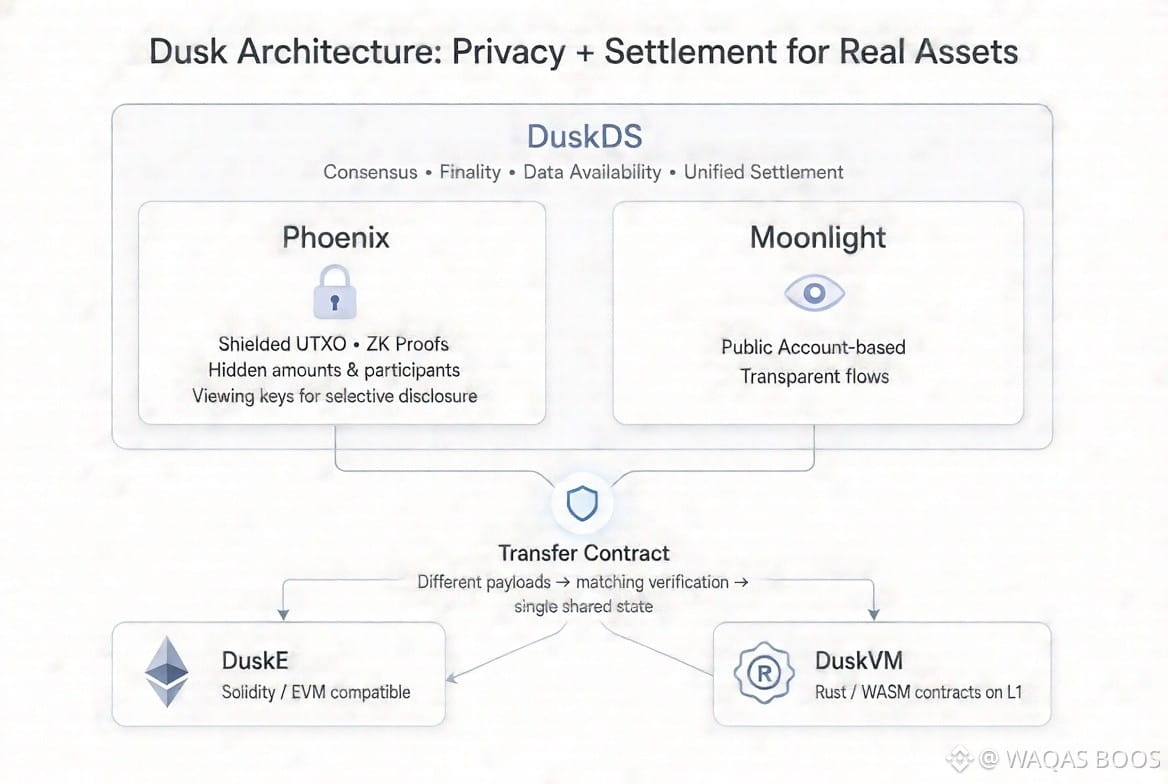
I’ve watched enough cycles to stop getting excited by the usual claims. Most chains still treat privacy like an afterthought and settlement like something you can just bolt on later. When securities and funds actually need to live on-chain, the friction shows up fast: who sees the amounts, who controls the state, and how you prove the settlement happened without leaking everything.
Looking at Dusk again, something about the way they split things feels different. DuskDS handles the consensus, finality, and the native models. Phoenix keeps the shielded UTXO path with ZK proofs that hide amounts and participants while still stopping double-spends, and viewing keys for selective disclosure. Moonlight stays public and account-based. Different payloads go into their own verification, but everything still settles under the same state.
I’ve seen dual models before. Most of them end up with one side underused or the privacy layer feeling bolted on. The Transfer Contract tying them together is the part that makes me pause. It gives each asset model its own entry point without fracturing the settlement layer.
I’m not sure yet whether developers will leave the EVM comfort zone long enough for DuskVM to matter, or whether real demand for private financial assets will ever grow past the noise. Most of these architectures look clean on paper and then quietly fail under actual institutional weight. Still, the problem they’re aiming at is the one that keeps coming back after every hype wave. Worth watching a bit longer.
@Dusk #dusk $DUSK