Compliance, in traditional finance, rests on an assumption that has never been seriously questioned: to prove you’re a good person, first hand over who you are. Dusk’s ZKC zero-knowledge compliance exists to flip that assumption.
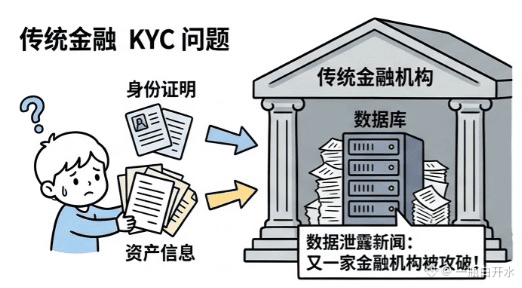
Think about how absurd that premise is. To complete a KYC, you must give up your identity documents and asset information, stored in some institution’s database, and then pray it won’t leak. Over the past years, how many data-breach headlines have we seen involving exchanges and financial institutions? The cost of compliance is surrendering privacy—this equation is treated as self-evident, simply because until now there were no other technical options.
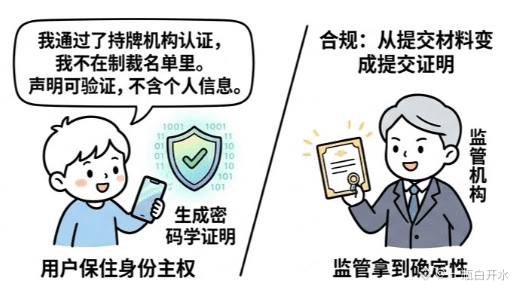
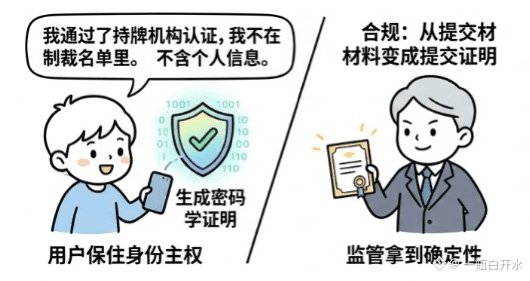
ZKC asks the question differently. Instead of requiring you to disclose your identity, it lets you generate a cryptographic proof and tell the counterparty and the regulator: I passed certification by a licensed institution, and I am not on any sanctions list. The statement is true and verifiable, but the proof itself contains no identity information. Compliance shifts from submitting materials to submitting a proof. One letter apart, and the entire paradigm changes. Regulators get the certainty they want; users keep control over their identity sovereignty. The two ends once thought irreconcilable now, for the first time, have a mathematical possibility of coexisting.
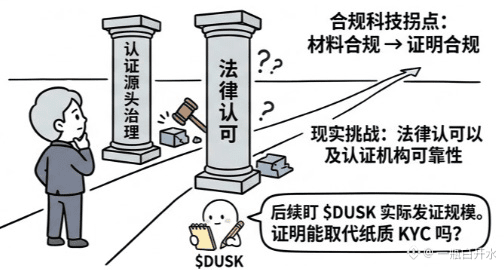
But the word “paradigm revolution”—I’ve heard it too many times in crypto. I need to pour some cold water. The trust foundation of this system hasn’t disappeared; it has simply moved. If the proof says you passed certification by a licensed institution, then the reliability of that issuing institution becomes the foundation of the whole chain. If the issuing step is compromised, or the certification standards are loosened, then no matter how precise the on-chain proof is, the proof only points to a false source. Zero-knowledge guarantees you don’t lie, not that what you say is the truth. Between “not lying” and “truth” lies the governance quality of the entire off-chain certification system.
Another real-world issue is legal recognition. Whether a cryptographic proof is accepted as equivalent to traditional KYC materials—regulators’ stance on that—is still blank territory in most jurisdictions. The technology is running ahead of the law.
In terms of direction, I believe this is the true inflection point for compliance technology: material compliance moving toward proof compliance is only a matter of time. But when the inflection point is realized depends on two legs: governance at the certification source and legal recognition. Going forward, I’ll keep an eye on the actual scale of ZKC-issued certificates under $DUSK . Do you think cryptographic proofs can replace paper-based KYC? #dusk $DUSK @Dusk
Think about how absurd that premise is. To complete a KYC, you must give up your identity documents and asset information, stored in some institution’s database, and then pray it won’t leak. Over the past years, how many data-breach headlines have we seen involving exchanges and financial institutions? The cost of compliance is surrendering privacy—this equation is treated as self-evident, simply because until now there were no other technical options.
ZKC asks the question differently. Instead of requiring you to disclose your identity, it lets you generate a cryptographic proof and tell the counterparty and the regulator: I passed certification by a licensed institution, and I am not on any sanctions list. The statement is true and verifiable, but the proof itself contains no identity information. Compliance shifts from submitting materials to submitting a proof. One letter apart, and the entire paradigm changes. Regulators get the certainty they want; users keep control over their identity sovereignty. The two ends once thought irreconcilable now, for the first time, have a mathematical possibility of coexisting.
But the word “paradigm revolution”—I’ve heard it too many times in crypto. I need to pour some cold water. The trust foundation of this system hasn’t disappeared; it has simply moved. If the proof says you passed certification by a licensed institution, then the reliability of that issuing institution becomes the foundation of the whole chain. If the issuing step is compromised, or the certification standards are loosened, then no matter how precise the on-chain proof is, the proof only points to a false source. Zero-knowledge guarantees you don’t lie, not that what you say is the truth. Between “not lying” and “truth” lies the governance quality of the entire off-chain certification system.
Another real-world issue is legal recognition. Whether a cryptographic proof is accepted as equivalent to traditional KYC materials—regulators’ stance on that—is still blank territory in most jurisdictions. The technology is running ahead of the law.
In terms of direction, I believe this is the true inflection point for compliance technology: material compliance moving toward proof compliance is only a matter of time. But when the inflection point is realized depends on two legs: governance at the certification source and legal recognition. Going forward, I’ll keep an eye on the actual scale of ZKC-issued certificates under $DUSK . Do you think cryptographic proofs can replace paper-based KYC? #dusk $DUSK @Dusk