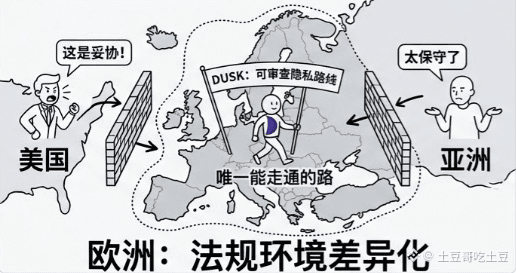
Many people haven’t understood one underlying logic behind Dusk: its privacy-auditable route. If you take this path in the U.S., it gets called a compromise; if you take it in Asia, people call it too conservative. Only in Europe is this the one path that actually works.
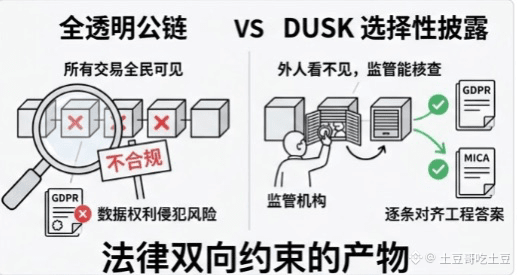
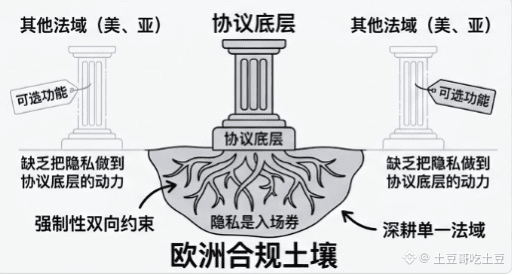
The reason is hidden in Europe’s legislative DNA. The GDPR turns the protection of personal data into a legal, statutory right—note that it’s not industry self-regulation, but a legal obligation. A public chain where every transaction detail is visible to everyone simply can’t stand up in Europe’s compliance review, because transparency itself may constitute an infringement of data rights. Add MiCA’s unified regulatory framework on top: on one hand, the project team must fulfill anti–money laundering and disclosure obligations; on the other hand, it must protect users’ data rights. Both sides are legal requirements—no one can bypass them. That’s why, in the European context, privacy isn’t an optional marketing selling point; it’s an entry ticket. Dusk’s selective disclosure, in essence, is engineering answers aligned point-by-point with these two legal regimes. Outsiders can’t see it, but regulators can verify it—precisely at the intersection of two legal duties.
This is also why I don’t think U.S. or Asian projects can easily replicate this path. It’s not that the technology can’t be built, but that the compliance soil is entirely different. Other jurisdictions don’t have such a strong, compulsory two-way constraint, so project teams naturally lack the motivation to build privacy all the way into the protocol layer—everything eventually degrades into an optional feature.
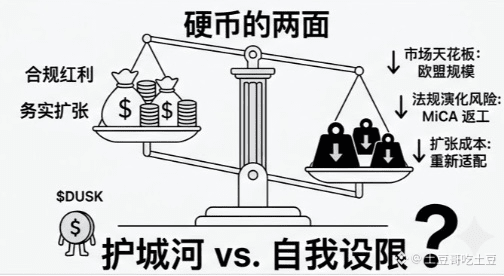
But the other side of the coin is just as clear. Tying your fate to European regulation also means your ceiling is capped by the European market. The EU’s securities market size and retail participation aren’t on the same scale as the U.S., and the compliance architecture is deeply customized to European standards. If you later want to expand into other jurisdictions, you effectively have to redo compliance adaptation from scratch—high cost and a passive schedule. A more immediate risk is that regulation itself will change. MiCA’s implementation rules are still evolving; what’s aligned today may need to be reworked tomorrow.
To be fair, mastering one jurisdiction and then expanding is more practical than spreading your bets globally everywhere. But how long the European tailwind can last depends on the regulator’s “pen” and the market’s “volume.” Going forward, I’ll keep an eye on $DUSK ’s compliance expansion trends outside Europe. Do you think deepening within a single jurisdiction is a moat, or self-imposed limits?#dusk $DUSK @Dusk