#dusk $DUSK @Dusk
At first I thought a cryptographically valid Citadel 2 session was a universal access pass: if the proof checked out on-chain, the service should let me in.
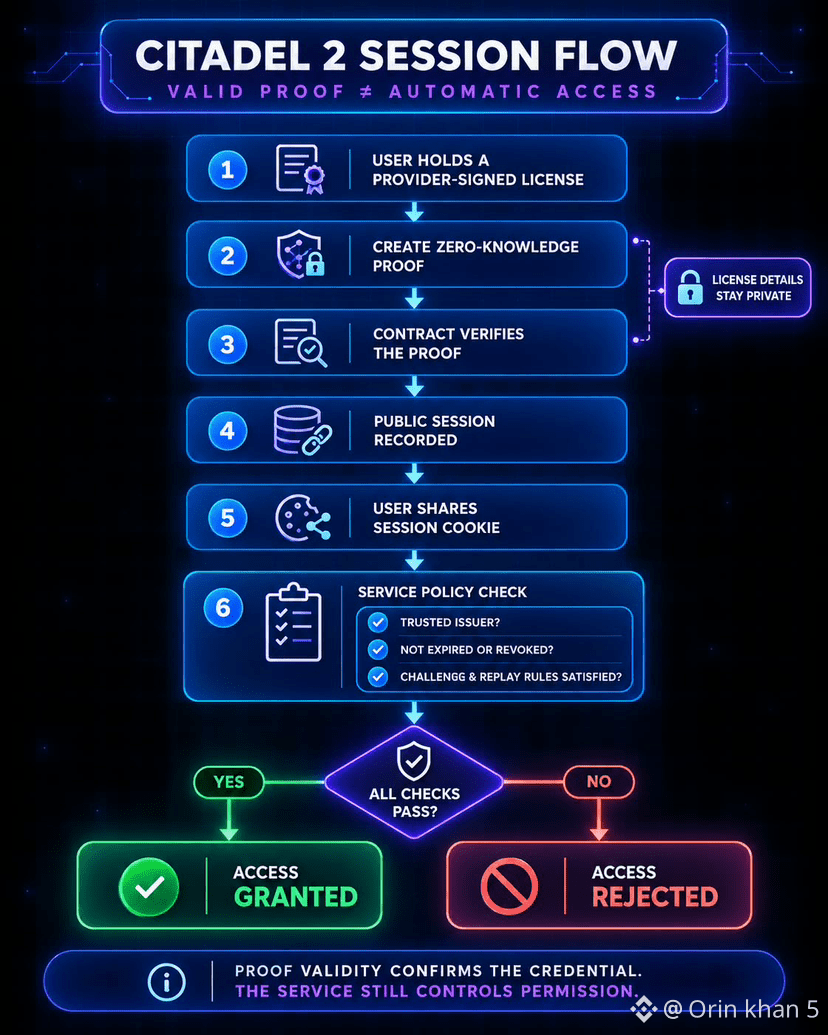
Looking closer at @Dusk, I realized its design separates proof validity from permission. The contract can verify that I hold a registered, provider-signed license and record a session without exposing which license I used. I then share a session cookie, which the service checks against that public record.
But the final decision still belongs to the service. It can reject me if it does not trust the issuer, the credential is expired or revoked, or its challenge and replay rules are not satisfied.
That is what I like about this approach. Privacy does not have to remove control; it can limit disclosure while leaving real-world policy intact.
I’m curious whether users will find that balance reassuring or confusing.
Would you prefer automatic access after proof verification, or service-specific checks?
At first I thought a cryptographically valid Citadel 2 session was a universal access pass: if the proof checked out on-chain, the service should let me in.
Looking closer at @Dusk, I realized its design separates proof validity from permission. The contract can verify that I hold a registered, provider-signed license and record a session without exposing which license I used. I then share a session cookie, which the service checks against that public record.
But the final decision still belongs to the service. It can reject me if it does not trust the issuer, the credential is expired or revoked, or its challenge and replay rules are not satisfied.
That is what I like about this approach. Privacy does not have to remove control; it can limit disclosure while leaving real-world policy intact.
I’m curious whether users will find that balance reassuring or confusing.
Would you prefer automatic access after proof verification, or service-specific checks?