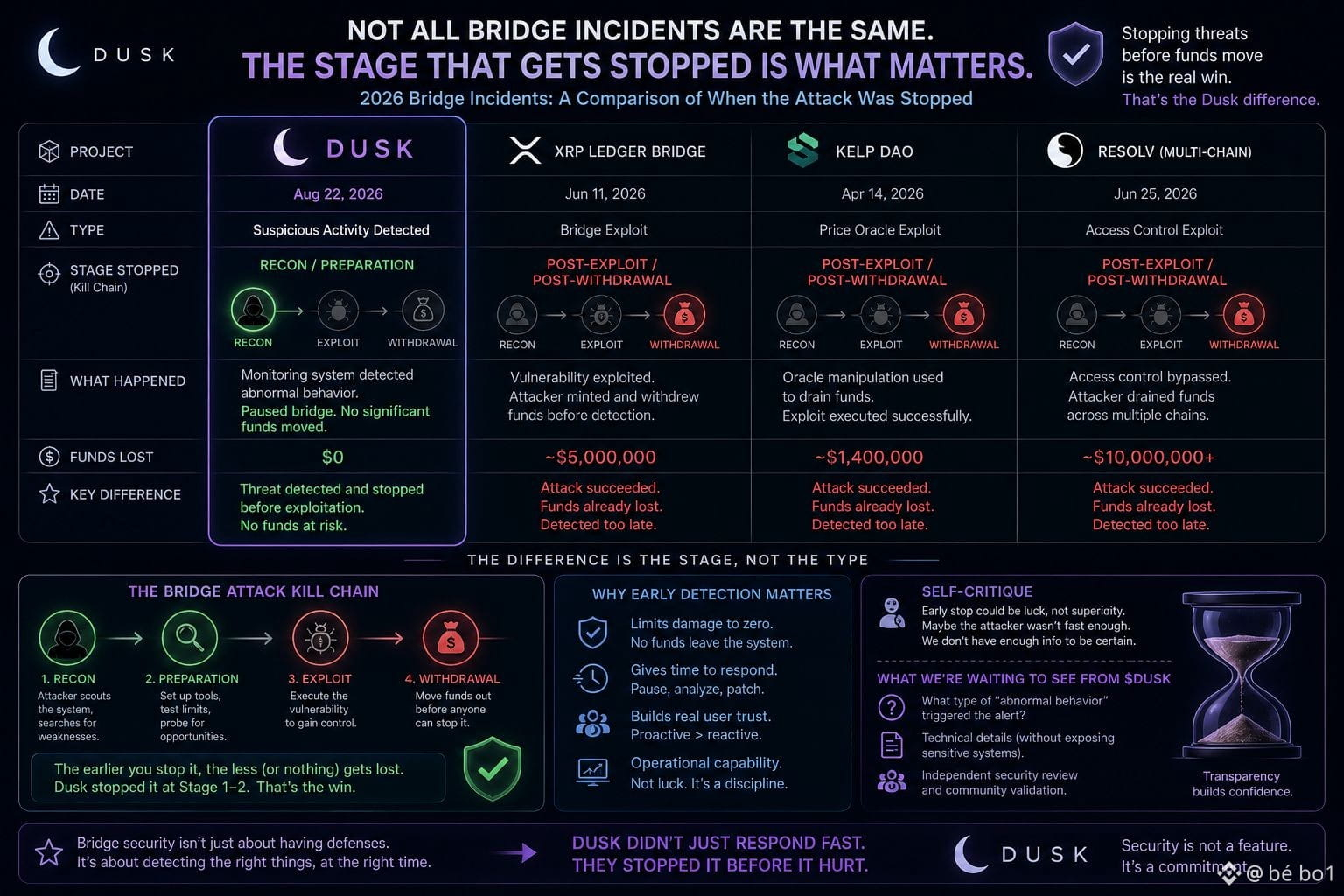
I noticed something noteworthy when placing the bridge incident of @Dusk alongside the list of major bridge hacks in 2026: the key difference doesn’t lie in whether the system was attacked or not, but in the stage at which the attack was stopped.
In the case of the XRP bridge or Kelp DAO, the attacker successfully exploited the vulnerability and withdrew the funds—an issue was only discovered after the assets had already left the system. But with Dusk, the monitoring system detected “abnormal behavior” before any significant amount of money was withdrawn—stopping the attack during reconnaissance or preparation, not after exploitation had occurred.
This difference is about the stage of an attack, which matters far more than the superficial similarity that “both had security incidents.” This suggests that even if the detection mechanism relies on manual monitoring, the ability to set warning thresholds sensitive enough to catch signs of abnormal activity at an early stage is a real operational capability, and shouldn’t be lumped together with the idea that “nothing special happened because everyone knows bridges are risky.”
Self-critique: stopping at an early stage could also simply mean the attacker hadn’t acted quickly yet, rather than Dusk’s monitoring system being clearly superior—there isn’t enough information to confirm whether this is an intentional early detection capability or just good timing luck.
I’m waiting to see whether $DUSK will publish technical details about what kind of “abnormal behavior” triggered the alerts, so the security community can assess whether this was truly early detection or merely a minor incident handled in time because of luck.
#dusk $BTC $ETH
In the case of the XRP bridge or Kelp DAO, the attacker successfully exploited the vulnerability and withdrew the funds—an issue was only discovered after the assets had already left the system. But with Dusk, the monitoring system detected “abnormal behavior” before any significant amount of money was withdrawn—stopping the attack during reconnaissance or preparation, not after exploitation had occurred.
This difference is about the stage of an attack, which matters far more than the superficial similarity that “both had security incidents.” This suggests that even if the detection mechanism relies on manual monitoring, the ability to set warning thresholds sensitive enough to catch signs of abnormal activity at an early stage is a real operational capability, and shouldn’t be lumped together with the idea that “nothing special happened because everyone knows bridges are risky.”
Self-critique: stopping at an early stage could also simply mean the attacker hadn’t acted quickly yet, rather than Dusk’s monitoring system being clearly superior—there isn’t enough information to confirm whether this is an intentional early detection capability or just good timing luck.
I’m waiting to see whether $DUSK will publish technical details about what kind of “abnormal behavior” triggered the alerts, so the security community can assess whether this was truly early detection or merely a minor incident handled in time because of luck.
#dusk $BTC $ETH