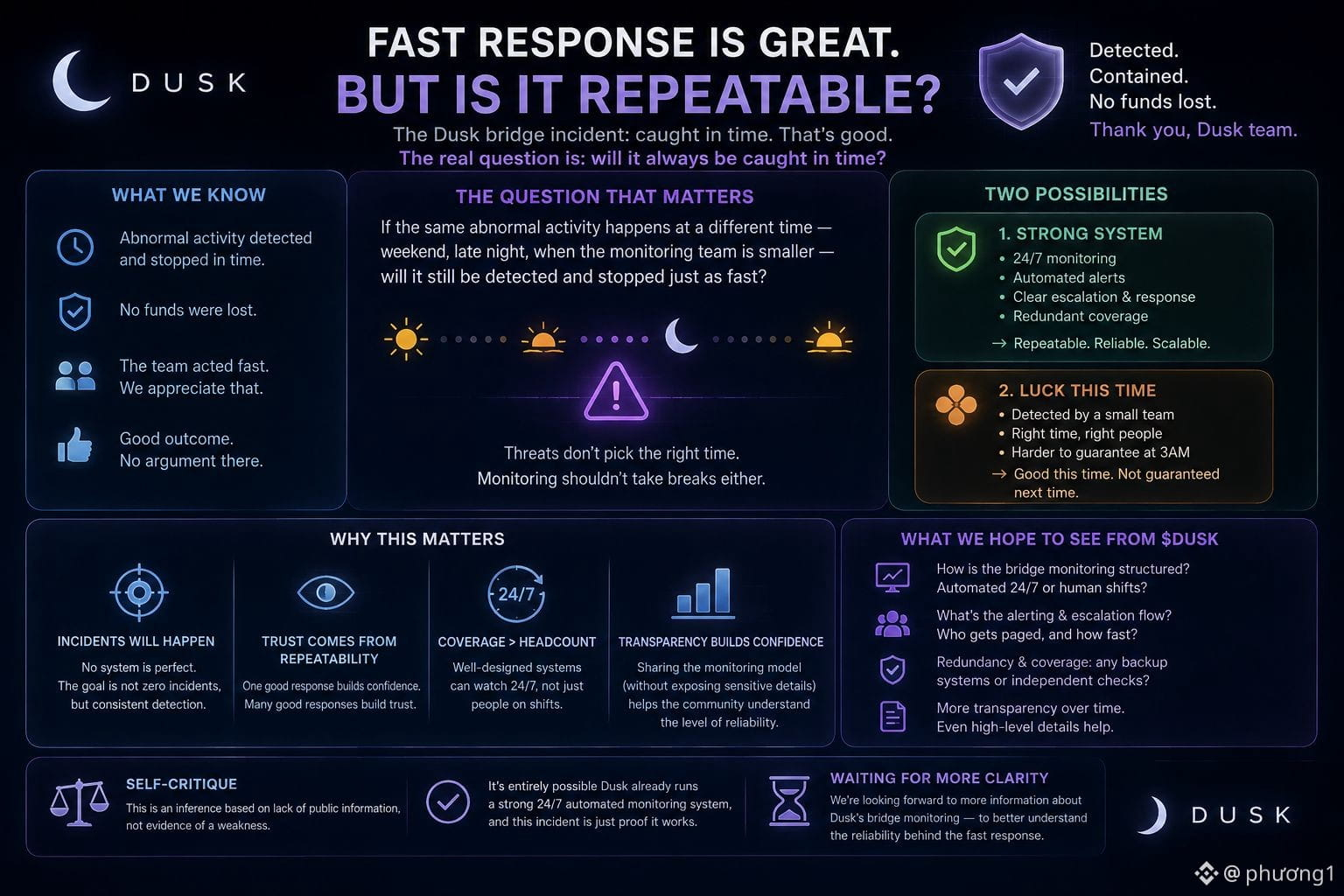
I notice something worth highlighting when thinking about the acknowledgments to the team in the incident notice from @Dusk — “thank you to the team for acting quickly” — placed alongside the question of whether fast response speed always comes from a good process, or sometimes just from luck because it was detected at the right moment.
Timely detection and prevention before assets are lost is a good outcome, and that cannot be denied. But a less commonly asked question is: if the abnormal behavior happened at a different time—on a weekend, in the middle of the night, when fewer people are on duty in the monitoring team—would the detection speed remain the same? There is no publicly available information about whether this monitoring operates 24/7 with a team large enough.
This is an important difference between a “reliable monitoring system” and “this time, luck detected it in time”—both can lead to the same good result in a specific incident, but only one of the two guarantees that a similar result will repeat if a different situation occurs at a different time. There isn’t enough publicly available data to determine which group Dusk is in, though I lean toward a positive interpretation based on the response speed shown in the recent event.
Self-reflection: this is speculation based on missing information, not concrete evidence of a weakness. It’s entirely possible that Dusk already has a sufficiently strong automated 24/7 monitoring system, and this incident is merely a normal demonstration of an existing process.
I’m waiting to see whether $DUSK will publish additional details about the bridge monitoring team’s structure—an always-on 24/7 automated system or reliance on human shift coverage—to clarify how reliable the incident-detection process is across all time windows
#dusk $BTC $ETH