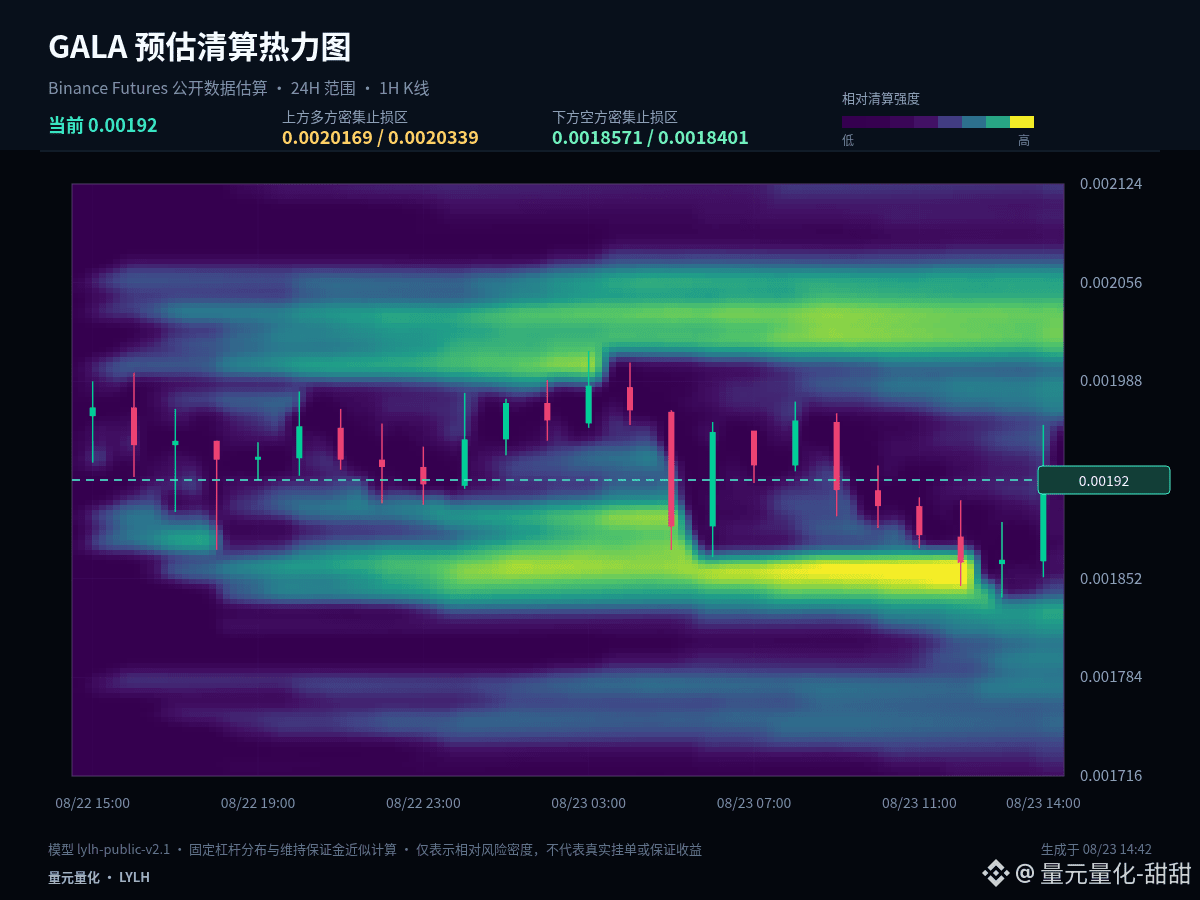
$GALA #GALA Do a structural review. Current price 0.001921, 1 hour +2.95%, 24 hours -2.69%, and the amplitude over the last 24 hours is about 8.7%.
In terms of cycle relationship, the 1-hour +2.95% is clearly stronger than the 24-hour -2.69%, indicating that short-term momentum is concentrated and being released. Strength does not mean you can ignore levels. If afterward the price can consolidate sideways or undergo a mild pullback to absorb the gains, the structure will have better continuity; if it quickly drops back below the midline, be careful that the impulse phase turns into a spike-and-retrace.
Key levels to review: 0.0019245 determines short-term initiative; 0.002008 is used to confirm upside room; 0.001841 is for observing downside defense. You don’t need to guess every step afterward—just check whether your original judgment still holds when price passes through these levels.
If the market behaves as expected, manage profits in stages and keep moving your protection upward; if it doesn’t match expectations, promptly acknowledge the change in conditions. Professional trading isn’t about being correct forever—it’s about maintaining consistent execution even after information updates.
Positioning needs to differentiate between spot and futures/contract trading. If you already hold spot, you can manage around the key levels in stages without constantly flipping direction due to a single 1-hour candlestick. If you’re flat, waiting for confirmation and then entering in batches is more comfortable. Contracts place more emphasis on entry location and invalidation conditions. When volatility increases, actively reduce position size to avoid turning a short-term view into passive holding.
Risk control still comes before the conclusion: only execute when conditions appear, and re-evaluate immediately when the price invalidates. The higher the volatility, the more you should restrain per-trade position size. The above is a scenario-based projection based on the current 1-hour and 24-hour data and does not constitute a promise of returns.
#SandboxSANDSuspectedInfiniteMintFlawOnBase
In terms of cycle relationship, the 1-hour +2.95% is clearly stronger than the 24-hour -2.69%, indicating that short-term momentum is concentrated and being released. Strength does not mean you can ignore levels. If afterward the price can consolidate sideways or undergo a mild pullback to absorb the gains, the structure will have better continuity; if it quickly drops back below the midline, be careful that the impulse phase turns into a spike-and-retrace.
Key levels to review: 0.0019245 determines short-term initiative; 0.002008 is used to confirm upside room; 0.001841 is for observing downside defense. You don’t need to guess every step afterward—just check whether your original judgment still holds when price passes through these levels.
If the market behaves as expected, manage profits in stages and keep moving your protection upward; if it doesn’t match expectations, promptly acknowledge the change in conditions. Professional trading isn’t about being correct forever—it’s about maintaining consistent execution even after information updates.
Positioning needs to differentiate between spot and futures/contract trading. If you already hold spot, you can manage around the key levels in stages without constantly flipping direction due to a single 1-hour candlestick. If you’re flat, waiting for confirmation and then entering in batches is more comfortable. Contracts place more emphasis on entry location and invalidation conditions. When volatility increases, actively reduce position size to avoid turning a short-term view into passive holding.
Risk control still comes before the conclusion: only execute when conditions appear, and re-evaluate immediately when the price invalidates. The higher the volatility, the more you should restrain per-trade position size. The above is a scenario-based projection based on the current 1-hour and 24-hour data and does not constitute a promise of returns.
#SandboxSANDSuspectedInfiniteMintFlawOnBase