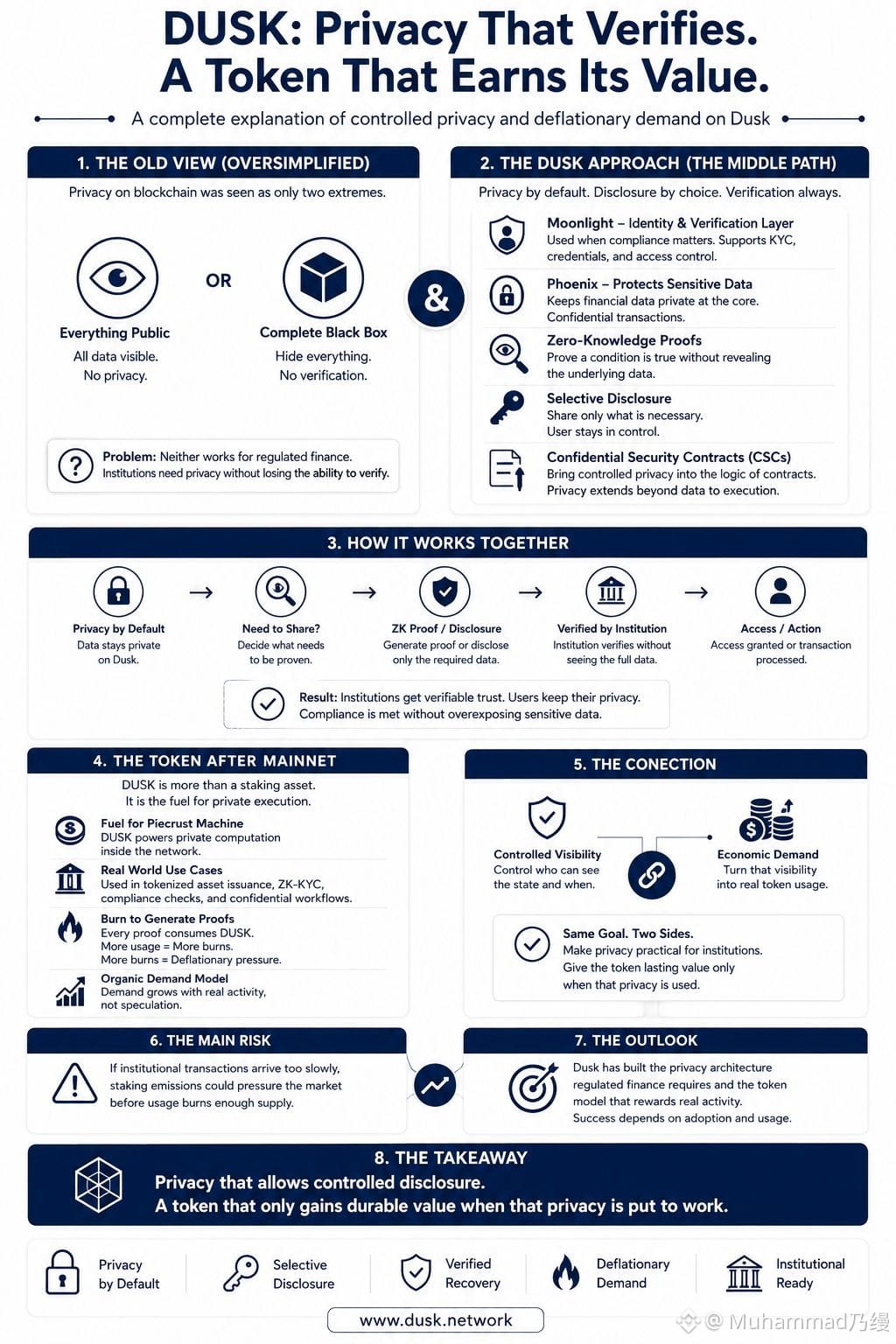
#dusk $DUSK @Dusk At first I thought privacy on a blockchain had only two options: make everything public, or turn transactions into a complete black box. Looking closer at Dusk changed that view.
The design is not about hiding everything. Moonlight acts as an identity and verification layer when compliance still matters. Phoenix protects sensitive financial data. Confidential transactions surface only what is necessary. Zero-knowledge proofs confirm a condition without revealing the full data. Selective disclosure keeps control with the user while allowing authorized parties to see exactly what they need. Confidential Security Contracts embed that same controlled privacy into the logic of the contracts themselves.
Something similar appears in how the token works after mainnet. DUSK is no longer just a staking asset — it became the fuel that powers private execution inside the Piecrust machine. Every time a bank or fund issues tokenized shares or verifies a user through ZK-KYC, the network burns DUSK to generate the required proofs. More real activity creates more demand for those proofs and therefore more deflationary pressure.
Both pieces start to feel connected.
One controls who can see the state and under which conditions.
The other turns that controlled visibility into actual economic demand for the token.
The underlying question remains the same: how do you keep privacy practical for institutions without losing the ability to verify, and how do you give the token lasting value only when that privacy is genuinely used?
The main risk is quiet but real. If institutional transactions arrive too slowly, staking emissions could pressure the market before usage burns enough supply. Dusk has built both the privacy architecture regulated finance requires and the token model that rewards real activity. Whether that combination proves stronger than pure speculation is still an open question.
I keep returning to the same thought privacy that allows controlled disclosure, and a token that only gains durable value when that privacy is put to work.
The design is not about hiding everything. Moonlight acts as an identity and verification layer when compliance still matters. Phoenix protects sensitive financial data. Confidential transactions surface only what is necessary. Zero-knowledge proofs confirm a condition without revealing the full data. Selective disclosure keeps control with the user while allowing authorized parties to see exactly what they need. Confidential Security Contracts embed that same controlled privacy into the logic of the contracts themselves.
Something similar appears in how the token works after mainnet. DUSK is no longer just a staking asset — it became the fuel that powers private execution inside the Piecrust machine. Every time a bank or fund issues tokenized shares or verifies a user through ZK-KYC, the network burns DUSK to generate the required proofs. More real activity creates more demand for those proofs and therefore more deflationary pressure.
Both pieces start to feel connected.
One controls who can see the state and under which conditions.
The other turns that controlled visibility into actual economic demand for the token.
The underlying question remains the same: how do you keep privacy practical for institutions without losing the ability to verify, and how do you give the token lasting value only when that privacy is genuinely used?
The main risk is quiet but real. If institutional transactions arrive too slowly, staking emissions could pressure the market before usage burns enough supply. Dusk has built both the privacy architecture regulated finance requires and the token model that rewards real activity. Whether that combination proves stronger than pure speculation is still an open question.
I keep returning to the same thought privacy that allows controlled disclosure, and a token that only gains durable value when that privacy is put to work.