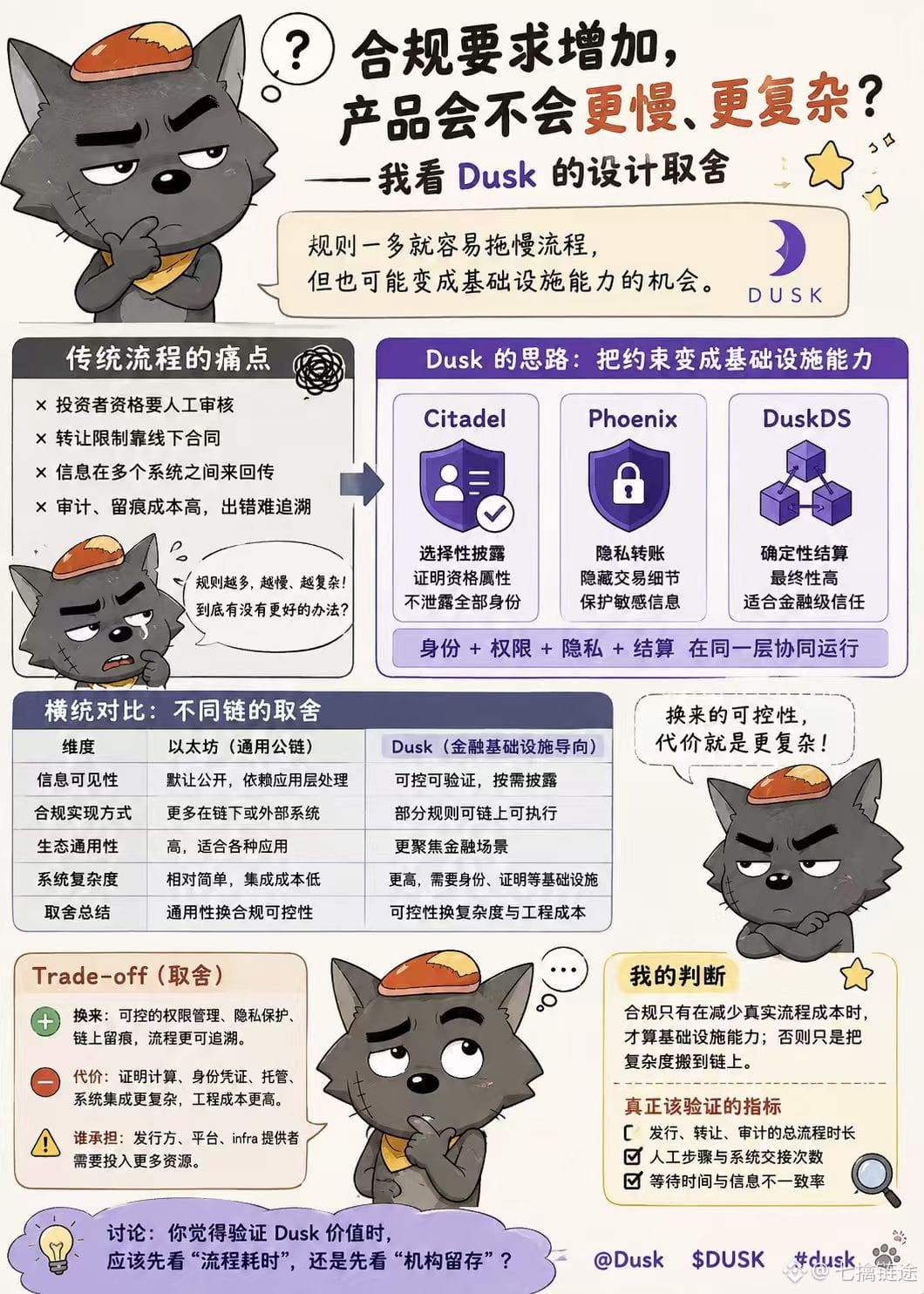
#dusk $DUSK Once financial products enter the real market, compliance is no longer the final stamp at the end—it’s embedded in the processes of issuance, qualification review, transfer, and auditing. The question then is: when rules are put on-chain, does it actually reduce the need for manual coordination, or does it simply relocate the complexity somewhere else?
The entry point I see through Dusk is that it puts several previously separate things into a single underlying system: Citadel uses selective-disclosure proofs to establish participation eligibility, Phoenix keeps sensitive transfers from being exposed, and DuskDS handles deterministic settlement. For issuers, the value isn’t that “compliance disappears,” but whether eligibility, privacy, and settlement can share the same verifiable state.
But it’s also easy to get misled by the marketing here. Ethereum is more general-purpose, so financial rules can be handled at the application layer and by external systems. Dusk, by contrast, pushes more constraints down into the infrastructure. The trade-off for improved controllability is that proof generation, identity credentials, custody, and system integration become more complex. Dusk itself also has dedicated Prover infrastructure to take on the ZK proof computation.
So my judgment is: compliance is only a real infrastructure capability if it reduces the cost of actual process execution; otherwise it’s just moving backend complexity onto the chain. What’s truly worth looking at is how many manual steps, how much waiting time, and how much information handoff are required for an institution to issue, transfer, and audit once. If that metric doesn’t go down, it’s hard to say that the design advantages of @Dusk can hold up. Would you rather first validate the time cost of the process, or validate how well institutions retain participants?
The entry point I see through Dusk is that it puts several previously separate things into a single underlying system: Citadel uses selective-disclosure proofs to establish participation eligibility, Phoenix keeps sensitive transfers from being exposed, and DuskDS handles deterministic settlement. For issuers, the value isn’t that “compliance disappears,” but whether eligibility, privacy, and settlement can share the same verifiable state.
But it’s also easy to get misled by the marketing here. Ethereum is more general-purpose, so financial rules can be handled at the application layer and by external systems. Dusk, by contrast, pushes more constraints down into the infrastructure. The trade-off for improved controllability is that proof generation, identity credentials, custody, and system integration become more complex. Dusk itself also has dedicated Prover infrastructure to take on the ZK proof computation.
So my judgment is: compliance is only a real infrastructure capability if it reduces the cost of actual process execution; otherwise it’s just moving backend complexity onto the chain. What’s truly worth looking at is how many manual steps, how much waiting time, and how much information handoff are required for an institution to issue, transfer, and audit once. If that metric doesn’t go down, it’s hard to say that the design advantages of @Dusk can hold up. Would you rather first validate the time cost of the process, or validate how well institutions retain participants?