When I previously researched public chains, I often first looked at TPS, the ecosystem, and the number of developers. But after re-examining @Dusk , I started to focus on another question: when complex assets such as securities and funds truly move onto the chain, how can a blockchain handle privacy, state control, and verifiable settlement at the same time?
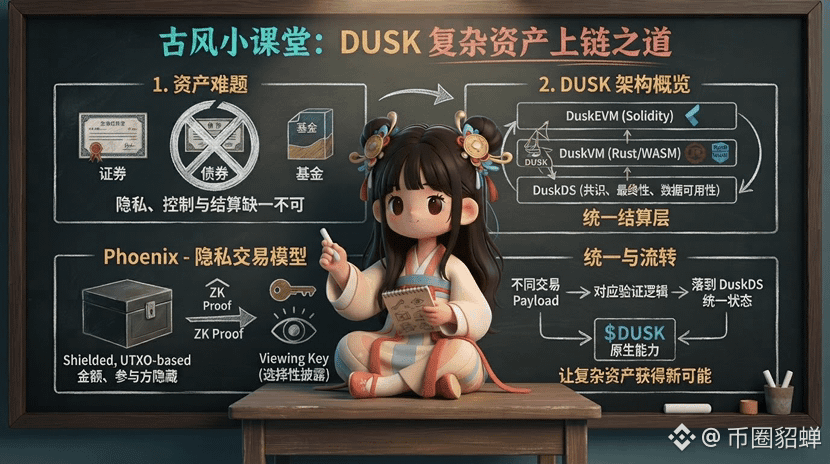
Dusk’s architecture gave me a new direction for thinking. DuskDS is responsible for consensus, finality, data availability, and the native transaction model. DuskEVM provides a Solidity/EVM-compatible environment, and DuskVM lets Rust/WASM contracts run directly on Dusk L1.
What really made me pause was Phoenix. It uses a shielded, UTXO-based transaction model. It verifies transaction validity and prevents double-spending using ZK proofs, while hiding amounts and participants, and it supports selective disclosure using viewing keys. Moonlight corresponds to a public account-based model.
After continuing my research on the Transfer Contract, I finally understood the key to this design: different transaction payloads enter the corresponding verification logic, and ultimately everything still falls under DuskDS’s unified state and settlement system. The core focus of Dusk’s design is to give different asset models matching execution entry points, while sharing the underlying settlement capability.
Of course, this architecture still needs time to prove itself: if developers stay in the EVM for the long term, can DuskVM truly demonstrate its value? And if demand for privacy assets grows, can this native capability translate into a real adoption advantage?
For me, what makes Dusk worth long-term observation is whether it can enable complex financial assets to find new possibilities on-chain—and that, in turn, will determine whether its architecture can truly be converted into real-world value.
#dusk $DUSK @Dusk
Dusk’s architecture gave me a new direction for thinking. DuskDS is responsible for consensus, finality, data availability, and the native transaction model. DuskEVM provides a Solidity/EVM-compatible environment, and DuskVM lets Rust/WASM contracts run directly on Dusk L1.
What really made me pause was Phoenix. It uses a shielded, UTXO-based transaction model. It verifies transaction validity and prevents double-spending using ZK proofs, while hiding amounts and participants, and it supports selective disclosure using viewing keys. Moonlight corresponds to a public account-based model.
After continuing my research on the Transfer Contract, I finally understood the key to this design: different transaction payloads enter the corresponding verification logic, and ultimately everything still falls under DuskDS’s unified state and settlement system. The core focus of Dusk’s design is to give different asset models matching execution entry points, while sharing the underlying settlement capability.
Of course, this architecture still needs time to prove itself: if developers stay in the EVM for the long term, can DuskVM truly demonstrate its value? And if demand for privacy assets grows, can this native capability translate into a real adoption advantage?
For me, what makes Dusk worth long-term observation is whether it can enable complex financial assets to find new possibilities on-chain—and that, in turn, will determine whether its architecture can truly be converted into real-world value.
#dusk $DUSK @Dusk