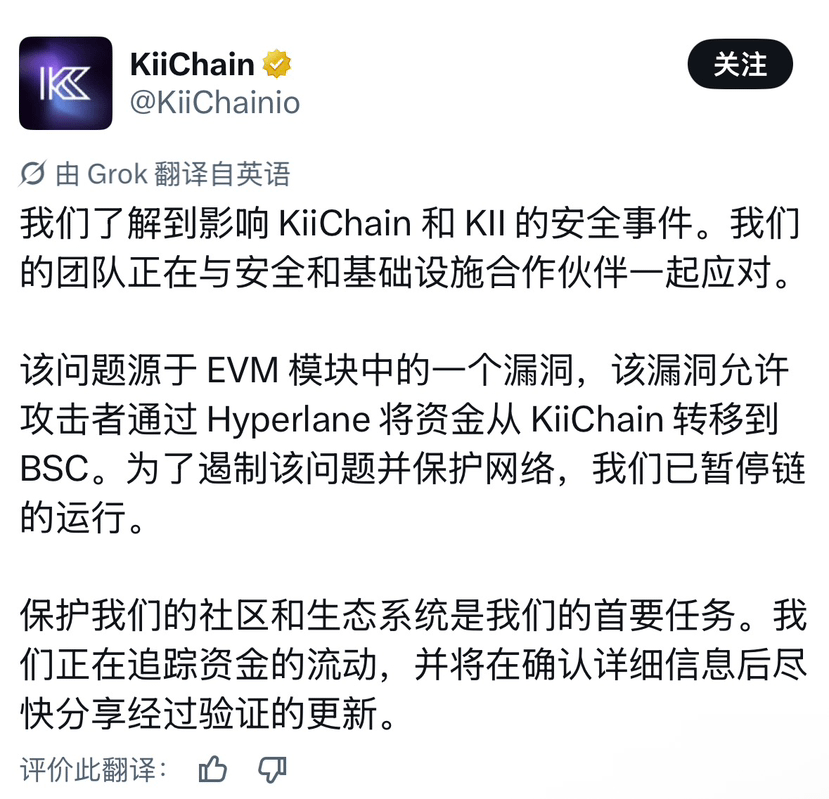
I thought the scammy maneuvers below the level of $KII were already the worst they could do. But I didn’t expect them to take advantage of the Trading Competition event to cut the final wave of profits, and then blame it on the hacker—now that’s truly ridiculous. Let’s look at their sell-off path: they first dumped hard on a centralized exchange, smashing the buy/sell wall and driving the market price to collapse in an instant. The following plot matches exactly what they said in their published tweet: the official admitted that a so-called “security incident” occurred, pointed to an EVM module vulnerability, and had no choice but to “pause the chain’s operation.”
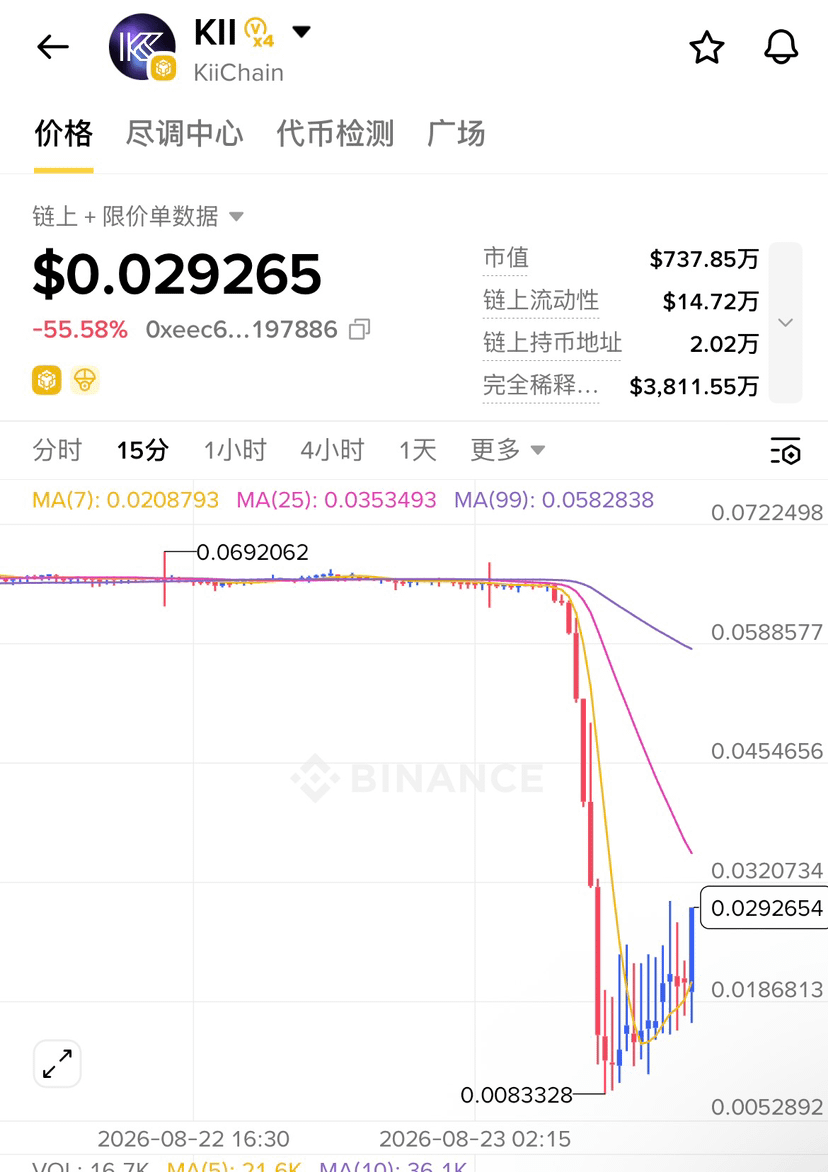
Paired with that shocking vertical sell-off on the KII/USDT candlestick chart. Liquidity was nearly dried up, and the price plunged from $0.069 to a low of $0.008. This feels more like collusion from the project side—first dumping to cut liquidity from retail like harvesting wheat, then using the “pausing the chain” excuse to lock users’ funds and prevent any reverse actions.
A chain that can be arbitrarily “paused” by the project team at any time is touted “decentralization,” but it is extremely fragile in the face of money. In market conditions lacking certainty, I value the risk-control infrastructure that @Dusk has welded together with code even more.
The core conflict that truly blocks RWA from taking off lies in the struggle between Settlement Finality and commercial confidentiality. Unlike the Probabilistic Finality (probabilistic finality) of other EVM chains—where there’s always a fatal loophole that transactions can be rolled back in theory—DuskNetwork’s uniquely invented Succinct Attestation consensus mechanism provides block certainty and finality. Once a block is approved, the state is completely and permanently “welded shut” at the cryptographic level with no possibility of reversal, and there will never be those absurd situations where, due to some so-called “security incident,” the project team can arbitrarily pause an entire network.
Together with its XSC confidential smart contract standard designed specifically for regulated finance and the Citadel identity protocol, Dusk achieves a perfect separation between public verifiability and private transactions. Nodes can only verify via ZKPs (zero-knowledge proofs) that a transaction meets compliance constraints and that funds are sufficient. They are completely unable to look back and inspect the trading operator’s intent, specific Transfer Details, or a Principal Part—this underlying state machine that perfectly stitches together access control and absolute settlement finality is the ultimate foundation that lets Wall Street institutions feel safe moving assets on-chain. Compared with a project that makes me worry about blaming the hacker at any time, I’d rather long-term lock in Dusk—the compliance privacy fortress built with mathematical rules. That’s also the underlying reason for my long-term lock-in.
#dusk $DUSK @Dusk
Paired with that shocking vertical sell-off on the KII/USDT candlestick chart. Liquidity was nearly dried up, and the price plunged from $0.069 to a low of $0.008. This feels more like collusion from the project side—first dumping to cut liquidity from retail like harvesting wheat, then using the “pausing the chain” excuse to lock users’ funds and prevent any reverse actions.
A chain that can be arbitrarily “paused” by the project team at any time is touted “decentralization,” but it is extremely fragile in the face of money. In market conditions lacking certainty, I value the risk-control infrastructure that @Dusk has welded together with code even more.
The core conflict that truly blocks RWA from taking off lies in the struggle between Settlement Finality and commercial confidentiality. Unlike the Probabilistic Finality (probabilistic finality) of other EVM chains—where there’s always a fatal loophole that transactions can be rolled back in theory—DuskNetwork’s uniquely invented Succinct Attestation consensus mechanism provides block certainty and finality. Once a block is approved, the state is completely and permanently “welded shut” at the cryptographic level with no possibility of reversal, and there will never be those absurd situations where, due to some so-called “security incident,” the project team can arbitrarily pause an entire network.
Together with its XSC confidential smart contract standard designed specifically for regulated finance and the Citadel identity protocol, Dusk achieves a perfect separation between public verifiability and private transactions. Nodes can only verify via ZKPs (zero-knowledge proofs) that a transaction meets compliance constraints and that funds are sufficient. They are completely unable to look back and inspect the trading operator’s intent, specific Transfer Details, or a Principal Part—this underlying state machine that perfectly stitches together access control and absolute settlement finality is the ultimate foundation that lets Wall Street institutions feel safe moving assets on-chain. Compared with a project that makes me worry about blaming the hacker at any time, I’d rather long-term lock in Dusk—the compliance privacy fortress built with mathematical rules. That’s also the underlying reason for my long-term lock-in.
#dusk $DUSK @Dusk