Dusk just launched a wallet and SDK but why they didn't do it the way the market does is the part worth reading
Most of what I've written about Dusk this campaign has circled the protocol: native issuance, privacy model, institutional partners. But there's one thing I kept skipping the thing that decides whether any protocol gets used by real builders: developer experience.
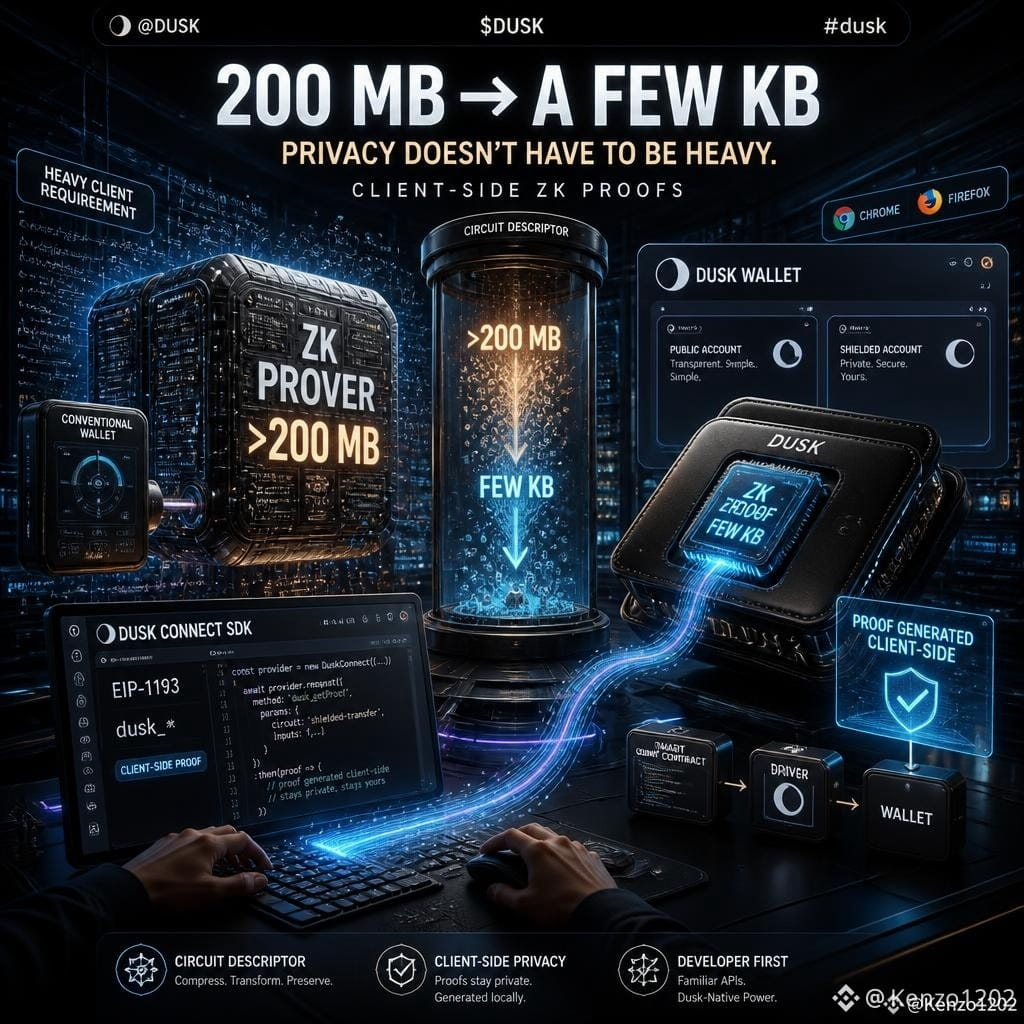
In April 2026, Dusk shipped the beta of Dusk Wallet and Dusk Connect SDK. Chrome and Firefox extensions, one codebase, supporting both public and shielded accounts in the same interface.
The provider API is modeled after EIP-1193 the exact interface MetaMask uses, familiar to most Web3 developers. Because Dusk isn't EVM, methods use a dusk_* prefix, and the discovery protocol is event-based, so multiple compatible wallets can coexist on the same page without conflicts.
The driver architecture is the more distinct part: developers deploy a smart contract alongside a "driver" users install it into the wallet to interact exactly the way the developer intended. This solves a real problem: ZK proofs originally required prover keys heavier than 200MB. The team compressed them down to a few KB using circuit descriptor technology.
This also explains why Dusk didn't follow the embedded wallet trend dominant in 2026 — where users sign in with email or Google and a wallet is silently created behind the SDK. That model puts ZK proof generation on a third-party server. With Dusk, proofs have to run client-side you can't delegate that and still keep the privacy model intact.
The question I'm sitting with: the rate at which real builders actually deploy dApps will be a more honest metric than any protocol benchmark.
@Dusk $DUSK #dusk $BTC $BNB
#dusk @Dusk
Most of what I've written about Dusk this campaign has circled the protocol: native issuance, privacy model, institutional partners. But there's one thing I kept skipping the thing that decides whether any protocol gets used by real builders: developer experience.
In April 2026, Dusk shipped the beta of Dusk Wallet and Dusk Connect SDK. Chrome and Firefox extensions, one codebase, supporting both public and shielded accounts in the same interface.
The provider API is modeled after EIP-1193 the exact interface MetaMask uses, familiar to most Web3 developers. Because Dusk isn't EVM, methods use a dusk_* prefix, and the discovery protocol is event-based, so multiple compatible wallets can coexist on the same page without conflicts.
The driver architecture is the more distinct part: developers deploy a smart contract alongside a "driver" users install it into the wallet to interact exactly the way the developer intended. This solves a real problem: ZK proofs originally required prover keys heavier than 200MB. The team compressed them down to a few KB using circuit descriptor technology.
This also explains why Dusk didn't follow the embedded wallet trend dominant in 2026 — where users sign in with email or Google and a wallet is silently created behind the SDK. That model puts ZK proof generation on a third-party server. With Dusk, proofs have to run client-side you can't delegate that and still keep the privacy model intact.
The question I'm sitting with: the rate at which real builders actually deploy dApps will be a more honest metric than any protocol benchmark.
@Dusk $DUSK #dusk $BTC $BNB
#dusk @Dusk