


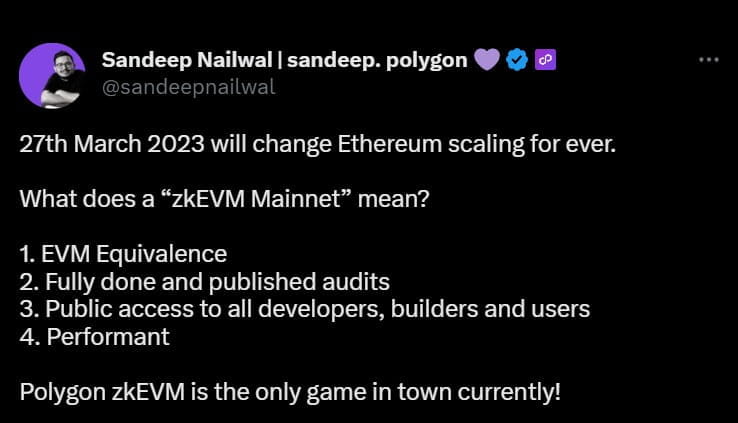
Polygon Labs recently made an important announcement that is planned to positively impact the future of the Ethereum network. The protocol launched the Ethereum zero-knowledge proof Polygon Virtual Machine (zkEVM) on the Beta mainnet, a public and permissionless network that allows users to transact and build applications.
According to the announcement, to further support the development of the protocol, Polygon zkEVM is now completely open source. With this launch, Polygon is said to be helping usher in the next phase of Ethereum's evolution, while also providing programmers and users with a new tool to build decentralized applications. concentrate.
What Are the Benefits of New Zkevm Polygons?
Polygon zkEVM is a zero-knowledge proof (ZPK) scaling solution developed by the same protocol, designed to enable faster and cheaper transactions on the Ethereum network. Public testnets for zkEVM have made it a frontrunner among ZK scaling solutions equivalent to the Ethereum Virtual Machine (EVM).
One of the main benefits of zkEVM is the use of zero-knowledge proof, ensuring security and reducing gas fees. Another benefit for users is that zero-knowledge proof allows transactions to be verified without revealing sensitive information, making them highly secure.
Furthermore, Polygon's zkEVM is designed to be fully compatible with EVM, so programmers can easily deploy existing Ethereum smart contracts on the network, facilitating them to port existing applications. have theirs to zkEVM.
Additionally, zkEVM is designed to improve Ethereum's scalability, enabling faster and more efficient transactions with lower fees for programmers and users with new features of the protocol.
Polygon Prevents Potential Risks When Launching Zkevm Mainnet Beta
According to the announcement, the protocol addresses the risks of using zkEVM Mainnet Beta. While the mainnet launch is an important development for the protocol, undetected errors can always disrupt network stability.
To address these potential risks, Polygon Labs has outlined “stringent” security measures, including the establishment of an interim security council, responsible for overseeing network security and addressing any problem.
The Security Council will be comprised of various companies and organizations in the blockchain industry. Additionally, Polygon will launch a bug bounty program, which will encourage researchers and programmers to identify and report any bugs or security vulnerabilities they find in the Mainnet Beta zkEVM by Polygon.
Given the potential risks and vulnerabilities, a bug bounty program is designed that will reward up to $1,000,000 for documenting critical vulnerabilities.
Despite the positive development of the new Polygon feature, the protocol's native token, MATIC, has not responded positively to this new move. Currently, MATIC is trading at $1.0462, showing a drop of over 5% in the past 24 hours.
However, the launch of this new development has been welcomed by the cryptocurrency community, which could have a positive impact on MATIC's price in the long term.
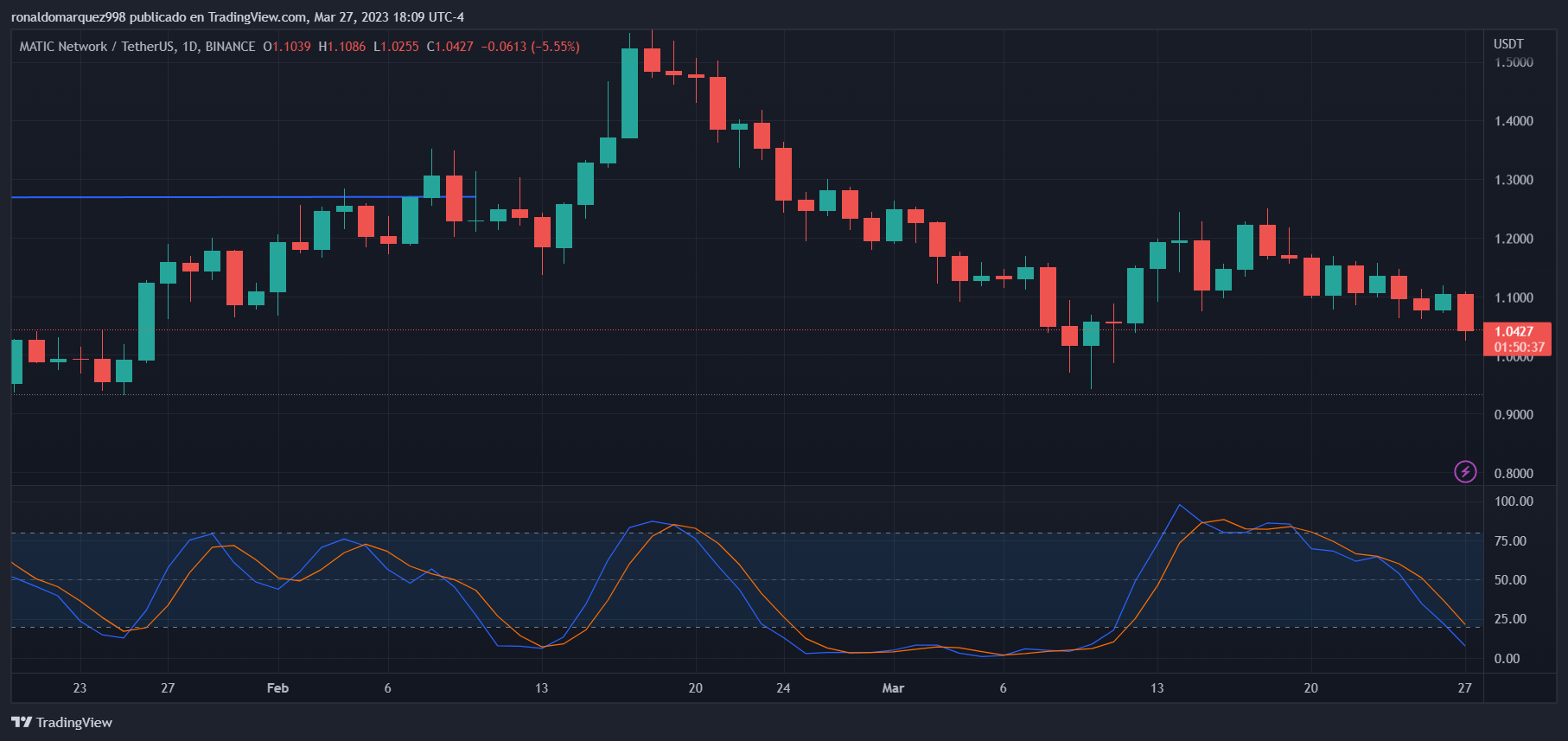
Image from Unsplash, chart from TradingView.com