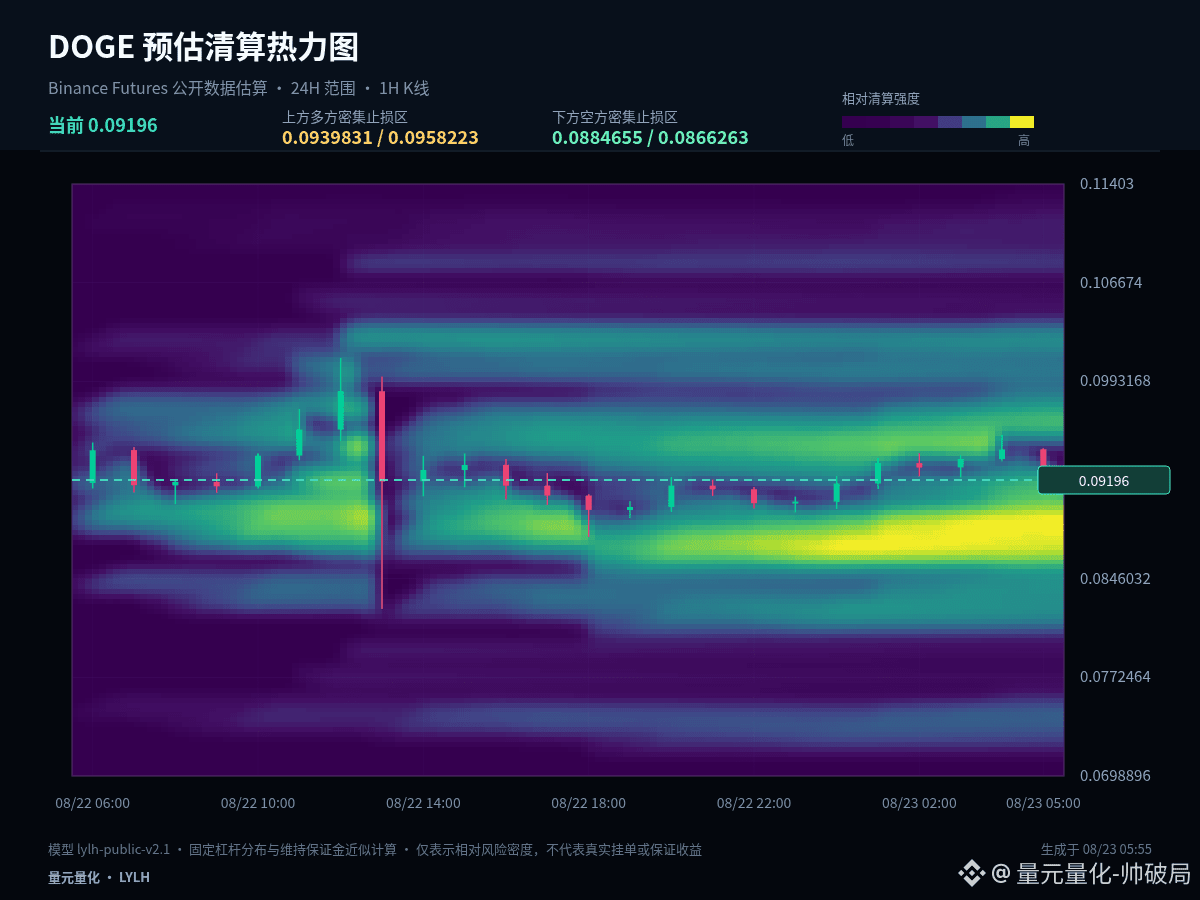
$DOGE #DOGE Right now it looks more like a range with turnover; there’s no need to explain every 1-hour candlestick as a new trend. Current price: 0.09194, 1-hour: -2.45%, 24-hour: +0.57%.
Currently, 1-hour is -2.45% and 24-hour is +0.57%, and the two cycles haven’t formed clear same-direction coordination. In a range market, the tolerance for chasing and selling is lower; it’s more suitable to use the upper boundary to confirm direction and the lower boundary to confirm support. The midline should only be used as a line to judge strength/weakness.
Upper boundary: 0.1008, lower boundary: 0.083, midline: 0.0919. When near the upper boundary, watch the breakout quality; when near the lower boundary, watch for support. Around the midline, reduce frequent trading—because it isn’t far enough from either side, and both direction and risk-reward ratio are not clear.
Signals worth acting on are truly the ones where, after breaking a boundary, the price is willing to stay in the new range; or after probing the boundary downward, it quickly reclaims. Without such confirmation, continue to treat it as a consolidation/range and don’t change the overall plan due to brief intraday fluctuations.
Position sizing needs to distinguish spot from contracts. If you already hold spot, manage in segments around key levels without frequently switching direction based on a single 1-hour candlestick. If you’re flat, wait for confirmation and then scale in more calmly. Contracts place more emphasis on the entry location and the invalidation conditions. When volatility amplifies, proactively reduce position size to avoid turning a short-term judgment into passive holding.
For contracts, the focus isn’t predicting every K-line; it’s ensuring there are reasons for entry, trimming, and exit. If there’s no confirmation, do less. If a key level fails, redo the plan—control single-trade risk first, and only then discuss potential upside/space.
#USThreeMajorIndexesPostWeeklyLosses
Currently, 1-hour is -2.45% and 24-hour is +0.57%, and the two cycles haven’t formed clear same-direction coordination. In a range market, the tolerance for chasing and selling is lower; it’s more suitable to use the upper boundary to confirm direction and the lower boundary to confirm support. The midline should only be used as a line to judge strength/weakness.
Upper boundary: 0.1008, lower boundary: 0.083, midline: 0.0919. When near the upper boundary, watch the breakout quality; when near the lower boundary, watch for support. Around the midline, reduce frequent trading—because it isn’t far enough from either side, and both direction and risk-reward ratio are not clear.
Signals worth acting on are truly the ones where, after breaking a boundary, the price is willing to stay in the new range; or after probing the boundary downward, it quickly reclaims. Without such confirmation, continue to treat it as a consolidation/range and don’t change the overall plan due to brief intraday fluctuations.
Position sizing needs to distinguish spot from contracts. If you already hold spot, manage in segments around key levels without frequently switching direction based on a single 1-hour candlestick. If you’re flat, wait for confirmation and then scale in more calmly. Contracts place more emphasis on the entry location and the invalidation conditions. When volatility amplifies, proactively reduce position size to avoid turning a short-term judgment into passive holding.
For contracts, the focus isn’t predicting every K-line; it’s ensuring there are reasons for entry, trimming, and exit. If there’s no confirmation, do less. If a key level fails, redo the plan—control single-trade risk first, and only then discuss potential upside/space.
#USThreeMajorIndexesPostWeeklyLosses