From Asia's morning to America's dusk: How USDT on TRON follows the Earth's rotation to become true digital cash
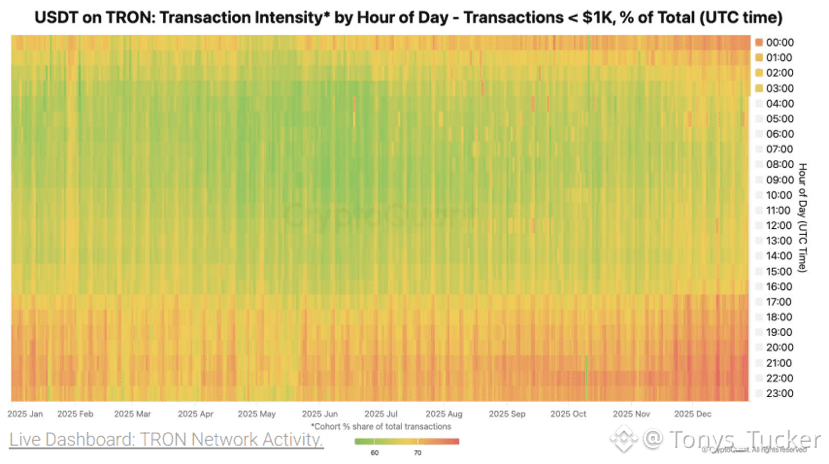
Data for the entire year of 2025 shows that small USDT transfers (single transaction < $1,000) on the TRON network have stabilized at a proportion of 60%–74%, becoming one of the most significant features of the network's transaction structure.
The following heatmap uses UTC time as the vertical axis (00:00–23:00) and the months of 2025 as the horizontal axis, with the depth of color representing the proportion of small transfers to the total number of transactions for that day (green low → red high):
The core timing patterns are very clear:
1/ UTC 00:00–08:00 (Main active window in Asia)
Maintains a high proportion almost throughout the year (65%–74%), corresponding to daytime to evening in the East Asia time zone, which is the most typical period for P2P payments, small off-exchange payments, and cross-border daily remittances.
2/ UTC 12:00–20:00 (Main active window in America)
Systematically high values are also seen, especially more pronounced in the second half of the year, reflecting enhanced small usage habits among users from Latin America and the North American West Coast.
3/ Around UTC 08:00–12:00 (Overlap period for Europe/Middle East/Africa)
The proportion of small transfers temporarily declines, while large transactions and institutional-level OTC flows significantly increase, forming a typical “institutional period” characteristic.
Yearly trend evolution:
1/ First half: Overall low proportion of small transfers but steadily rising
2/ From July: The evening (UTC 18:00–23:00) red area significantly expands, indicating that more global users are starting to use TRON USDT as “money that can be used at night”
3/ October–December: Multiple regions maintain a high level of 70%+, indicating that the network's small payment attributes are very solid
The core conclusion of this chart is:
USDT on TRON is no longer just a channel for inflows and outflows at exchanges but a payment/value transfer tool that many ordinary people are using daily in real scenarios.
Its usage time distribution highly matches the daily routines of residents in major global economies, rather than being concentrated in the few hours of exchange openings or dramatic price fluctuations. This is one of the most direct on-chain evidences of stablecoins transitioning towards “currency” attributes.
When the proportion of small transactions remains stable at over 2/3 for a long time, and the time distribution shows such strong regional life rhythm characteristics, we can actually see the embryonic form of a new type of digital cash infrastructure.
Data for the entire year of 2025 shows that small USDT transfers (single transaction < $1,000) on the TRON network have stabilized at a proportion of 60%–74%, becoming one of the most significant features of the network's transaction structure.
The following heatmap uses UTC time as the vertical axis (00:00–23:00) and the months of 2025 as the horizontal axis, with the depth of color representing the proportion of small transfers to the total number of transactions for that day (green low → red high):
The core timing patterns are very clear:
1/ UTC 00:00–08:00 (Main active window in Asia)
Maintains a high proportion almost throughout the year (65%–74%), corresponding to daytime to evening in the East Asia time zone, which is the most typical period for P2P payments, small off-exchange payments, and cross-border daily remittances.
2/ UTC 12:00–20:00 (Main active window in America)
Systematically high values are also seen, especially more pronounced in the second half of the year, reflecting enhanced small usage habits among users from Latin America and the North American West Coast.
3/ Around UTC 08:00–12:00 (Overlap period for Europe/Middle East/Africa)
The proportion of small transfers temporarily declines, while large transactions and institutional-level OTC flows significantly increase, forming a typical “institutional period” characteristic.
Yearly trend evolution:
1/ First half: Overall low proportion of small transfers but steadily rising
2/ From July: The evening (UTC 18:00–23:00) red area significantly expands, indicating that more global users are starting to use TRON USDT as “money that can be used at night”
3/ October–December: Multiple regions maintain a high level of 70%+, indicating that the network's small payment attributes are very solid
The core conclusion of this chart is:
USDT on TRON is no longer just a channel for inflows and outflows at exchanges but a payment/value transfer tool that many ordinary people are using daily in real scenarios.
Its usage time distribution highly matches the daily routines of residents in major global economies, rather than being concentrated in the few hours of exchange openings or dramatic price fluctuations. This is one of the most direct on-chain evidences of stablecoins transitioning towards “currency” attributes.
When the proportion of small transactions remains stable at over 2/3 for a long time, and the time distribution shows such strong regional life rhythm characteristics, we can actually see the embryonic form of a new type of digital cash infrastructure.