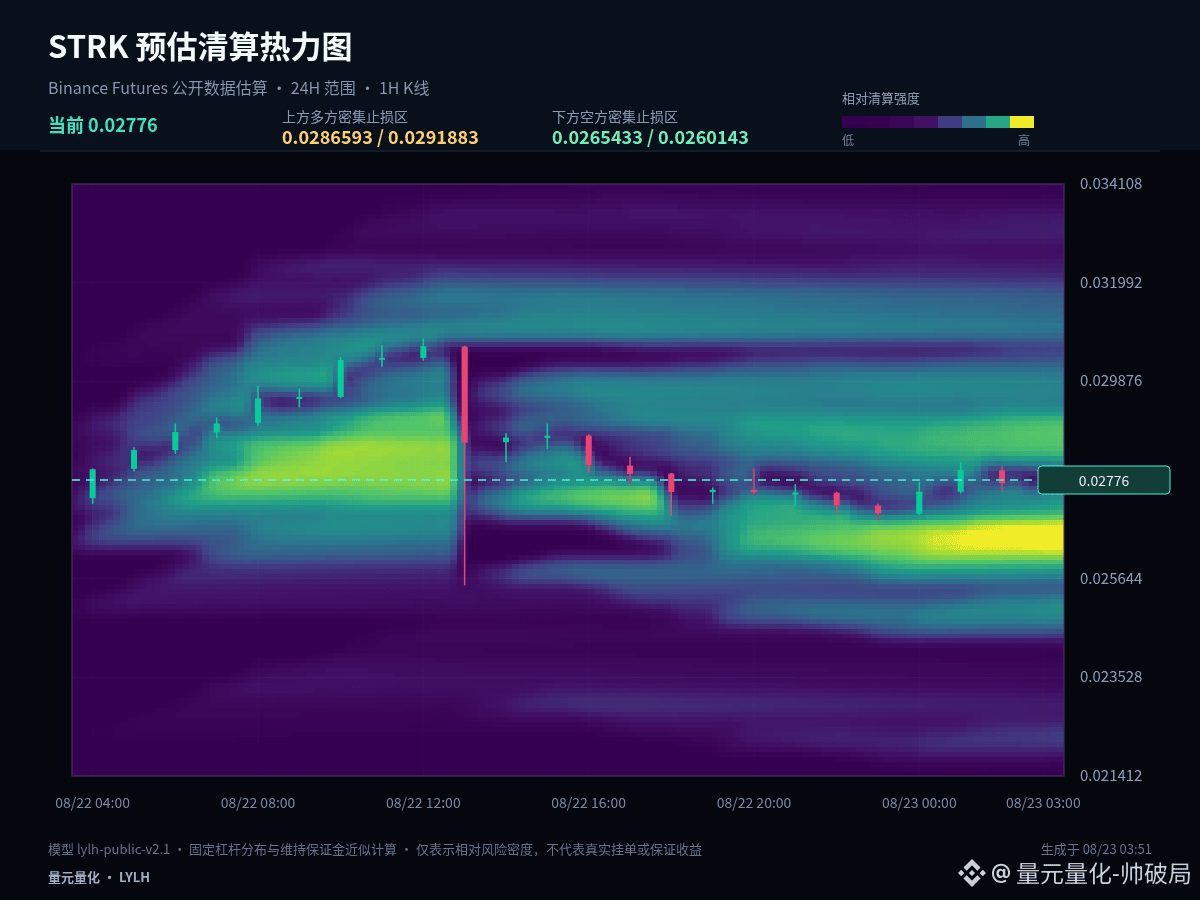
$STRK #STRK Current price 0.02776, +0.29% in the last 1 hour, +1.43% in the last 24 hours. Rather than taking a long/short position first, it’s better to list the possible paths and the corresponding actions clearly.
At present, +0.29% over 1 hour and +1.43% over 24 hours do not form a sufficiently clear directional alignment across the two time windows. In range-bound markets, the tolerance for chasing and killing trades is lower. It’s more suitable to use upper-bound confirmation for direction and lower-bound confirmation for holding/continuation; the midline only serves as a line between strength and weakness.
The first path is upward: price needs to break above 0.03075 and form a stable close above it; only then is the confirmation valid. A subsequent pullback that does not break it counts as effective confirmation. The second path is downward: once 0.02587 is broken and any rebound cannot be closed back above it, it indicates insufficient support. In that case, prioritize defense rather than rushing to add positions.
If price continues to stay between 0.03075 and 0.02587, 0.02831 is only a reference for short-term initiative. The middle of the range has no clear advantage—don’t force a trade just for the sake of being involved. Wait for the market to show direction.
For those with existing positions, the key is to manage based on whether support fails, not to be carried away by every fluctuation. For those without positions, prioritize waiting for a breakout with a pullback or for support confirmation. Spot can be scaled in batches, while for futures/contracts you should shorten the decision chain: first determine the stop-loss level, then decide whether to participate.
Risk control still comes before the conclusion: execute only when conditions appear, and if the price invalidates the setup, reassess promptly. The larger the volatility, the more restrained each single position should be. The above is a scenario projection based on current 1-hour and 24-hour data and does not constitute a promise of returns.
#USThreeMajorIndexesPostWeeklyLosses
At present, +0.29% over 1 hour and +1.43% over 24 hours do not form a sufficiently clear directional alignment across the two time windows. In range-bound markets, the tolerance for chasing and killing trades is lower. It’s more suitable to use upper-bound confirmation for direction and lower-bound confirmation for holding/continuation; the midline only serves as a line between strength and weakness.
The first path is upward: price needs to break above 0.03075 and form a stable close above it; only then is the confirmation valid. A subsequent pullback that does not break it counts as effective confirmation. The second path is downward: once 0.02587 is broken and any rebound cannot be closed back above it, it indicates insufficient support. In that case, prioritize defense rather than rushing to add positions.
If price continues to stay between 0.03075 and 0.02587, 0.02831 is only a reference for short-term initiative. The middle of the range has no clear advantage—don’t force a trade just for the sake of being involved. Wait for the market to show direction.
For those with existing positions, the key is to manage based on whether support fails, not to be carried away by every fluctuation. For those without positions, prioritize waiting for a breakout with a pullback or for support confirmation. Spot can be scaled in batches, while for futures/contracts you should shorten the decision chain: first determine the stop-loss level, then decide whether to participate.
Risk control still comes before the conclusion: execute only when conditions appear, and if the price invalidates the setup, reassess promptly. The larger the volatility, the more restrained each single position should be. The above is a scenario projection based on current 1-hour and 24-hour data and does not constitute a promise of returns.
#USThreeMajorIndexesPostWeeklyLosses