#dusk $DUSK @Dusk
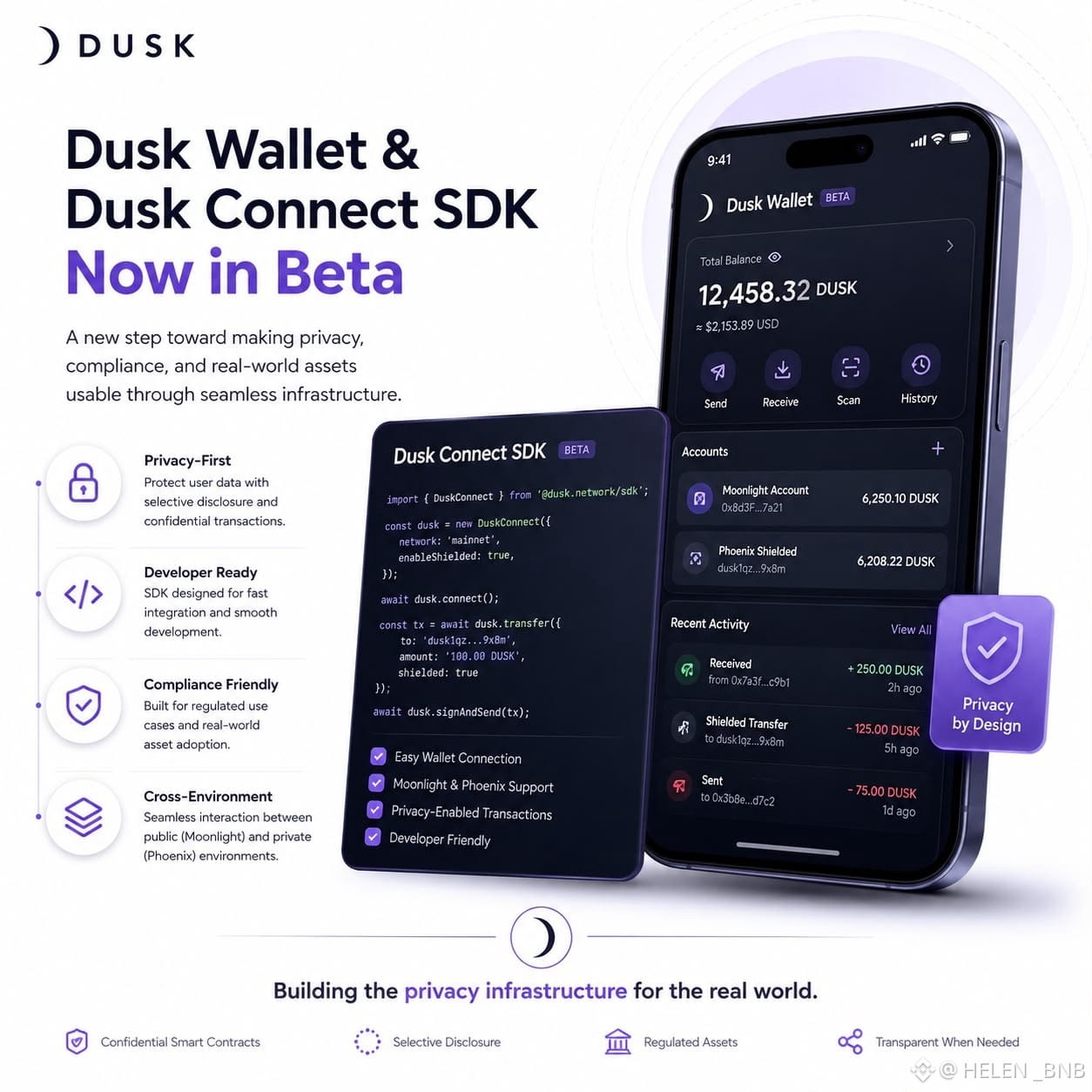
I went looking at the Dusk Wallet beta expecting the interesting part to be the wallet itself. I ended up paying more attention to Dusk Connect.
That changed how I see the release..
A wallet is mostly a user facing layer. Connect is where the harder coordination problem starts: how applications actually interact with Dusk accounts signatures and privacy enabled transactions without every developer rebuilding that plumbing independently.
That matters because Dusk’s architecture already separates different transaction environments. Moonlight handles the account based side while Phoenix introduces shielded notes and nullifiers. Add selective disclosure on top and the developer experience can become complicated very quickly.
The SDK therefore looks less like a convenience package and more like an attempt to compress that complexity into a usable interface.
The beta stage is important here. Documentation can describe how privacy works but only real developers integrating wallets and applications expose the friction: signing flows transaction construction account handling error states compatibility issues and everything that happens between a user clicking “confirm” and the network accepting the transaction.
I also think this connects to Dusk’s broader regulated asset thesis. Privacy only becomes useful at scale if applications can actually use it without forcing every integration to understand the underlying cryptographic machinery.
So I’m watching the beta less for the number of wallets created and more for what developers manage to build around it.
If Dusk Connect reduces enough operational friction the architecture becomes easier to access. And that may ultimately matter more than another feature announcement: infrastructure only becomes valuable when developers stop noticing the infrastructure.
I went looking at the Dusk Wallet beta expecting the interesting part to be the wallet itself. I ended up paying more attention to Dusk Connect.
That changed how I see the release..
A wallet is mostly a user facing layer. Connect is where the harder coordination problem starts: how applications actually interact with Dusk accounts signatures and privacy enabled transactions without every developer rebuilding that plumbing independently.
That matters because Dusk’s architecture already separates different transaction environments. Moonlight handles the account based side while Phoenix introduces shielded notes and nullifiers. Add selective disclosure on top and the developer experience can become complicated very quickly.
The SDK therefore looks less like a convenience package and more like an attempt to compress that complexity into a usable interface.
The beta stage is important here. Documentation can describe how privacy works but only real developers integrating wallets and applications expose the friction: signing flows transaction construction account handling error states compatibility issues and everything that happens between a user clicking “confirm” and the network accepting the transaction.
I also think this connects to Dusk’s broader regulated asset thesis. Privacy only becomes useful at scale if applications can actually use it without forcing every integration to understand the underlying cryptographic machinery.
So I’m watching the beta less for the number of wallets created and more for what developers manage to build around it.
If Dusk Connect reduces enough operational friction the architecture becomes easier to access. And that may ultimately matter more than another feature announcement: infrastructure only becomes valuable when developers stop noticing the infrastructure.