
Is Binance valid, legal, and reliable in India in 2026?
If you're asking “Is Binance legit?”, the short answer is yes, Binance is a legitimate cryptocurrency exchange, but being “legit” doesn't mean being risk-free.
I don't judge Binance solely based on its size or reputation. I looked at the aspects that really matter: its legal history, regulatory status, security controls, Proof of Reserves, KYC/AML framework, custody of user assets, customer complaints, and current product availability.
One point is particularly important for Indian users in 2026: Binance's regulatory status and available products largely depend on its compliance with India's evolving crypto framework. Binance's experience in India depends on its proactive coordination with local financial authorities and tax regulations.
Summary: Binance is a genuine, large-scale cryptocurrency exchange with adequate infrastructure, published Proof of Reserves, comprehensive security controls, and a long operating history. However, Binance also has a significant regulatory enforcement history, including a 2023 US criminal settlement. I would consider it a legitimate exchange, but I would not consider it risk-free or assume that every Binance product is legally available everywhere.
>> Sign up for a Binance account and get 45% off trading fees + 100 USD voucher
Is Binance legit?
Is Binance a real company?
Yes. Binance is a genuine cryptocurrency exchange and infrastructure company that provides trading, custody, payments, and other crypto-related services.
The exchange was founded in 2017 and has grown to become one of the world's largest cryptocurrency trading platforms. The U.S. Department of Justice, in its 2023 case, described Binance as the world's largest cryptocurrency exchange at the time.
Its ecosystem extends far beyond a basic buying and selling exchange. Depending on the user's jurisdiction, Binance offers the following products:
Spot Trading
Futures
Margin
Options
P2P
Copy Trading
Trading Bots
Arn Products
Web3 services
Wallet Functionality
So there is very little ambiguity as to whether Binance is a genuine operating business or not.
The more useful question is whether you should rely on it for your particular use case.
Is Binance a scam?
Based on the available evidence, I do not consider Binance a scam.
However, there is a significant difference between Binance itself and the fake websites, apps, emails, social-media accounts, and customer-support accounts that pretend to be Binance.
Crypto users are often targeted by impersonation scams. Someone claiming to be "Binance Support" on Telegram, WhatsApp, X, or any other platform is not automatically connected to Binance.
Additionally, Binance has faced actual regulatory enforcement actions. These shouldn't be ignored just because the platform is still operating.
A regulatory violation is serious, but it's different from saying that the entire exchange is a fraudulent operation.
>> Read More:How to Register on Binance to Get 45% Fee Discount + 100 USD Welcome Voucher
Is Binance trustworthy?
I would describe Binance as: established but not beyond scrutiny.
My assessment depends on several factors:
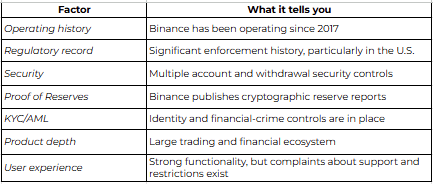
Factors What it tells you Operational history Binance has been operating since 2017 Regulatory record Significant enforcement history, particularly in the US Security Numerous account and withdrawal security controls Proof of Reserves Binance publishes cryptographic reserve reports KYC/AML Identity and financial-crime controls in place Product depth Large trading and financial ecosystem User experience Strong functionality, but complaints exist about support and restrictions
The biggest caveat isn't that Binance isn't regulated, but rather that its regulatory history has been complex, including serious US enforcement actions in 2023.
This must be part of any honest Binance review.
Is Binance safe to use?
It could be, but I wouldn't reduce it to a simple yes or no.
There are at least five different risks to distinguish:
Exchange security: How well Binance protects its infrastructure.
Account security: How well you protect your login, 2FA, passkeys, and withdrawal settings.
Custody risk: The fact that assets held on a centralized exchange are not under your direct control.
Market risk: Crypto prices can fall quickly, no matter how secure the exchange is.
User responsibility: A phishing attack, incorrect wallet address, or leaked authentication code can still cause losses.
That's why my answer is "reasonably safe, with meaningful safeguards," not "completely safe."
>> Sign up for a Binance account and get 45% off trading fees + 100 USD voucher
Why is Binance considered legit?
Binance is an established cryptocurrency exchange
Binance has been operating since 2017 and has built a huge trading ecosystem.
Longevity alone doesn't prove an exchange is safe. We've seen large crypto companies fail even after years of operation. However, Binance's ability to scale and continue to operate demonstrates a solid operational infrastructure behind the platform.
Binance operates through regulated and jurisdiction-specific entities
This is where many online Binance articles become misleading.
Binance does not have a single universal regulatory status that applies equally around the world.
Its institutions, registrations, licenses, and available products vary by jurisdiction. Therefore, simply stating "Binance is regulated" without naming the country is incomplete.
Binance has KYC and AML controls in place
Binance requires identity verification for many services and jurisdictions and maintains AML controls to identify suspicious transactions and financial activity.
This matters because an exchange handling billions of dollars worth of crypto transactions cannot operate as a completely anonymous marketplace.
Binance says its financial-crime controls include transaction monitoring, fraud prevention, account restrictions, and cooperation with law enforcement. (Binance Academy)
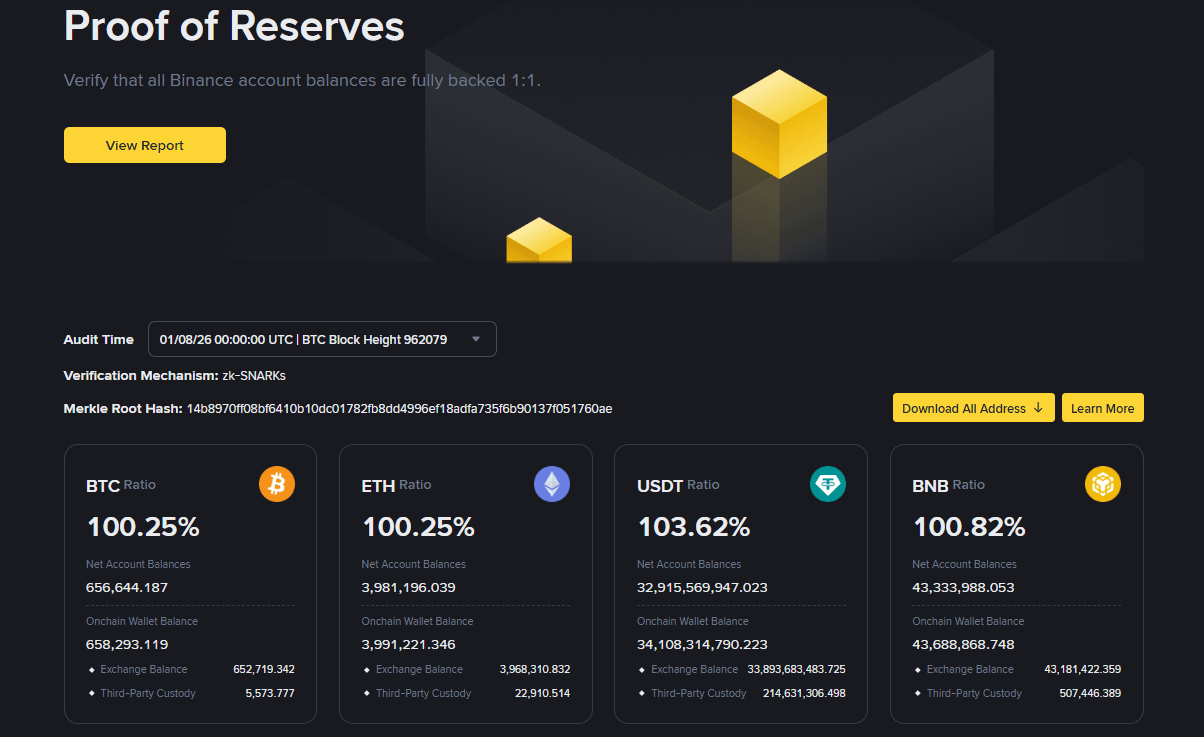
Binance publishes Proof of Reserves
Binance publishes Proof of Reserves reports that allow users to verify that their account balance is included in the reported reserve calculation.
Its current PoR methodology uses cryptographic techniques including Merkle trees and zero-knowledge proofs. Binance also states that users can independently verify whether their balance is included in the published snapshot.
This is useful evidence of transparency.
But this is not a magical certificate that says “Binance cannot fail.”
I'll explain this limitation in more detail below.
Binance has a large global user base and trading ecosystem
Binance's scale is another reason why it is viewed differently from a smaller, unknown exchange.
It has a comprehensive product ecosystem, large trading markets, P2P functionality, derivatives, automation tools, and Web3 services.
Scale doesn't eliminate risk. However, it does mean we're evaluating a mature, operational platform, not a newly launched exchange with little history.
>> Read More:How to Register on Binance to Get 45% Fee Discount + 100 USD Welcome Voucher
Is Binance regulated in India?
Where is Binance regulated?
According to the regulatory landscape in 2026, offshore exchanges are required to comply with strict local laws. For Indian users, Binance's legality and operational status depend on its registration with the Financial Intelligence Unit - India (FIU-IND) and its strict adherence to the Prevention of Money Laundering Act (PMLA), as well as local AML requirements.
Does Binance have regulatory licenses?
Binance and its affiliates have obtained regulatory registrations and licenses in various jurisdictions.
But this does not mean that Binance holds every kind of financial license in every country.
This distinction becomes especially important when it comes to derivatives, securities-related products, fiat services, and custody.
Why Binance's regulatory status varies by country
Crypto regulation is not globally standardized.
One country may allow crypto derivatives while another may prohibit them. One jurisdiction may require a specific exchange license while another uses a registration framework.
As a result, Binance can offer futures to one user while restricting the same product to another.
Are Binance products available everywhere?
No.
Product availability may vary depending on the following:
Country
local regulation
User verification status
Product Type
Binance organization serving the customer
Local banking and payment systems
So if you're considering Binance, don't just stop there: "Can I access Binance?"
The better question is:
“Can I legally and practically use the specific Binance products I need?”
Binance and KYC requirements
KYC means Know Your Customer.
Binance uses identity verification as part of its compliance framework. Depending on the jurisdiction and service, you may be required to submit identification documents and possibly additional information. (Binance Academy)
Binance and AML compliance
AML stands for Anti-Money Laundering.
Binance's AML framework is designed to identify suspicious transactions and prevent the platform from being used for money laundering, sanctions evasion, and related financial crimes.
Interestingly, AML compliance is also one of the reasons why legitimate users may sometimes face account reviews or withdrawal restrictions.
What the regulation means for Binance users
Regulation can provide oversight, but it doesn’t turn cryptocurrencies into risk-free assets.
A regular exchange may nevertheless have:
Trading Losses
Security incidents
Account Restrictions
service interruption
Product Restrictions
Custody Risk
Think of regulation as a layer of protection and accountability, not a guarantee.
Binance's Legal and Regulatory History
This is the section I wouldn't skip if you're seriously asking if Binance is legit.
What happened to Binance in 2023?
November 21, 2023 was a major turning point.
The US Department of Justice announced that Binance Holdings pleaded guilty to federal charges related to violations of the Bank Secrecy Act, failure to register as a money-transmitting business, and violations of the International Emergency Economic Powers Act. Binance agreed to pay approximately $4.3 billion in fines and forfeitures and accepted ongoing compliance requirements and independent monitoring.
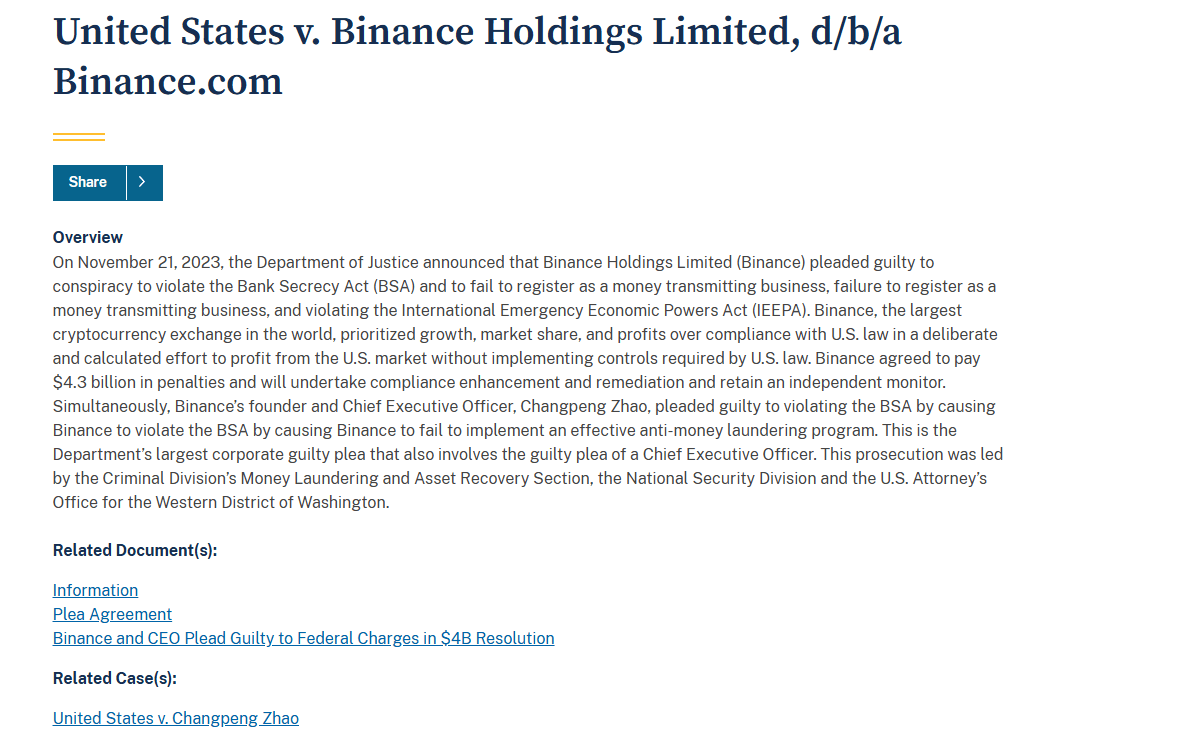
This is no minor regulatory warning.
This is one of the most important legal events in Binance's history.
Binance's US legal case
The 2023 DOJ settlement was not the only US legal action involving Binance.
In June 2023, the SEC filed 13 charges against Binance entities and Changpeng Zhao. The charges included operating an unregistered exchange, broker-dealer, and clearing agency, as well as other securities-law violations.
Importantly, the SEC's case should be characterized as an enforcement action and allegation, not as evidence that every allegation was ultimately proven in court.
The SEC and the defendants subsequently agreed to dismiss that civil enforcement case with prejudice in May 2025.
What did Binance plead guilty to?
According to the DOJ, Binance pleaded guilty to the following:
Conspiracy to violate the Bank Secrecy Act.
Failure to register as a money-transmitting business.
Violation of the International Emergency Economic Powers Act.
The DOJ said Binance had prioritized growth and market share above compliance with US law.
How much did Binance pay in fines?
Binance was required to pay approximately $4.3 billion in fines and forfeitures under the DOJ settlement.
This amount included criminal fines and forfeitures associated with the settlement.
What happened to Changpeng Zhao?
Binance founder and then-CEO, Changpeng Zhao, also pleaded guilty in the US to Bank Secrecy Act violations related to Binance's failure to maintain an effective AML program.
He resigned as Binance CEO as part of a 2023 agreement.
What changed after the 2023 agreement?
The agreement required Binance to take compliance improvements and remedial steps and operate under an independent monitor.
From a user perspective, the most important thing is that Binance's compliance framework today should not be evaluated as if nothing happened in 2023.
The company was forced to make significant compliance changes.
Does Binance's Legal History Make It a Scam?
No, but it does mean you should take its compliance history seriously.
These are two different conclusions: regulatory violations ≠ not automatic proof that an exchange is a scam.
Also: a legitimate exchange may still have committed serious regulatory violations.
I think both things should be discussed together in the same discussion.
Ignoring Binance's $4.3 billion US settlement would be misleading. Calling Binance a scam solely because of that settlement would also be oversimplifying the evidence.
Is Binance safe?
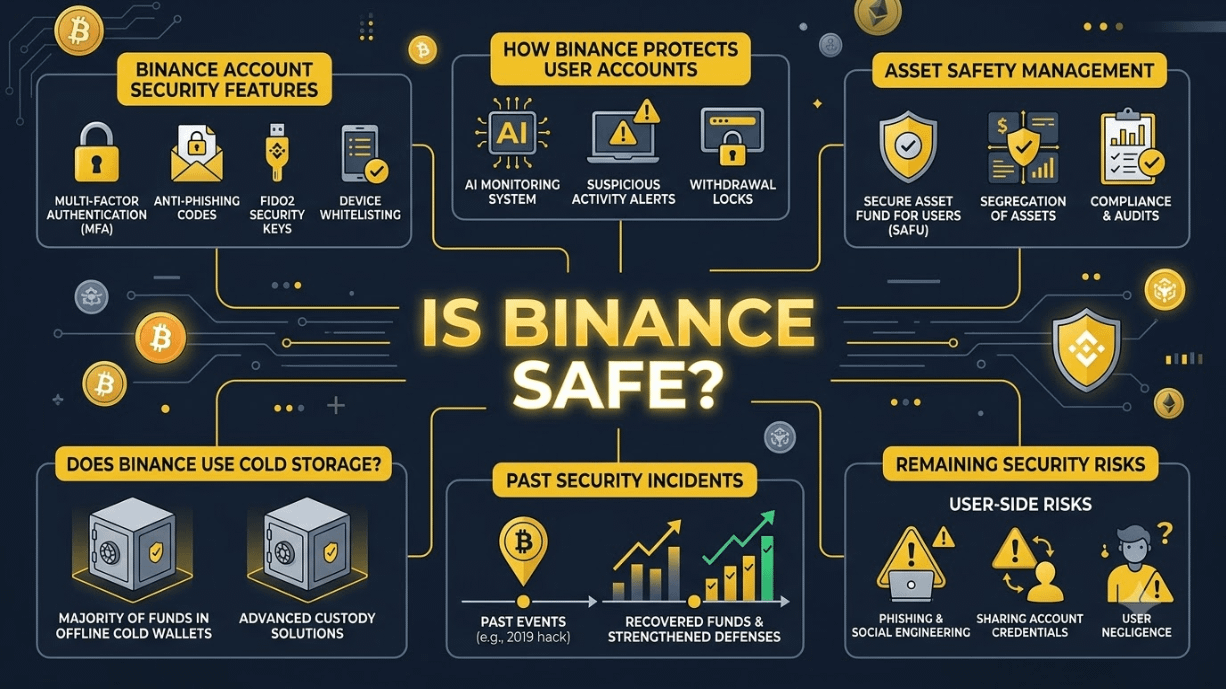
Binance Account Security Features
Binance offers several security tools, including:
Two-factor authentication.
Passkeys.
Hardware security keys.
Anti-phishing protection.
Withdrawal Address Whitelisting.
Device and account monitoring.
Withdrawal whitelisting is particularly useful. Binance says that withdrawals to addresses not included in your whitelist may be blocked, while newly added addresses may undergo a 24- to 48-hour waiting period before becoming active. (Binance Academy)
This additional delay may seem annoying when you want to transfer funds quickly. However, from a security perspective, it can give you time to notice an unauthorized address change.
How Binance protects user accounts
The basic idea is layered security.
Instead of relying solely on passwords, Binance gives users additional authentication and withdrawal controls.
I strongly recommend using at least these:
A unique password.
2FA or a passkey.
Anti-phishing protection.
Withdrawal Address Whitelisting.
Device/Account Monitoring.
How Binance manages user asset security
Binance uses a combination of custody infrastructure, wallet control, risk monitoring, and its SAFU Emergency Fund.
The Secure Asset Fund for Users (SAFU) was established in 2018 as an emergency fund aimed at protecting users in extreme situations.
It's a useful extra layer, but I wouldn't think of SAFU as traditional deposit insurance.
Does Binance use cold storage?
Binance uses cold-wallet infrastructure for custody and security purposes, including its SAFU arrangements.
Cold storage means that private keys are kept offline rather than constantly exposed to internet-connected systems.
This can mitigate some attack vectors, although it does not eliminate operational or custody risk.
Has Binance ever faced security incidents?
Yes.
Binance has faced security incidents throughout its history. A notable example was a 2019 security breach in which approximately 7,000 BTC were stolen from the exchange's hot wallet.
This incident is important because it shows that “Binance is safe” should never be interpreted as “Binance can never be hacked.”
Binance had established SAFU before that incident, in 2018, as an emergency fund for user protection. (Binance Academy)
What security risks still exist for users?
Binance Security ≠ Zero Risk
You still have to deal with these:
Phishing
Account Takeover
social engineering
Wrong-Address Withdrawal
Compromised devices
Leverage and Liquidation
Custody Risk
In other words, Binance can protect its infrastructure extremely well and you can still lose money by approving a wrong transaction.
Binance Proof of Reserves Explained
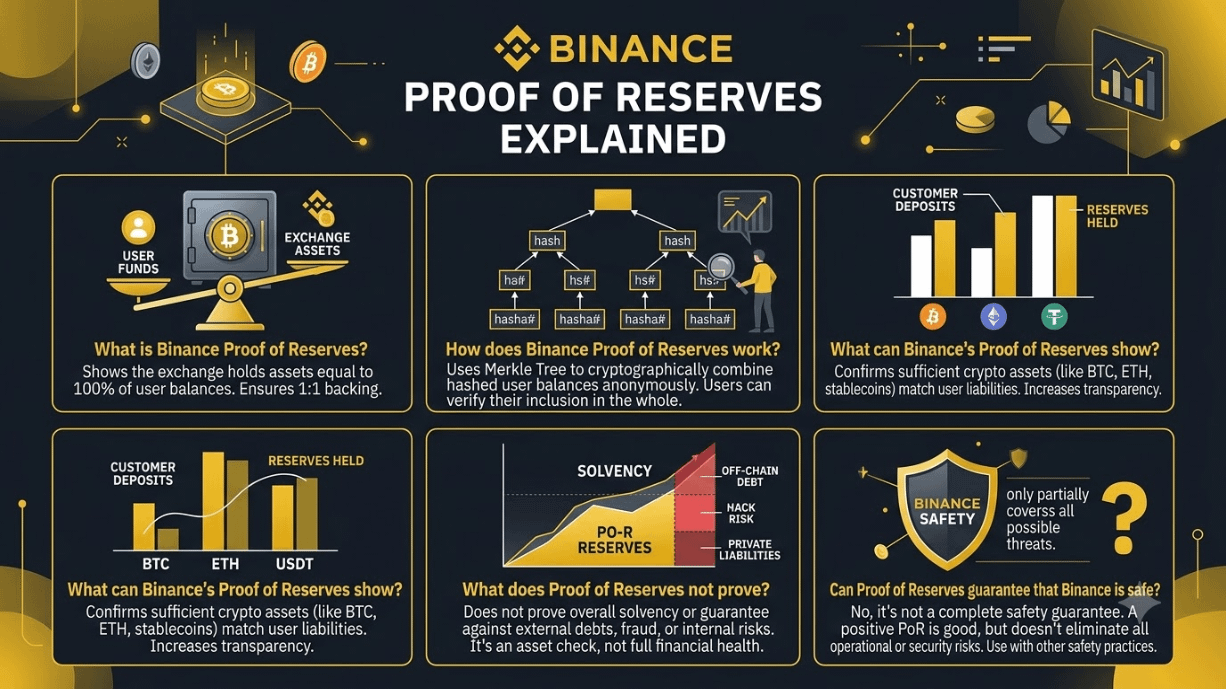
What is Binance Proof of Reserves?
Proof of Reserves, or PoR, is a system that allows a crypto exchange to demonstrate that it has sufficient on-chain assets to cover reported customer balances.
Binance's current PoR method uses cryptographic verification including Merkle trees and zero-knowledge proofs.
How does Binance Proof of Reserves work?
At a high level:
User Balance → Cryptographic Structure → Published Proof → Wallet/Reserve Verification
A Merkle tree allows individual users to verify that their balance is included, without exposing everyone else's account information.
Binance also describes the methods used to verify control over reserve addresses, which include cryptographic signatures and blockchain verification.
What can Binance's Proof of Reserves show?
The PoR can provide evidence that:
User balances included in a specific snapshot.
Binance controlled the associated wallet addresses.
At that time, reported reserves equaled or exceeded some customer-asset balances.
This is meaningful transparency.
What does Proof of Reserves not prove?
This is where some crypto articles go too far.
PoR does not automatically prove:
Binance has no liability outside the PoR scope.
Binance can never go bankrupt.
Binance cannot be hacked.
Your account cannot be frozen.
Binance will never have operational problems.
The value of your crypto holdings can never drop.
Binance itself acknowledges that PoR is a snapshot of a specific point in time and does not verify off-chain liabilities. (Binance Academy)
Can Proof of Reserves guarantee that Binance is safe?
No.
The correct relation is:
Proof of Reserves → Proof of Transparency
Not this:
Proof of Reserves → Guaranteed solvency and zero risk
This difference is extremely important.
Can Binance freeze your account?
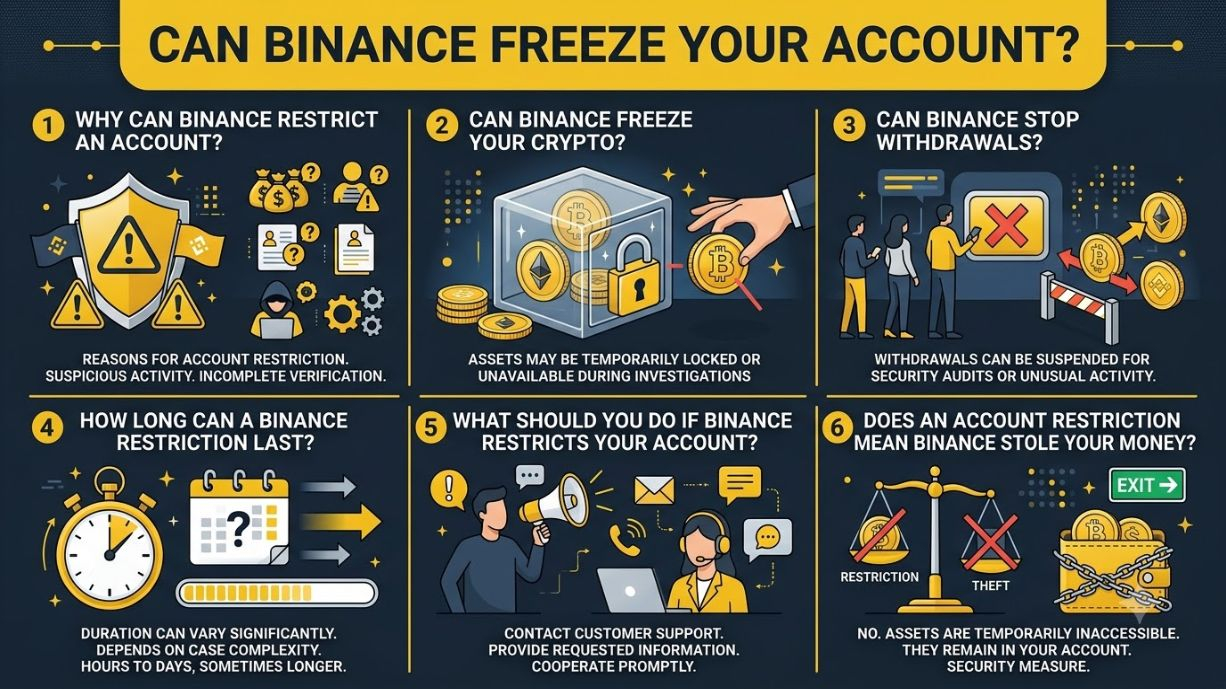
Why might Binance ban an account?
An account can potentially be banned for the following reasons:
KYC related problems.
AML Review.
suspicious activity.
Sanctions screening.
Security concerns.
legal requirements.
This doesn't necessarily mean the user did something wrong.
Automated risk systems can flag transactions that require subsequent human review.
Can Binance freeze your crypto?
Binance may restrict access to assets held in a custodial account if required by applicable law, compliance procedures, security checks, or platform rules.
The exact cause and duration depend on the circumstances.
Can Binance block withdrawals?
Yes, withdrawals may be temporarily restricted.
This may occur during security reviews, compliance checks, technical issues, maintenance, or other circumstances.
How long could Binance's ban last?
There is no universal timeframe for this.
A simple verification issue may be resolved relatively quickly, while a complex compliance check may take significantly longer.
This is one of the biggest practical differences between holding crypto on an exchange and holding it in a self-custody wallet.
What should you do if Binance bans your account?
Keep your conversation factual and organized.
I would recommend having ready:
Your account information.
Transaction ID.
Deposit/Withdrawal Details.
Verification documents requested by Binance.
Screenshots.
Previous support case number.
Then use Binance's official support channels rather than anyone calling themselves "Binance Support" via an unofficial messaging account.
Does an account ban mean Binance stole your money?
No.
A banned account and stolen funds are not the same thing.
An account may be restricted as part of a compliance or security review. This does not indicate that Binance has taken ownership of your assets.
Also, a long-lasting ban is a legitimate concern for the affected user and should not be simply dismissed.
Is Binance safe to store crypto?
Binance as a crypto custodian
When you hold crypto on Binance, Binance controls the custody infrastructure and you access your assets through your account.
it is convenient.
You don't need to manage seed phrases or individually secure private keys.
But you also don't have direct control over those private keys.
Exchange Custody vs. Self-Custody
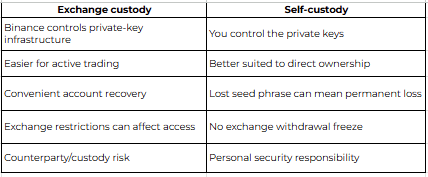
Exchange custodySelf-custodyBinance controls the private-key infrastructureYou control the private keysEasier for active tradingMore suitable for direct ownershipConvenient account recoveryLosing the seed phrase can mean permanent lossExchange restrictions can affect accessNo exchange withdrawal freezeCounterparty/custody riskPersonal security responsibility
No option is automatically safer for everyone.
Binance Wallet vs. Exchange Custody
Do not confuse a Binance exchange account with a self-custody Web3 wallet.
An exchange balance is part of Binance's custodial infrastructure.
A self-custody wallet gives you control over the private keys.
This distinction becomes extremely important if your goal is long-term storage rather than active trading.
Should you keep all your crypto on Binance?
I would not recommend keeping 100% of your long-term crypto portfolio on any centralized exchange.
This is not a criticism of Binance specifically.
This is basic counterparty-risk management.
If you trade actively, it's wise to maintain a working balance on the exchange. For long-term holdings, some users prefer to keep some of their assets in self-custody.
When should you consider self-custody?
It is appropriate to consider self-custody if:
You've been holding crypto for years.
You understand seed-freeze protection.
You don't need constant Exchange access.
You are comfortable managing your own wallet security.
But don't move funds into self-custody just because someone told you “not your keys, not your crypto.”
If you lose your seed phrase, no Binance support agent can easily reset it for you.
What do users say about Binance?
What do positive Binance reviews say?
Looking at current user reviews, recurring positive themes include:
Competitive fees.
Large property selection.
P2P functionality.
Extensive trading tools.
Large product range.
Strong liquidity in key markets.
These themes are also reflected in recent Trustpilot reviews. For example, one recent reviewer praised Binance's low fees, large coin selection, and P2P functionality, while criticizing its slow customer support.
This combination is worth noting: a user can really like the platform and still be unhappy with the support.
What do negative Binance reviews say?
Frequent complaints are different:
Customer support.
Account restrictions.
Verification problems.
Delay in withdrawal.
Slow reactions.
Difficulty solving complex cases.
Current Trustpilot reviews include several recent complaints about long account bans, verification issues, withdrawal delays, and support responses.
I wouldn't consider every complaint to be evidence that Binance did something wrong. A public review usually only shows one side of the dispute.
But when the same complaint appears repeatedly across multiple reviews, it becomes relevant as a user-experience signal.
What do Binance Trustpilot reviews show?
Trustpilot requires some careful reading here.
At the time I checked, Binance's main Trustpilot profile showed 6,155 reviews, but Trustpilot also displayed a warning that the company's rating was unavailable due to guideline violations, and said it had removed several fake reviews.
This means I wouldn't just quote a Trustpilot score and call it Binance's "real reputation."
Useful information is in the pattern:
Positives: Fees, product range, P2P, trading functionality.
Negative topics: support, verification, account restrictions, withdrawals.
Limitation: The review ecosystem itself has quality and selection issues.
Can you trust Binance reviews online?
Not indiscriminately.
There are several reasons for this:
Fake reviews: Some platforms detect and remove obviously fraudulent reviews.
Peak experiences: People are more likely to write reviews when something is very good or very bad.
Selection bias: A satisfied trader may never leave a review.
Age of review: A complaint from 2022 may describe a very different product from the one you use today.
Regional differences: A user's experience with Binance can depend heavily on their country and the products available.
So I use reviews to identify recurring problems, not to calculate an accurate “trust score.”
Is Binance legal in my country?
Why Binance availability varies by country
Crypto regulation is local.
Binance has to consider the laws that apply to the markets it serves. This is why a product may be accessible in one country while not in another.
Binance and local regulation
The relevant question is not only whether cryptocurrencies are legal or not.
You also need to consider whether:
Binance is allowed to operate on its own.
Crypto trading is allowed.
Derivatives are allowed.
Fiat deposits are supported.
P2P trading is available.
Specific tokens or products are restricted.
Restricted countries and regions
Binance maintains geographical restrictions and does not provide the same services to every jurisdiction.
These restrictions may change as regulations change.
For this reason, I won’t copy a list of “Binance Restricted Countries” from an old article and assume it’s still accurate.
How to check Binance availability in India (2026)
The safest approach is to verify Binance's FIU-IND compliance status and ensure its app or URL are not restricted by the Ministry of Electronics and Information Technology (MeitY). Always check Binance's official terms and local banking support (such as UPI fiat channels) for Indian residents before depositing funds.
Why the same Binance product can't be available everywhere
Products may be subject to completely different regulatory treatment.
For example, spot crypto trading may be available while derivatives are restricted. Fiat services may also depend on relationships with local banks and payment providers.
So:
Being available on Binance ≠ having every Binance product available.
FAQs (FAQ)
Is Binance Legit or Scam?
Binance is a legitimate cryptocurrency exchange. However, it has a complex regulatory history and should not be considered risk-free.
Is Binance a legit crypto exchange?
Yes. Founded in 2017, Binance is an established exchange with a large global trading ecosystem.
Is Binance safe?
Binance has adequate security controls, but exchange custody, phishing, account compromise, market losses, and other risks still exist.
Is Binance regulated?
Binance's regulatory status depends on the jurisdiction and the specific Binance entity serving you.
Is Binance legal in India?
Until 2026, using Binance in India is considered legal, provided the platform maintains its FIU registration, and users meet their 1% TDS (Tax Deducted at Source) and 30% flat tax obligations on crypto profits under Indian tax laws.
Can Binance freeze your account?
Yes. Accounts may be restricted for compliance, security, KYC, AML, sanctions, or legal reasons.
Can Binance freeze your crypto?
Access to assets in a custodial account may be restricted under certain compliance, security, or legal circumstances.
Does Binance have Proof of Reserves?
Yes. Binance publishes Proof of Reserves reports using cryptographic verification methods. (Binance Academy)
Has Binance ever been hacked?
Yes. Binance experienced a major security breach in 2019 involving approximately 7,000 BTC.
Has Binance ever been fined?
Yes. In 2023, Binance agreed to a US settlement involving approximately $4.3 billion in fines and forfeitures.
Does Binance require KYC?
KYC is required for many Binance services and jurisdictions, the exact requirements depend on the user's circumstances.
Can I trust Binance with my crypto?
You can use Binance as a custodian, but I wouldn't put every long-term holding on any centralized exchange.
Is Binance safe for beginners?
It can be, especially for basic spot trading, but Binance's large number of products can overwhelm someone completely new to crypto.
Is Binance available in my country?
Availability depends on your jurisdiction. Please check Binance's current regional terms and product availability before registering or making a deposit.
Is Binance better than Coinbase?
Neither is universally superior. Binance generally offers comprehensive trading functionality, while Coinbase may be more appealing if you prioritize simplicity and its regulatory status in supported markets.
What are the safest alternatives to Binance?
Coinbase, Kraken, OKX, and Bybit are among the major options worth comparing, but the “safest” depends on your country, products, custody preferences, and regulatory requirements.
Final Verdict: Is Binance Legit?
After separating marketing claims from anecdotal evidence, my conclusion is quite clear:
Yes, Binance is legit.
It is a genuine, established cryptocurrency exchange with extensive infrastructure, large-scale trading activity, KYC/AML controls, security mechanisms, and published Proof of Reserves.
But I would keep three things in mind before depositing money.
First, Binance has a serious legal history. A 2023 US settlement included a guilty plea and approximately $4.3 billion in fines and forfeitures.
Second, regulation is jurisdiction-specific. You can't assume that Binance has the same legal status or offers the same products in every country.
Third, exchange security is not the same as personal financial security. Binance can protect its infrastructure, but it cannot eliminate the risks of phishing, account compromise, leverage losses, wrong-address transfers, or leaving assets with a centralized custodian.
So if you're using Binance for active trading, I'd focus on security settings, fees, liquidity, and checking if the products you need are available in your jurisdiction.
If you plan to hold crypto for years, I would think more carefully about custody and whether it makes sense to keep the entire portfolio on a centralized exchange.
Legitimate? Yes. Risk-free? Absolutely not.