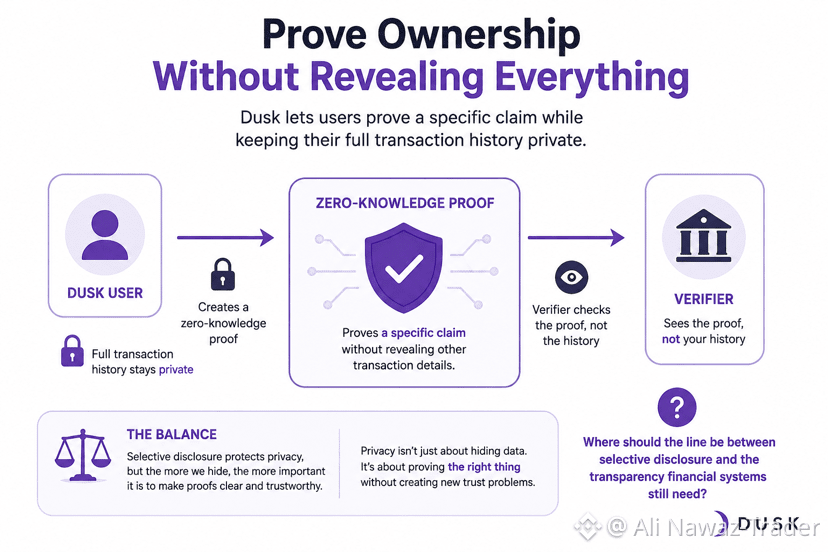

The useful part of Dusk’s privacy design, to me, is that proving ownership doesn’t have to mean opening your whole financial history.
With selective disclosure and zero-knowledge proofs, a user can prove a specific claim while keeping unrelated transaction details private. That sounds simple, but there’s a real trade-off: the more selectively information is revealed, the more important it becomes to make those proofs understandable and trustworthy to whoever is checking them.
Privacy isn’t just about hiding data. It’s also about proving the right thing without creating a new trust problem.
So where should the line be between selective disclosure and the transparency financial systems still need?
#dusk $DUSK @Dusk
With selective disclosure and zero-knowledge proofs, a user can prove a specific claim while keeping unrelated transaction details private. That sounds simple, but there’s a real trade-off: the more selectively information is revealed, the more important it becomes to make those proofs understandable and trustworthy to whoever is checking them.
Privacy isn’t just about hiding data. It’s also about proving the right thing without creating a new trust problem.
So where should the line be between selective disclosure and the transparency financial systems still need?
#dusk $DUSK @Dusk