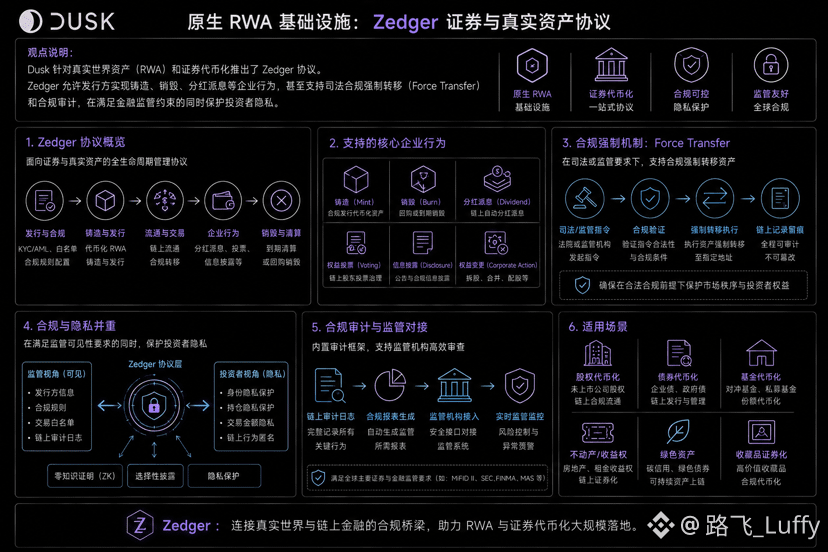
After watching too many projects in the RWA track, I noticed a pattern—most teams think that once they move assets on-chain, they’re done. It’s as if tokenization itself is the end goal. But anyone who has dealt with traditional finance knows that issuance is only the first step. After that come all sorts of corporate actions like dividends, stock splits, forced buybacks, and even judicial freezes. Those are the messy, real-world things that keep institutional legal teams up at night. While reviewing Zedger’s protocol in @Dusk , I could tell it has clearly been tortured by these exact issues.
Zedger isn’t just a token-issuing tool. It bakes the dirty work across the entire securities lifecycle into the protocol layer. Minting and burning are the basic operations, and on-chain dividend and coupon payments can be executed automatically—saving the traditional issuance-and-settlement back-and-forth reconciliation process. But what really made me look twice is Force Transfer—judicial-compliant forced transfer. In plain terms: once a court rules or regulators require it, the issuer can directly move the tokens from one address to another on-chain.
Sure, this feature will definitely get criticized in crypto circles: “Where’s decentralization? Where’s immutability?” But think about it calmly—securities work exactly like this. If a court freezes your brokerage account, the broker has to execute. That’s not some evil design; it’s a prerequisite for financial markets to function. Dusk didn’t pretend this need doesn’t exist. Instead, it made it a native protocol capability, and used Phoenix’s privacy layer to protect investors from having their position details exposed to unrelated parties. Compliance is compliance, privacy is privacy—handle them separately. #dusk
But here’s the problem. Who gets the authority to trigger Force Transfer? How do you prevent abuse? Once a forced transfer happens on-chain, if something goes wrong, unlike traditional systems, you can’t just route it through internal processes and roll it back. Smart contracts execute, and that’s it. If the boundaries of this power aren’t clearly defined, it will become a reason institutions won’t dare to use it. $DUSK
Can you accept assets being forcibly transferred on-chain, or do you think that fundamentally contradicts the spirit of blockchain?
Zedger isn’t just a token-issuing tool. It bakes the dirty work across the entire securities lifecycle into the protocol layer. Minting and burning are the basic operations, and on-chain dividend and coupon payments can be executed automatically—saving the traditional issuance-and-settlement back-and-forth reconciliation process. But what really made me look twice is Force Transfer—judicial-compliant forced transfer. In plain terms: once a court rules or regulators require it, the issuer can directly move the tokens from one address to another on-chain.
Sure, this feature will definitely get criticized in crypto circles: “Where’s decentralization? Where’s immutability?” But think about it calmly—securities work exactly like this. If a court freezes your brokerage account, the broker has to execute. That’s not some evil design; it’s a prerequisite for financial markets to function. Dusk didn’t pretend this need doesn’t exist. Instead, it made it a native protocol capability, and used Phoenix’s privacy layer to protect investors from having their position details exposed to unrelated parties. Compliance is compliance, privacy is privacy—handle them separately. #dusk
But here’s the problem. Who gets the authority to trigger Force Transfer? How do you prevent abuse? Once a forced transfer happens on-chain, if something goes wrong, unlike traditional systems, you can’t just route it through internal processes and roll it back. Smart contracts execute, and that’s it. If the boundaries of this power aren’t clearly defined, it will become a reason institutions won’t dare to use it. $DUSK
Can you accept assets being forcibly transferred on-chain, or do you think that fundamentally contradicts the spirit of blockchain?