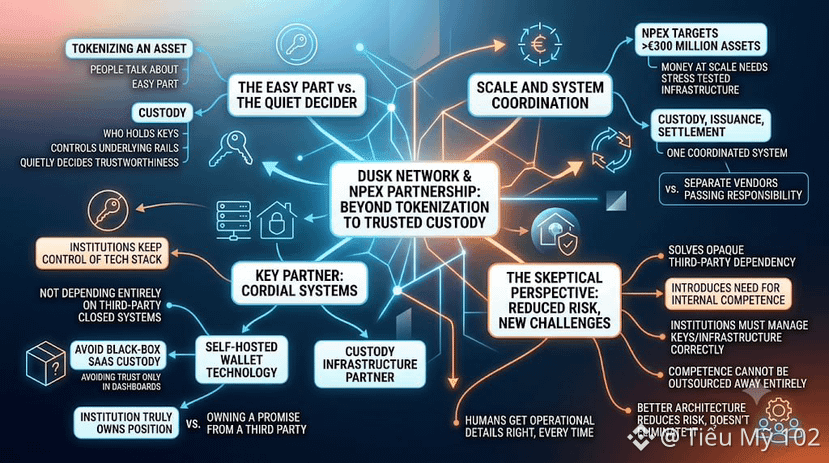
Tokenizing an asset is the easy part people talk about. Custody, who actually holds the keys and controls the underlying rails, is the part that quietly decides whether the whole thing is trustworthy.
Dusk Network's partnership with NPEX doesn't stop at tokenization. It includes Cordial Systems, a custody infrastructure partner providing self-hosted wallet technology, so financial institutions involved in bringing assets onchain through NPEX can keep control of their own technology stack rather than depending entirely on a third party's closed system they can't inspect or verify. That detail matters more than it sounds like on first read.
Cordial's own pitch is specifically about avoiding black-box SaaS custody, the kind where an institution hands its private keys to a vendor's infrastructure and simply has to trust the dashboard. Self-hosted wallet technology keeps that control internal instead. It's a more demanding setup operationally, but it's also the difference between an institution truly owning its position and an institution owning a promise from a third party.
The scale involved makes that custody question sharper too. NPEX is targeting north of 300 million euros in assets eventually moving onto Dusk, and money at that scale doesn't move through infrastructure nobody has stress tested. Custody, issuance, and settlement are meant to function as one coordinated system instead of three separate vendors passing responsibility back and forth whenever something goes wrong.
I'll admit the skeptical part of my brain doesn't fully relax here either. Self-hosted custody solves one trust problem, dependency on an opaque third party, while introducing a different one: institutions now need real internal competence to manage keys and infrastructure correctly, and that competence can't be outsourced away entirely. Better architecture reduces risk. It doesn't eliminate the need for the humans running it to get the operational details right, every single time.
@Dusk $DUSK #dusk