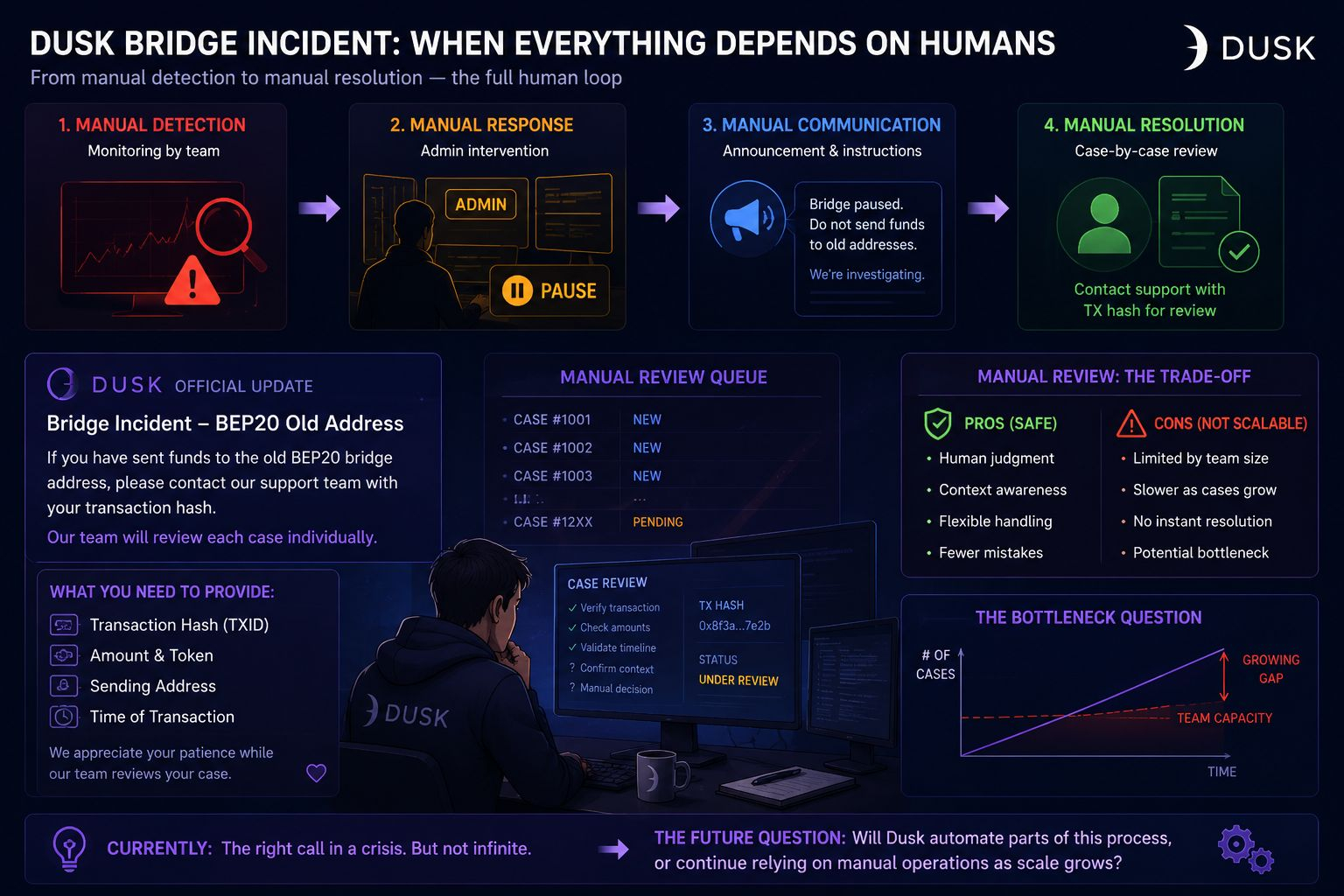
I notice something notable when placing the @Dusk bridge incident bulletin next to a minor operational detail: the team asks users who previously sent funds to an old BEP20 bridge address to contact support with a transaction code so that the “team can review each case.” In other words, the incident remediation process also depends on people manually approving each case, not an automatic refund mechanism.
This is consistent with the bigger picture: the incident is detected through manual monitoring, responses are handled through manual admin permissions, and now the resolution of consequences is also done via manual review. Nothing is wrong in principle—in an emergency, humans handling each specific scenario can be safer than an automatic script that might miss context. But this also means the speed of resolution depends on the support team’s bandwidth, not on a process that can scale as the number of cases increases.
This is a point worth considering about the difference between “safety” and “scalability” in bridge operations. Manual review is a reasonable choice when the number of cases is still small. But if Dusk significantly expands the bridge’s scale in the future—aligned with the institutional direction that the narrative is headed toward—this manual handling model could become a bottleneck once the workload grows many times over.
Self-critique: at the current scale, manual review is entirely reasonable—though the real question is whether this is a temporary solution during the crisis phase.
I’m waiting to see whether $DUSK will publish a plan to partially automate the bridge incident-handling process in the future, or whether they will continue relying on the current manual operations team.
#dusk $BTC $ETH
This is consistent with the bigger picture: the incident is detected through manual monitoring, responses are handled through manual admin permissions, and now the resolution of consequences is also done via manual review. Nothing is wrong in principle—in an emergency, humans handling each specific scenario can be safer than an automatic script that might miss context. But this also means the speed of resolution depends on the support team’s bandwidth, not on a process that can scale as the number of cases increases.
This is a point worth considering about the difference between “safety” and “scalability” in bridge operations. Manual review is a reasonable choice when the number of cases is still small. But if Dusk significantly expands the bridge’s scale in the future—aligned with the institutional direction that the narrative is headed toward—this manual handling model could become a bottleneck once the workload grows many times over.
Self-critique: at the current scale, manual review is entirely reasonable—though the real question is whether this is a temporary solution during the crisis phase.
I’m waiting to see whether $DUSK will publish a plan to partially automate the bridge incident-handling process in the future, or whether they will continue relying on the current manual operations team.
#dusk $BTC $ETH