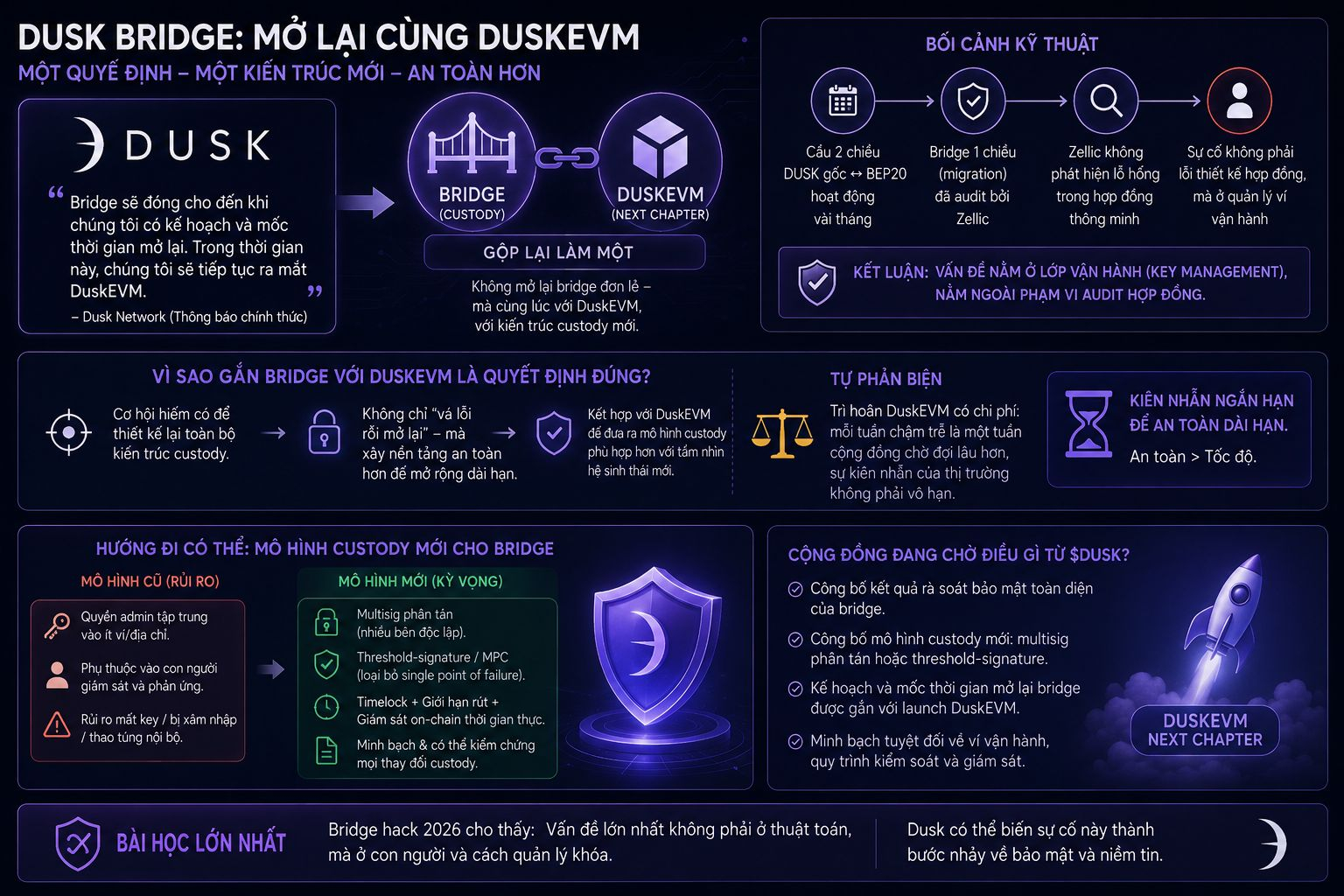
I noticed an important detail when looking at how @Dusk links the reopening of the bridge with DuskEVM itself: the official announcement clearly states that the bridge will remain closed until there is a plan and a timeline for reopening, while also continuing to roll out DuskEVM—meaning these two things are being combined into a single decision, not separate ones.
This is the point that made me pause. At first, one might think the bridge incident is simply an isolated operational issue, and that after fixes are made, it can be reopened as before. But tying it directly to the DuskEVM launch suggests another possibility: the team may be taking this opportunity to redesign the bridge’s entire custody architecture.
If that’s true, then this would be a much more mature response than simply patching and reopening as quickly as possible to reduce public pressure. The technical context is also noteworthy: the two-way bridge between the original DUSK and the new BEP20 has been live only a few months before the incident, and the one-way bridge for migration that has already gone through a Zellic audit found no vulnerabilities. This strengthens the view that the incident was not a smart-contract design flaw; rather, as the announcement suggests, the issue lies in the management of the operational wallets—a layer outside the scope of typical smart-contract audits.
Counterargument: delaying DuskEVM to make the bridge portion more thorough also has its own costs—each week of delay means an extra week for the community waiting for the most important milestone in the recent roadmap, and the market’s patience is not infinite.
I’m waiting to see whether $DUSK will publish a new custody model for the bridge—potentially a more distributed multisig or threshold-signature—not just restoring the exact operational structure from before the incident.
#dusk $BTC $ETH
This is the point that made me pause. At first, one might think the bridge incident is simply an isolated operational issue, and that after fixes are made, it can be reopened as before. But tying it directly to the DuskEVM launch suggests another possibility: the team may be taking this opportunity to redesign the bridge’s entire custody architecture.
If that’s true, then this would be a much more mature response than simply patching and reopening as quickly as possible to reduce public pressure. The technical context is also noteworthy: the two-way bridge between the original DUSK and the new BEP20 has been live only a few months before the incident, and the one-way bridge for migration that has already gone through a Zellic audit found no vulnerabilities. This strengthens the view that the incident was not a smart-contract design flaw; rather, as the announcement suggests, the issue lies in the management of the operational wallets—a layer outside the scope of typical smart-contract audits.
Counterargument: delaying DuskEVM to make the bridge portion more thorough also has its own costs—each week of delay means an extra week for the community waiting for the most important milestone in the recent roadmap, and the market’s patience is not infinite.
I’m waiting to see whether $DUSK will publish a new custody model for the bridge—potentially a more distributed multisig or threshold-signature—not just restoring the exact operational structure from before the incident.
#dusk $BTC $ETH