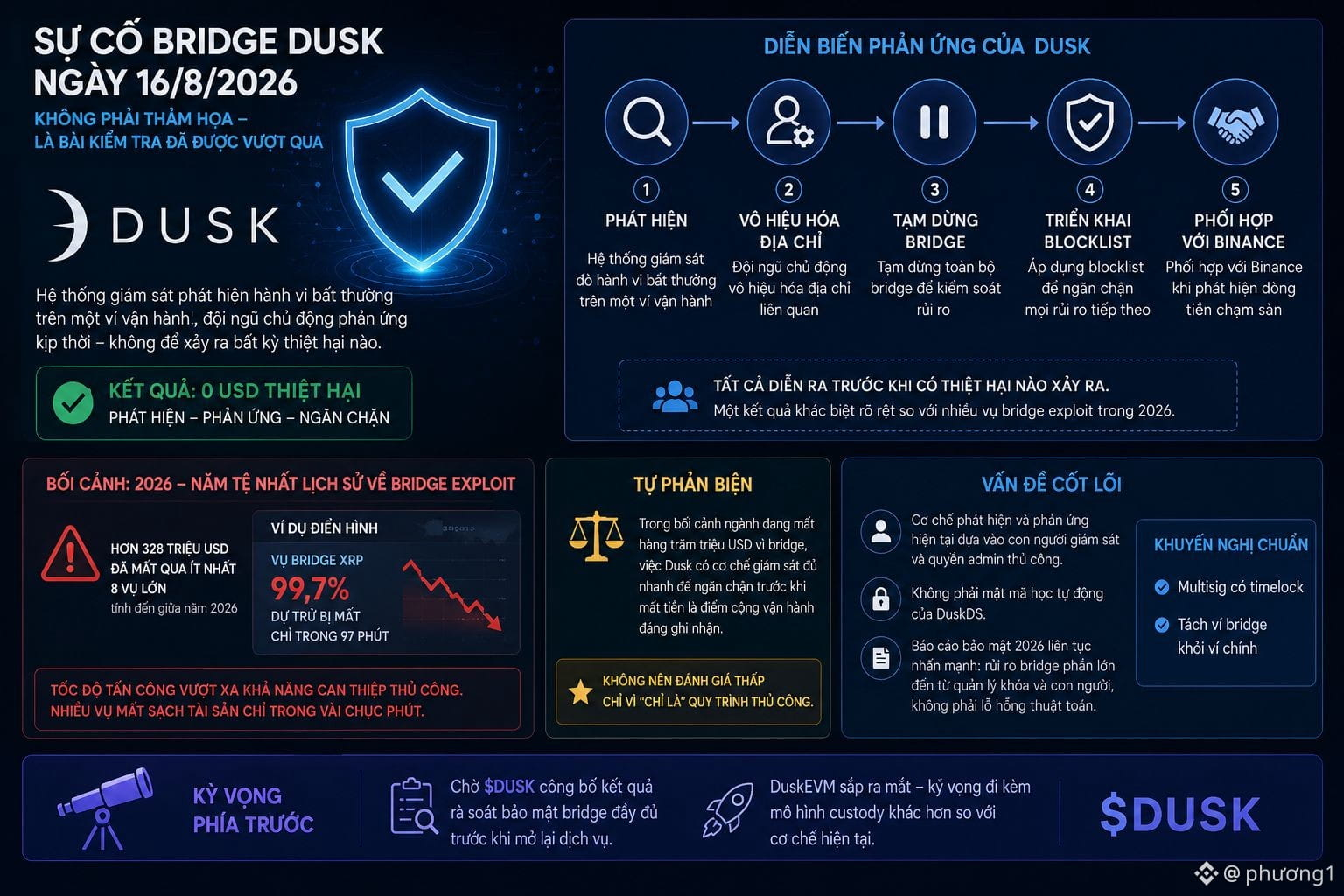
I see something worth putting alongside the bridge incident of 16/8 involving @Dusk —this isn’t an isolated incident, but one that happened amid 2026, the worst year in history for bridge exploits. Over $328 million was lost in at least eight major incidents by mid-year, including the XRP bridge case where 99.7% of reserves were wiped out in just 97 minutes.
Against that backdrop, Dusk’s handling of the incident stands out in a positive way: its monitoring system detected abnormal behavior on an operating wallet, the team proactively disabled addresses, paused the bridge, deployed a blocklist, and coordinated with Binance when it detected flows hitting the floor—everything occurred before any damage took place. Compared with cases where assets were completely drained in just dozens of minutes because the speed outpaced manual intervention.
But what makes me pause is still the old question: the detection and response mechanism relies entirely on human monitoring and manual admin privileges—not on DuskDS’s automated cryptographic defenses. This is exactly the pattern that 2026 security reports repeatedly emphasize: bridge risk largely comes from key management and people, not algorithmic vulnerabilities, and the recommended standard practices remain operational measures like multisig with timelock separation.
Self-reflection: in a context where the industry is losing hundreds of millions of dollars due to bridges, the fact that Dusk has a monitoring mechanism fast enough to stop things before money is lost is a notable operational plus, and shouldn’t be discounted just because it “only” involves a manual process.
I’m waiting to see whether $DUSK will publish a full bridge security audit outcome before the service is reopened, and whether the upcoming DuskEVM launch comes with a different custody model than the current one.
#dusk $BTC $ETH
Against that backdrop, Dusk’s handling of the incident stands out in a positive way: its monitoring system detected abnormal behavior on an operating wallet, the team proactively disabled addresses, paused the bridge, deployed a blocklist, and coordinated with Binance when it detected flows hitting the floor—everything occurred before any damage took place. Compared with cases where assets were completely drained in just dozens of minutes because the speed outpaced manual intervention.
But what makes me pause is still the old question: the detection and response mechanism relies entirely on human monitoring and manual admin privileges—not on DuskDS’s automated cryptographic defenses. This is exactly the pattern that 2026 security reports repeatedly emphasize: bridge risk largely comes from key management and people, not algorithmic vulnerabilities, and the recommended standard practices remain operational measures like multisig with timelock separation.
Self-reflection: in a context where the industry is losing hundreds of millions of dollars due to bridges, the fact that Dusk has a monitoring mechanism fast enough to stop things before money is lost is a notable operational plus, and shouldn’t be discounted just because it “only” involves a manual process.
I’m waiting to see whether $DUSK will publish a full bridge security audit outcome before the service is reopened, and whether the upcoming DuskEVM launch comes with a different custody model than the current one.
#dusk $BTC $ETH