Let’s talk about a topic that a retail investor is very hard to empathize with. On-chain transparency is a virtue for retail traders; for institutions, it’s almost like torture.
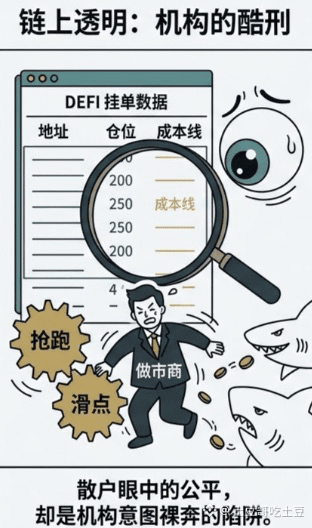
Open the order-book data of any DeFi protocol—addresses, positions, and cost lines are all laid out in full sunlight. Retail investors call that fairness, and no one is allowed to do anything under the table. But put yourself in the shoes of a market maker managing hundreds of millions of dollars. If you place a big order, your intentions are instantly exposed to the entire chain. Rivals swarm in to frontrun you, and slippage wipes your strategy profits clean.
This isn’t a hypothetical—it happens on-chain every day.
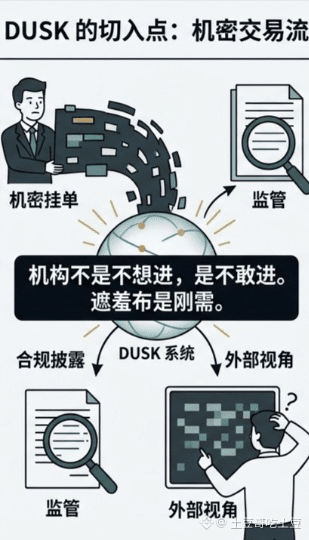
Dusk is built to target exactly this pain point. Institutions don’t want to join on-chain markets because they don’t want to; they’re afraid to.
Its confidential transaction flow ensures order intent is no longer exposed, and coupled with the underlying compliance-disclosure mechanism, regulators can see what they’re supposed to, while counterparties can’t see what they shouldn’t.
That entry point is indeed ruthless—it doesn’t attack the retail narrative; it targets the toughest gate institutions face when entering.
But it’s time for some cold water. Once the order book is no longer transparent, a new problem emerges: who guarantees the fairness of matching?
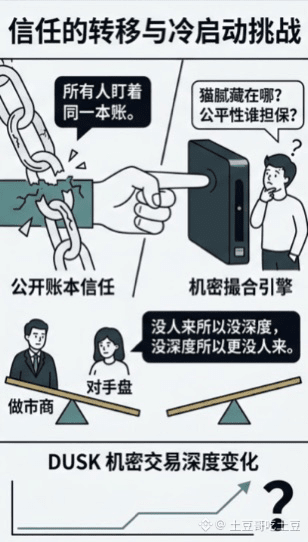
In a public market, everyone stares at the same ledger—no tricks can be hidden. Once you move into a confidential environment, whether the matching engine can “cut the line,” whether price discovery can be manipulated, and whether external parties can verify it in real time are all hard.
You’ve essentially shifted trust from a public ledger to the correct implementation of privacy logic.
For institutions, this may be a worthwhile deal, but the trust transfer itself needs to be audited and proven over time.
There’s also a more practical friction. Liquidity naturally has aggregation effects—whether market makers are willing to move their real positions into a confidential environment depends on whether there are enough real counterpart orders inside.
In the cold-start phase, a confidential order book may end up with little to no participation—no depth means fewer participants—which creates a vicious cycle.
I agree with the direction: the layer of “plausible cover” institutions want really is a must-have. But whether confidential matching can also preserve fair verification and deep liquidity depends on the real order-book data after the mainnet launches.
In the future, I’ll keep an eye on the changes in the confidential transaction depth of $DUSK . Do you think institutions will pay for privacy, or would they rather be frontrun in a public market?
#dusk $DUSK @Dusk