Pulled up the Dusk Network ($DUSK ) bridge incident notice from August 16 while working through this task. #Dusk @Dusk . The team flagged suspicious activity on a team-managed bridge wallet, disabled and recycled the related addresses, paused bridge services, and coordinated with Binance — all apparently before any user funds moved. No protocol-level issue on DuskDS. Standard incident response. But I kept re-reading it for a different reason.
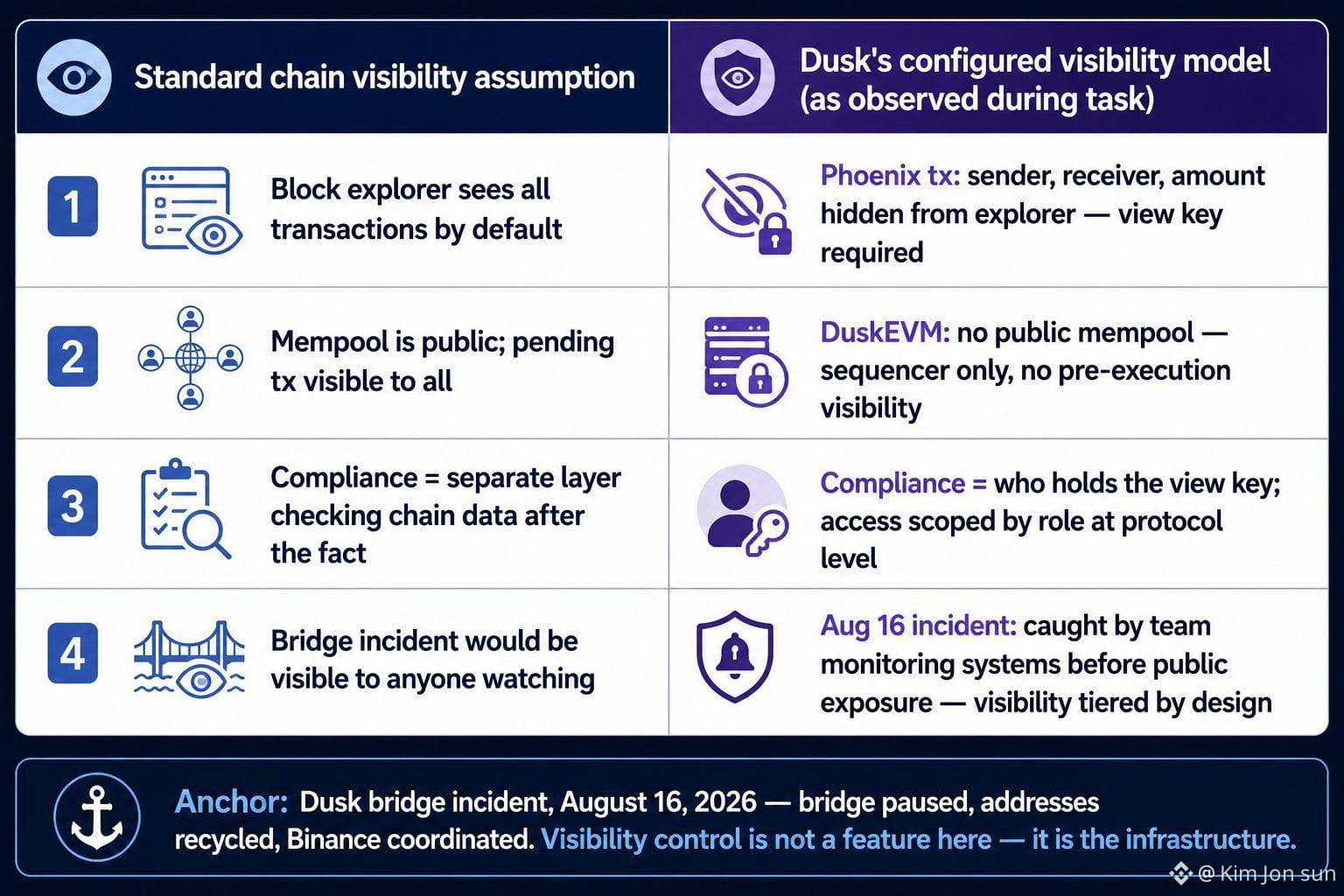
The part that stuck: their monitoring systems caught this. Meaning the team had visibility into specific wallet behavior that external observers, including anyone watching the block explorer, probably didn't. That's not an accident. It's the architecture. Phoenix transactions on DuskDS don't expose sender, receiver, or amount to anyone without a view key. DuskEVM runs with no public mempool — sequencer only. Visibility on Dusk is assigned, not assumed.
And that's actually the institutional pitch. Not privacy as a feature bolted on. Visibility as a configurable permission. Regulators get a view key scoped to what they need. Counterparties see what the contract allows. Operators see what their role grants. Everyone else sees... not much.
I kept thinking about how different that is from standard chain design, where the block explorer sees everything by default and access controls are afterthoughts. Here the default is opacity. Institutions apparently prefer that. Which is understandable — until you start asking who controls the view key distribution, and whether that control ever drifts toward fewer hands than the design implies.
The part that stuck: their monitoring systems caught this. Meaning the team had visibility into specific wallet behavior that external observers, including anyone watching the block explorer, probably didn't. That's not an accident. It's the architecture. Phoenix transactions on DuskDS don't expose sender, receiver, or amount to anyone without a view key. DuskEVM runs with no public mempool — sequencer only. Visibility on Dusk is assigned, not assumed.
And that's actually the institutional pitch. Not privacy as a feature bolted on. Visibility as a configurable permission. Regulators get a view key scoped to what they need. Counterparties see what the contract allows. Operators see what their role grants. Everyone else sees... not much.
I kept thinking about how different that is from standard chain design, where the block explorer sees everything by default and access controls are afterthoughts. Here the default is opacity. Institutions apparently prefer that. Which is understandable — until you start asking who controls the view key distribution, and whether that control ever drifts toward fewer hands than the design implies.