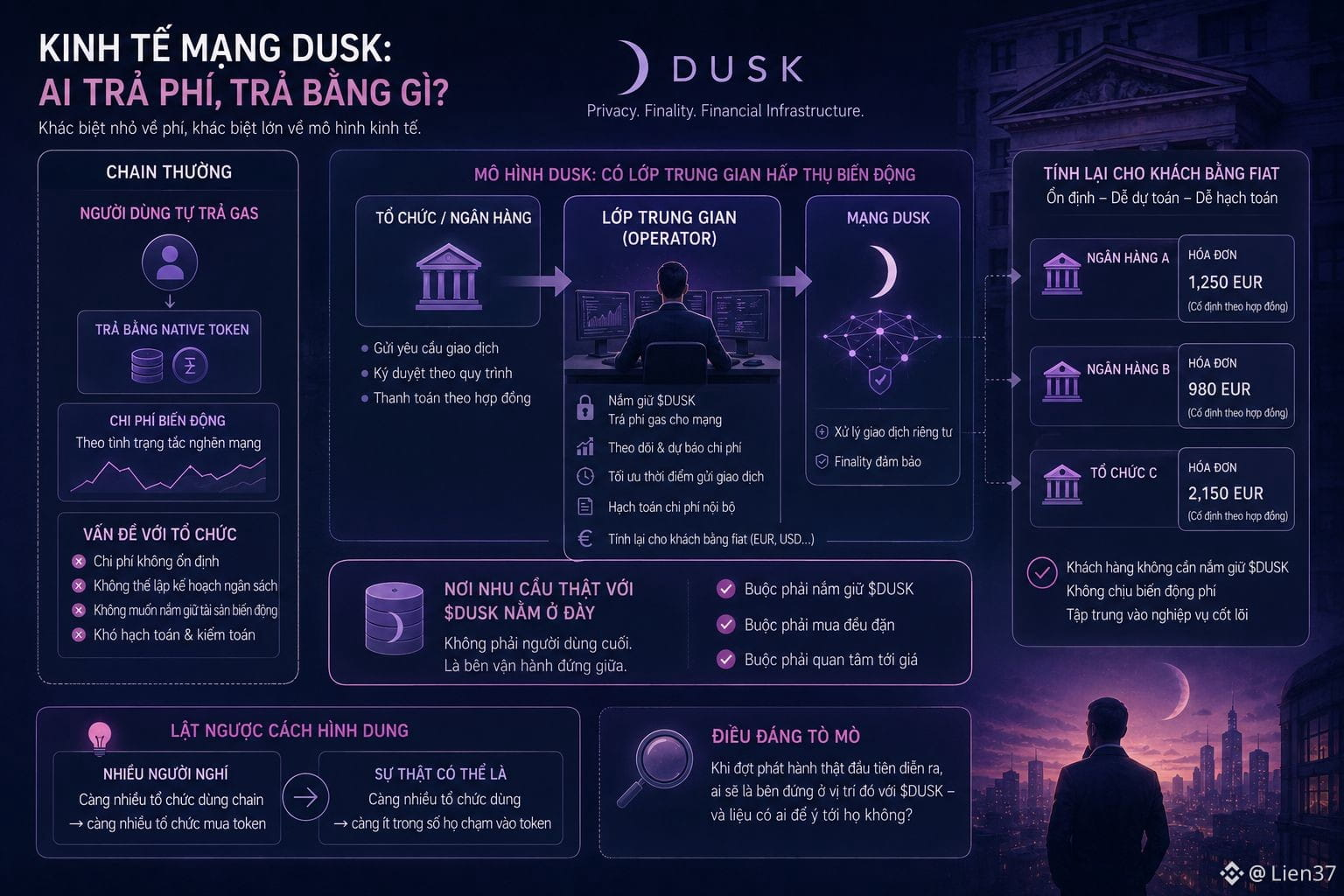
While doing creatorpad duties, I reread the network economics section of @Dusk and what remained in my mind was the issue of fees—specifically, who pays and what currency they use. On regular chains, users pay gas themselves; they accept that it fluctuates, treating it as normal.
But if the user is a bank executing securities settlement, that model won’t work. No organization accepts operating costs that change with network congestion, and no accounting department wants to hold an asset that fluctuates just to pay fees. Hold on… to serve this group, there has to be an intermediary layer that absorbs all of it. Someone holds tokens, pays the fees, and then charges the customer in euros based on a fixed contract.
And that intermediary layer is especially noteworthy, because that’s where the real demand for the token sits. Not the end user. It’s the operator in the middle. They’re the ones forced to hold it, forced to buy regularly, forced to care about the price. This flips how most people usually imagine things.
People tend to think the more organizations use a chain, the more organizations buy tokens. In reality, the more organizations use it, the fewer of them actually touch the tokens—because someone else handles that part. Not a criticism. That’s how financial infrastructure has always operated; it just makes forecasting demand much harder.
So I’m curious: when the very first real issuance happens, who will be in that position with $DUSK —and will anyone actually pay attention to them?
#dusk $BTC $ETH
But if the user is a bank executing securities settlement, that model won’t work. No organization accepts operating costs that change with network congestion, and no accounting department wants to hold an asset that fluctuates just to pay fees. Hold on… to serve this group, there has to be an intermediary layer that absorbs all of it. Someone holds tokens, pays the fees, and then charges the customer in euros based on a fixed contract.
And that intermediary layer is especially noteworthy, because that’s where the real demand for the token sits. Not the end user. It’s the operator in the middle. They’re the ones forced to hold it, forced to buy regularly, forced to care about the price. This flips how most people usually imagine things.
People tend to think the more organizations use a chain, the more organizations buy tokens. In reality, the more organizations use it, the fewer of them actually touch the tokens—because someone else handles that part. Not a criticism. That’s how financial infrastructure has always operated; it just makes forecasting demand much harder.
So I’m curious: when the very first real issuance happens, who will be in that position with $DUSK —and will anyone actually pay attention to them?
#dusk $BTC $ETH