#dusk Over the past two days, I re-read @Dusk ’s token design and wanted to figure out what, exactly, $DUSK uses to capture value. For most public-chain token narratives, it’s network effects—but how network effects actually translate into token demand is something very few people have clearly explained.
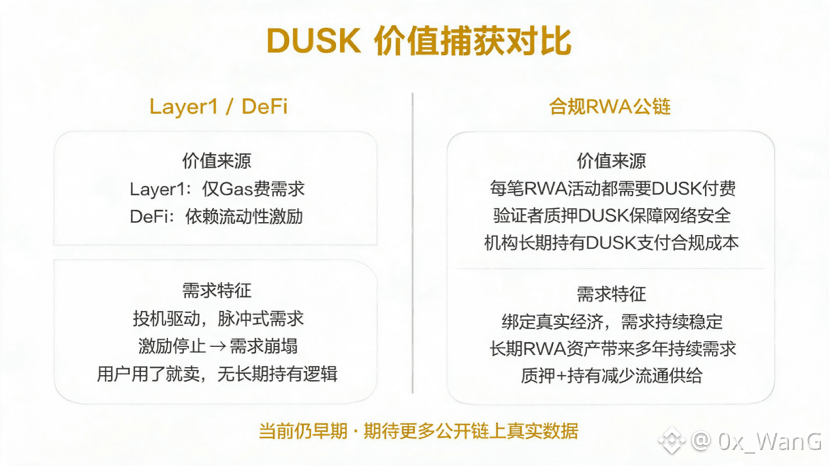
Dusk’s scenario is relatively straightforward. It tokenizes compliant financial assets on-chain. For every on-chain issuance, trade, settlement, and distribution, network fees must be paid. These fees are settled using $DUSK . As the size of on-chain assets grows, network activity increases, and demand for DUSK also increases. More importantly, validators need to stake DUSK to maintain network security, and institutional issuers may also need to hold DUSK long-term to cover ongoing compliance and settlement costs.
I’ve noticed that DUSK’s demand is tied to real economic activity, with less purely speculative component. Many Layer 1 tokens only provide Gas functionality—people buy them when they need to use them, then sell immediately when they don’t. Dusk’s use case naturally requires continuous on-chain activity. Once a bond is issued, for many years to come there will be interest payments, redemptions, and compliance disclosures—each of these creates transactions.
I think DUSK’s value-capture logic is more stable than many DeFi token models. Often, DeFi token value depends on whether the protocol continues to distribute incentives; once incentives stop, demand can collapse. If Dusk can keep institutional assets on-chain, then DUSK demand can be sustained.
But the key prerequisite is whether Dusk can truly attract large-scale RWA business. Right now it’s still early; on-chain asset size is limited, and token demand mainly comes from staking and expectations. I believe Dusk should publish more data on real on-chain economic activity—such as how many assets have been issued, how many settlements have been completed, and how much fees have been generated—because that’s more convincing than just describing token-economics models.
Do you think the scale effects of RWA on-chain can truly support DUSK’s long-term value? Let’s discuss.
Dusk’s scenario is relatively straightforward. It tokenizes compliant financial assets on-chain. For every on-chain issuance, trade, settlement, and distribution, network fees must be paid. These fees are settled using $DUSK . As the size of on-chain assets grows, network activity increases, and demand for DUSK also increases. More importantly, validators need to stake DUSK to maintain network security, and institutional issuers may also need to hold DUSK long-term to cover ongoing compliance and settlement costs.
I’ve noticed that DUSK’s demand is tied to real economic activity, with less purely speculative component. Many Layer 1 tokens only provide Gas functionality—people buy them when they need to use them, then sell immediately when they don’t. Dusk’s use case naturally requires continuous on-chain activity. Once a bond is issued, for many years to come there will be interest payments, redemptions, and compliance disclosures—each of these creates transactions.
I think DUSK’s value-capture logic is more stable than many DeFi token models. Often, DeFi token value depends on whether the protocol continues to distribute incentives; once incentives stop, demand can collapse. If Dusk can keep institutional assets on-chain, then DUSK demand can be sustained.
But the key prerequisite is whether Dusk can truly attract large-scale RWA business. Right now it’s still early; on-chain asset size is limited, and token demand mainly comes from staking and expectations. I believe Dusk should publish more data on real on-chain economic activity—such as how many assets have been issued, how many settlements have been completed, and how much fees have been generated—because that’s more convincing than just describing token-economics models.
Do you think the scale effects of RWA on-chain can truly support DUSK’s long-term value? Let’s discuss.