
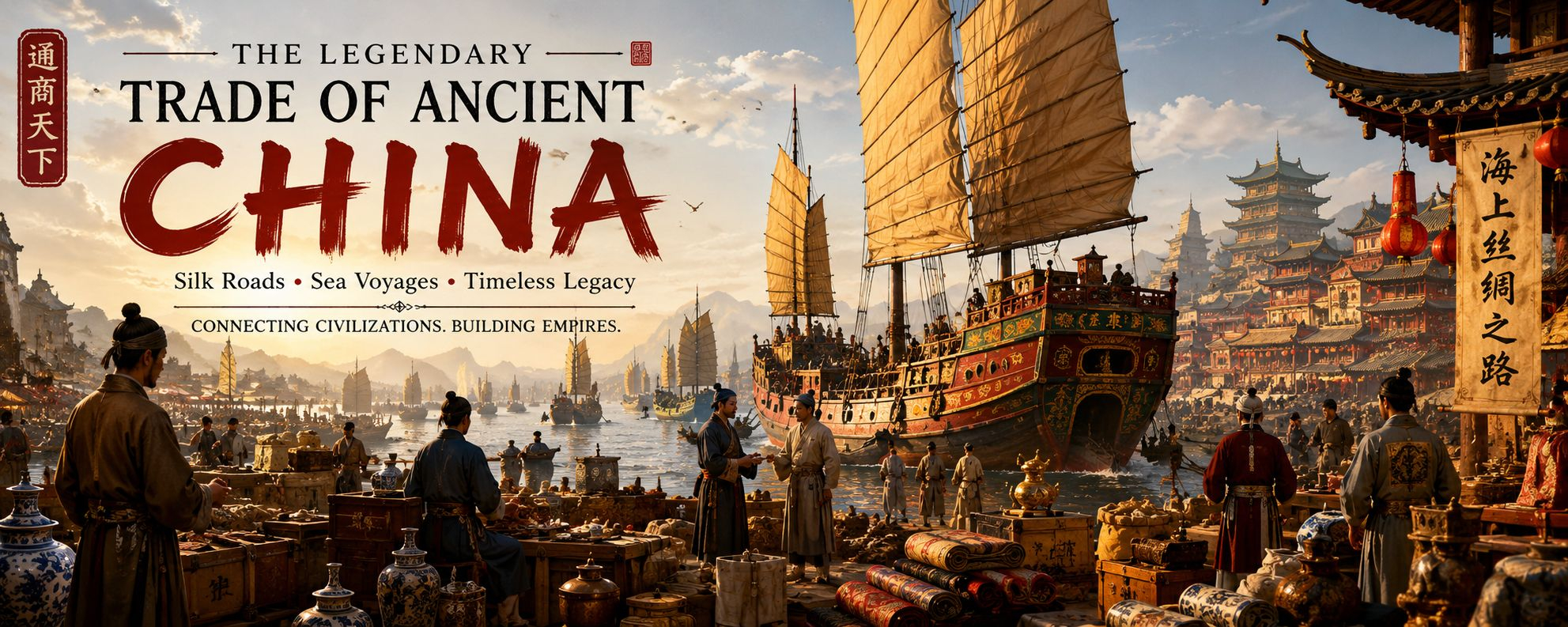

When Silk, Tea, and Spices Connect the World
Long before the internet, container ships, and modern banking systems emerged, China had already become one of the world’s largest trading hubs. The wealth of this nation came not only from its vast territory and population, but also from its ability to produce goods that other countries greatly desire.
During the Han Dynasty (206 BCE – 220 CE), a legendary trade route known as the Silk Road was born. This route was not merely an ordinary road, but a network of overland and sea routes connecting China with Central Asia, the Middle East, Africa, and even Europe. Along this route, merchants carried silk, ceramics, tea, paper, and various luxury goods whose value was equivalent to gold.
Silk became the most famous commodity from ancient China. The process of making it was kept secret by the state for centuries. Even the Romans considered silk fabric a symbol of the highest luxury. Many nobles were willing to pay fantastic prices just to have authentic silk clothing from China.
However, ancient Chinese trade was not only about goods. The Silk Road also became a means of exchanging culture, religion, knowledge, and technology. Through this route, Buddhist teachings entered China from India. Conversely, paper-making technology and various Chinese inventions spread to other regions and changed world civilization.
During the Tang Dynasty (618–907 AD), trade reached a golden age. Chang'an, now known as Xi'an, grew into one of the largest international cities in the world. Merchants from Persia, Arabia, India, and Central Asia gathered there to carry out transactions. Various languages, cultures, and religions lived side by side at the center of this trade.
Besides the overland routes, China also developed highly advanced maritime trade. Large ships sailed from the ports of Guangzhou and Quanzhou to Southeast Asia, India, the Middle East, and as far as the coasts of East Africa. They carried porcelain, tea, silk, and various crafted goods that were highly in demand in international markets.
Interestingly, the government of ancient China played a major role in regulating trade. Some dynasties implemented strict controls on the export of certain goods, while other dynasties opened trade to encourage economic growth. These policies often changed according to the political and security conditions of the country.
During the Ming Dynasty (1368–1644), a massive naval fleet led by Admiral Zheng He demonstrated China’s strength in trade and diplomacy. Its extraordinary large ships visited dozens of regions across Asia and Africa. These expeditions not only brought commercial goods, but also strengthened political and economic relationships with various kingdoms.
Even so, ancient Chinese trade did not always run smoothly. Robbers, conflicts between kingdoms, extreme weather, and high travel costs were major challenges for merchants. Many spent months and even years to complete a single trading trip. The risk of losing goods or one’s life was part of their everyday life.
The success of ancient Chinese trade ultimately formed a strong economic foundation and made the country one of the world’s economic centers for centuries. Even to this day, traces of that trading heyday can still be seen in the influence on culture, technology, and the global trade networks they once built.
When the modern world talks about globalization, actually, the concept was practiced by Chinese merchants thousands of years ago. They proved that trade is not only about profit, but also about connecting different people, cultures, and civilizations into a single interdependent world network.
And in this era, look at what China is like. They have produced a golden generation with an unbounded triumph, looking at examples from their ancestors in the past to show the world that they will always be there, moving forward with the wheel of time.
The question is:
Who is a worthy match for China’s current generation?
Will China continue to exist like it does now? Until when?
What kind of generation will emerge after the current era?
Free and polite comments, please🙏😇...next, let’s discuss which generation of the nation is good again?
#BitcoinBestWeekSinceMarch2023 $BTC
