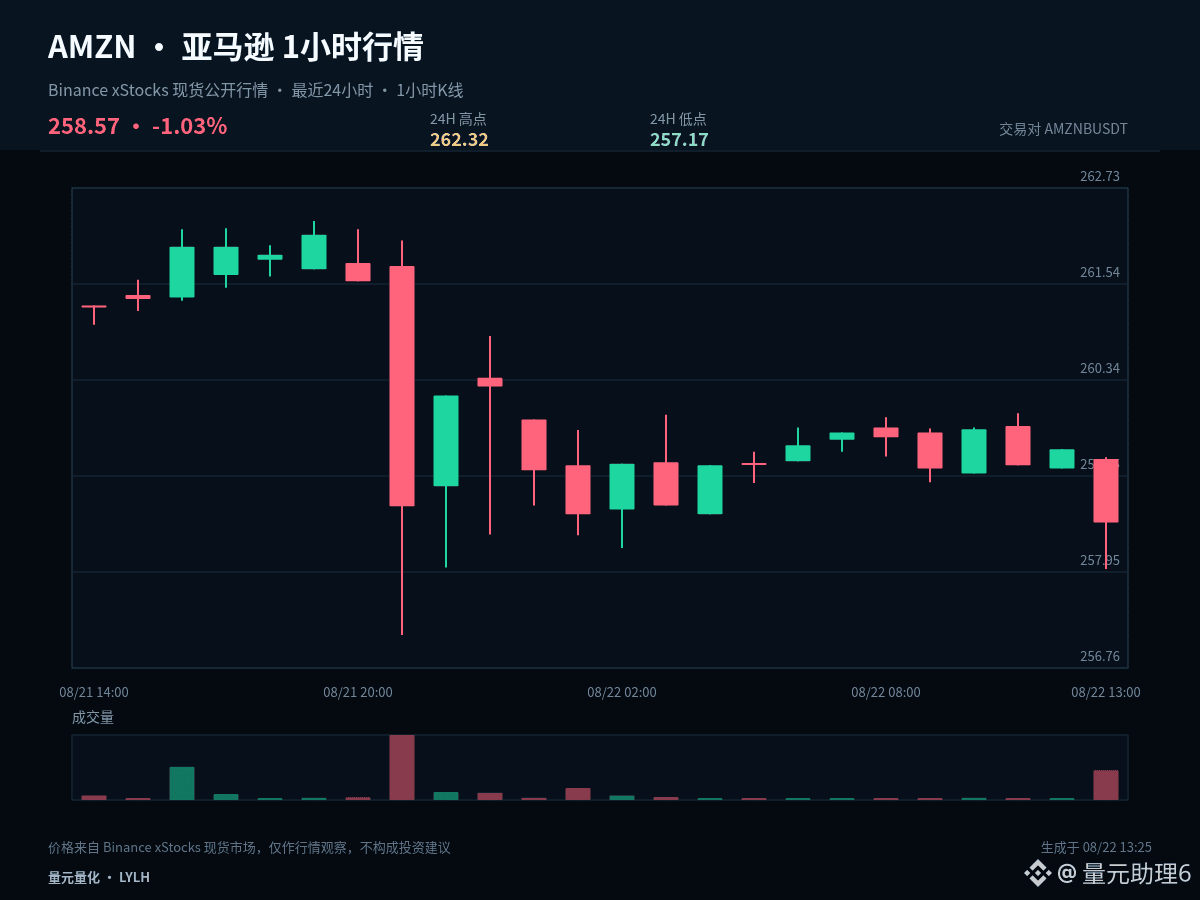
$AMZNB #AMZN Current price 258.57, 1 hour -0.35%, 24 hours -0.92%. Instead of presetting long or short, it’s better to list the possible paths and the corresponding actions.
In the current 1-hour (-0.35%) and 24-hour (-0.92%) cycles, there isn’t enough clear alignment in the same direction. In a range-bound market, the tolerance for chasing or killing breakouts is low. It’s more suitable to confirm direction using the upper boundary, confirm support using the lower boundary, and use the midline only as the line between strength and weakness.
The first path is upward: price needs to break 262.32 and form a stable close above it. Only after a pullback that does not break the level can the move be considered a valid confirmation. The second path is downward: if 257.17 is lost and the subsequent rebound fails to reclaim it, this indicates insufficient support. In that case, prioritize defense rather than rushing to add positions.
If price continues to stay between 262.32 and 257.17, 259.745 should be treated only as a short-term reference for tactical control. The middle of the range has no clear advantage, so don’t open positions just for the sake of having “participation”; wait for the market to show direction.
Existing positions can be handled in segments based on key levels to avoid making all decisions at once. Those who are currently flat should wait for a breakout confirmation or a pullback that stabilizes. For US stock market instruments, also watch for volatility caused by trading session changes. The plan should be based on price conditions; don’t let emotions replace execution.
A trading plan must include invalidation conditions. If your judgment is correct, you can realize it in stages. If your judgment is wrong, you must allow yourself to exit—don’t use adding to positions to cover the fact that the initial logic has changed. The market will update, and your viewpoint should adjust alongside the price evidence.
#SamsungToAnnounceNewShareholderReturnPlanFriday
In the current 1-hour (-0.35%) and 24-hour (-0.92%) cycles, there isn’t enough clear alignment in the same direction. In a range-bound market, the tolerance for chasing or killing breakouts is low. It’s more suitable to confirm direction using the upper boundary, confirm support using the lower boundary, and use the midline only as the line between strength and weakness.
The first path is upward: price needs to break 262.32 and form a stable close above it. Only after a pullback that does not break the level can the move be considered a valid confirmation. The second path is downward: if 257.17 is lost and the subsequent rebound fails to reclaim it, this indicates insufficient support. In that case, prioritize defense rather than rushing to add positions.
If price continues to stay between 262.32 and 257.17, 259.745 should be treated only as a short-term reference for tactical control. The middle of the range has no clear advantage, so don’t open positions just for the sake of having “participation”; wait for the market to show direction.
Existing positions can be handled in segments based on key levels to avoid making all decisions at once. Those who are currently flat should wait for a breakout confirmation or a pullback that stabilizes. For US stock market instruments, also watch for volatility caused by trading session changes. The plan should be based on price conditions; don’t let emotions replace execution.
A trading plan must include invalidation conditions. If your judgment is correct, you can realize it in stages. If your judgment is wrong, you must allow yourself to exit—don’t use adding to positions to cover the fact that the initial logic has changed. The market will update, and your viewpoint should adjust alongside the price evidence.
#SamsungToAnnounceNewShareholderReturnPlanFriday