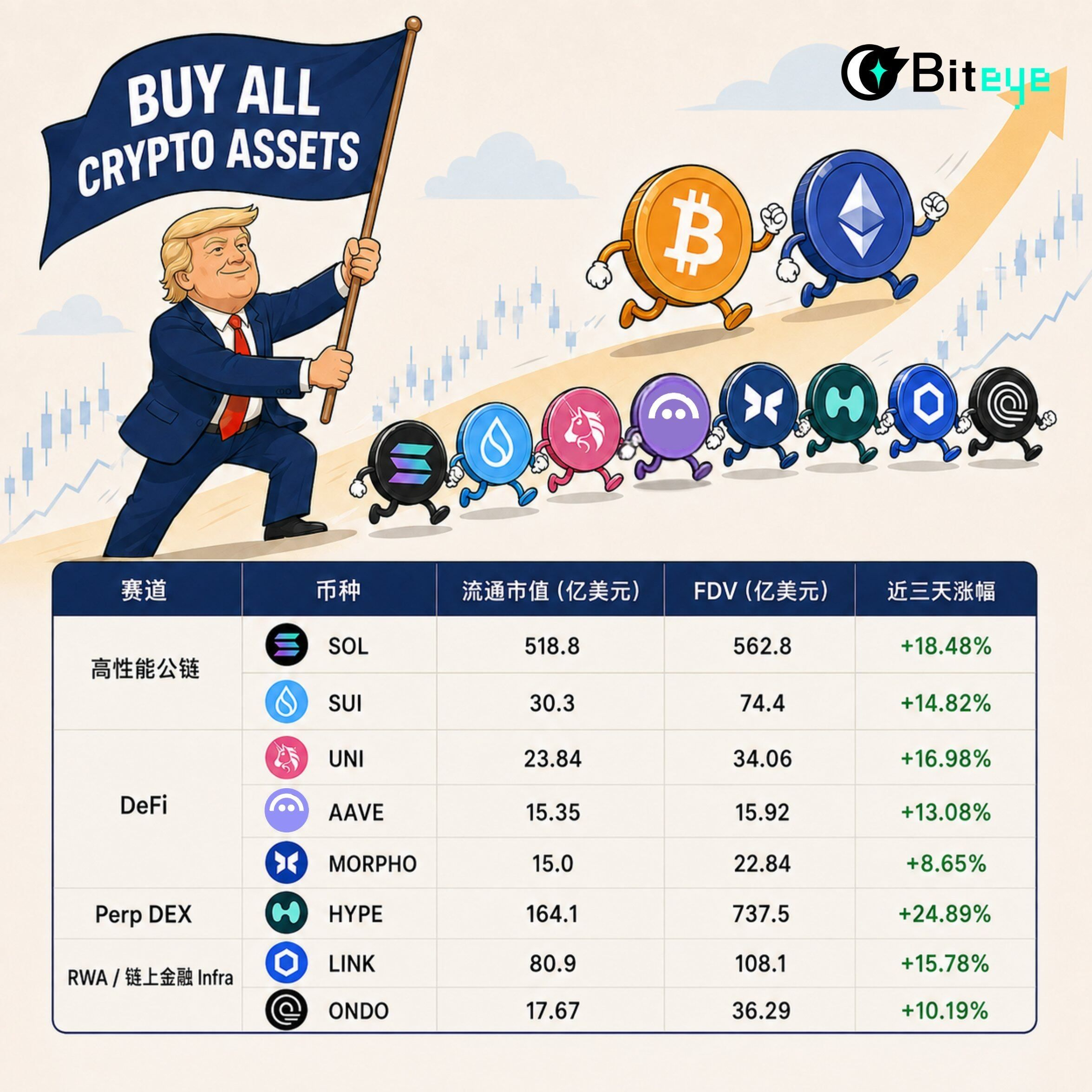
Within three days, Bitcoin is expected to stay strong and target $77,000, breaking above the EMA200 and a host of other bullish indicators. Ethereum, meanwhile, surged 20% in a single day and is just one step away from $2,400. As BTC stabilizes and ETH begins to catch up, expectations are rising again that capital will rotate from major coins into high-beta altcoins—expanding the spread of funds.
However, after a bull market where BTC ran alone and a bear-market cleanup, this altcoin cycle is unlikely to be “ten thousand coins all rising together.” The projects most likely to receive overflow capital flows from major coins are still those with real users, stable protocol revenue, clear token value capture, and relatively healthy token-holder/coin supply structures.
High-performance public chain sector
Leader: SOL
Circulating market cap / FDV: about $51.88 billion / $56.28 billion
Last three days: +18.48%
On-chain situation: TVL is about $5.31 billion, stablecoins about $15.86 billion, and 24-hour DEX trading volume about $2.8 billion
Unlocking: Circulating supply is 583 million tokens, about 92.2% of the current total. There is no obvious large “cliff” unlock; the main risk comes from long-term PoS inflation
Token distribution (chips): The top 10 addresses account for only 6.58%
Outlook: Strictly speaking, SOL itself is already a mainstream coin, and the public chain sector has the highest certainty. But volatility is high; compared with Bitcoin and Ethereum, it’s currently weaker—perhaps you can wait for a catch-up move.
Potential coin: SUI
Circulating market cap / FDV: about $3.03 billion / $7.44 billion
Last three days: +14.82%
On-chain situation: TVL is about $427 million, stablecoins about $466 million, and 24-hour DEX trading volume about $39 million
Unlocking: Currently only 40.75% has been released. On Sep 1, 2026, an unlock of about 13.5 million tokens (worth about $9.93 million) is expected. Subsequent releases continue beyond 2030.
Token distribution (chips): Top 10 addresses account for about 13.55%, with a moderate concentration level.
Outlook: In the last bull cycle, performance was outstanding and volatility was high. However, a lower circulation rate is a risk factor—pay close attention to subsequent unlock nodes.
Sector conclusion: The public chain sector is a solid pick—SOL is steady, and it’s currently the top choice for blockchain startups with a strong ecosystem. Go for higher volatility with SUI. But since public chains are actually dominated by ETH, it’s advisable to take a relatively medium position in SOL and a small position in SUI for a more balanced bet.
DeFi lending and borrowing sector
Leader 1: UNI
Circulating market cap / FDV: about $2.384 billion / $3.406 billion
Last three days: +16.98%
On-chain situation: Total TVL across Uniswap V2, V3, and V4 is about $3.1 billion; 30-day fees about $79.2 million, and protocol revenue about $6.12 million
Unlocking: The original vesting plan has already been completed 100%, with no clear large unlocks ahead. Currently, about 62.4% of the supply has entered circulation; the rest is mainly in the community treasury, burn addresses, and protocol contracts
Token distribution (chips): Top 10 addresses account for about 52.03%. The basic structure is: governance Timelock contract 26.72%, burn addresses 10.91%, major exchange addresses total about 6.69%, and Token Distributor 1.25%
Outlook: One of the tickers Scotiabank has called out. After the fee switch and buyback-and-burn mechanism are implemented, UNI will shift from being a pure governance token to an asset with protocol-value-capture capability. Its 30-day fee volume is clearly higher than AAVE’s.
Leader 2: AAVE
Circulating market cap / FDV: about $1.535 billion / $1.592 billion
Last three days: +13.08%
On-chain situation: Aave V3 TVL is about $16.47 billion; 30-day fees about $30.01 million, and protocol revenue about $4.08 million
Unlocking: About 97% has already been released
Token distribution (chips): Top 10 addresses account for about 43.07%, including a staking pool (15.32%), V3 contracts (5.24%), and ecosystem reserves (3.61%).
Outlook: One of the tickers called out by Scotiabank. The token circulation structure and revenue-generating ability are the most balanced, but after rebounding from the bottom, it has already gained a lot of upside.
Potential coin: MORPHO
Circulating market cap / FDV: about $1.50 billion / $2.284 billion
Last three days: +8.65%
On-chain situation: Morpho Blue TVL is about $8.93 billion; 30-day fees about $16.34 million, but current protocol-layer income is close to 0
Unlocking: There are明显 discrepancies in the circulating supply figures. CoinGecko’s circulation is about 65.7%, while Tokenomist’s trade/release-based figures are about 34%; there is currently no clear date for the next “cliff” unlock
Token distribution (chips): Top 10 addresses account for about 64.4%, including wrapped contracts 39.13% and seed-round addresses 9.01%
Outlook: The protocol is growing very fast, but token value capture is weaker than AAVE, and the supply statistics are not transparent enough.
Sector conclusion: The DeFi sector is one of the few areas in the crypto market that currently has projects with real revenue. It’s an old, battle-tested sector that has been proven by the market. Consider allocating some DeFi assets.
Perp DEX sector
Leader: HYPE
Circulating market cap / FDV: about $16.41 billion / $73.75 billion
Last three days: +24.89%
On-chain situation: Hyperliquid L1 TVL is about $1.45 billion, stablecoins about $6.57 billion, Bridge TVL about $6.27 billion; 30-day fees about $48.39 million, and revenue about $34.52 million
Unlocking: The reported circulating amount is about 222 million tokens, only about 23% of the total. The whitepaper model for expected release on Sep 5–6 is about 9.92 million tokens, but in practice the team’s claimed amount has historically usually been lower than the model.
Token distribution (chips): Future incentives 26.3%, core contributors 25.4%, and the foundation 6.4%. Combined, the three categories total 58.1%
Outlook: As the leader of the Perp DEX, Hype can’t be toppled by anyone right now. But after being hyped by Trump, the current rally and the unlock structure are not suitable for blindly chasing the price.
Sector conclusion: Perp DEX is arguably the hottest sector in this cycle. However, Hype’s income and the buyback gap are leading right now, and Hype’s token price and market cap are already not low—so you may need to position cautiously.
RWA and on-chain financial infrastructure sector
Leader: LINK
Circulating market cap / FDV: about $8.09 billion / $10.81 billion
Last three days: +15.78%
On-chain situation: The community staking pool is about 40.88 million LINK. Ondo tokenized stocks and ETFs already use Chainlink data sources.
Unlocking: CoinGecko’s circulation rate is about 74.8%, and Tokenomist’s tradable float is about 58.8%; no fixed large unlock date yet
Token distribution (chips): Top 10 addresses account for about 30.5%. About 20.2% are non-circulating official wallets, and 4.09% is the community staking pool
Outlook: Can benefit simultaneously from RWA, stablecoins, cross-chain, and institutions bringing finance on-chain—more certain than a single RWA project.
Potential coin: ONDO
Circulating market cap / FDV: about $1.767 billion / $3.629 billion
Last three days: +10.19%
On-chain situation: Ondo Yield Assets TVL is about $2.51 billion, and Global Markets is about $971 million
Unlocking: Currently 49%–53% has been released. But on Jan 18, 2027, an unlock of 1.94 billion tokens is expected!
Token distribution (chips): Top 10 addresses account for about 70.41%, of which the single official multisig address accounts for 54.79%
Outlook: Strong business growth, but there are clear risks in terms of token value capture, token concentration, and the major unlock in 2027.
Sector conclusion: LINK is suitable as the main position in the RWA segment. ONDO is only suitable as an event-driven small position; it’s best to wait until the market fully prices in the 2027 unlock.