


(Source: Economic Daily)
Reposted from: Economic Daily
“In this important market in China, where new robot innovations are continuously emerging, Arm will continue to work hand in hand with local ecosystem partners to advance adaptive robotics technology toward broader real-world applications.” In a keynote speech at the 2026 World Robot Conference (WRC) Developer Day held recently, Federico Pecora (Federico Pecora), Global Head of Research for Arm physical AI robotics technology, said.
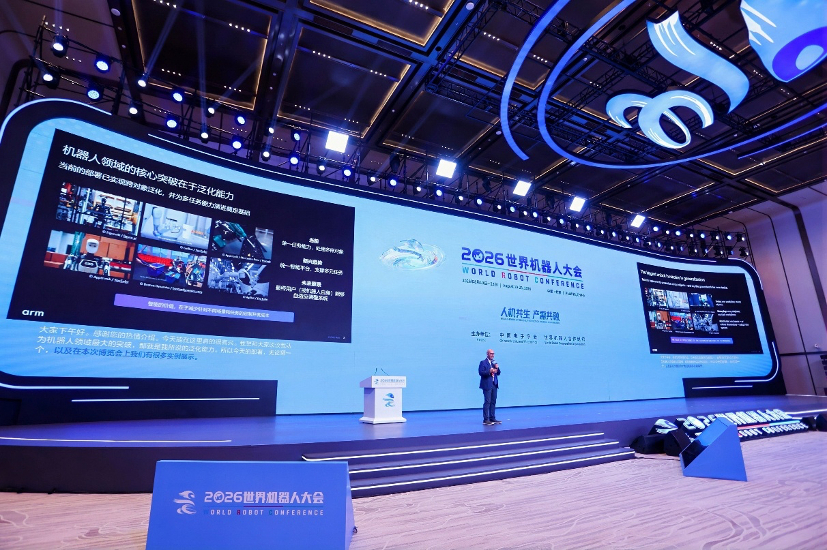
During this period, Federico Pecora shared his views on the development of the physical AI industry. He said that, judging by industry development trends, robot capabilities are undergoing three stages. The first stage is cross-object generalization, meaning that a robot can handle different types of objects within the same task workflow without needing to retrain or reprogram for each object. This capability has already been validated in structured scenarios such as sorting, logistics, and retail. The second stage is multi-task intelligence. A unified intelligent platform enables multiple tasks to be performed; robots no longer serve a single fixed workflow, but can switch between different capability combinations according to task requirements. The third stage is system-level adaptation. At that time, both end users and the robots themselves will be able to adjust their capabilities in response to changes in the environment, without redeveloping, retraining, or redeploying the system.
“The commercial value of generalization capability lies in its ability to significantly reduce the cost and complexity of adapting and deploying robots to new scenarios, new processes, and new tasks. Therefore, generalization capability is regarded as a key ability driving the large-scale implementation of robot technology, and how to support this capability with efficient computing has also become one of Arm’s core challenges,” said Federico Pecora.
Federico Pecora believes that today many individual capabilities can already be achieved through targeted training, model optimization, and engineering implementation. However, the real challenge lies in how to enable robots to autonomously coordinate and combine these capabilities to complete complex tasks in the real world.
“Arm believes that the next stage of large-scale robot deployment will revolve around four system-level challenges,” Federico Pecora said. First, how capabilities are realized: robots cannot rely on a single model to complete all tasks, but instead need suitable models, policies, planners, and controllers for different stages. Second, how different capabilities continue to collaborate during operation: robot workloads in the real world have different time scales, and without clear temporal structure and priority scheduling, these capabilities may compete for computing resources, causing response delays that not only affect system efficiency but may also create safety risks. Third, how capabilities are mapped to computing resources: for robots, real-time responsiveness, autonomy, and safety often depend on strong local computing power. The core challenge facing system architecture is how to reasonably allocate workloads among CPUs, dedicated accelerators, memory, and communication links so that the overhead of data transfer does not offset the performance and energy-efficiency advantages brought by heterogeneous computing. Fourth, how capabilities are governed: as robots gain stronger adaptive capabilities, the industry needs to focus not only on basic safety issues such as collision avoidance, speed limits, and force control, but also on higher-level constraints such as spatial and temporal rules, task preferences, and behavioral norms in specific scenarios.
Federico Pecora said that the challenges facing the robotics industry are not only technical and systemic; there is also a gap between innovation priorities and industry needs. The industry needs a general computing foundation that can connect, organize, and coordinate these capabilities in large-scale deployment scenarios. Arm is playing a role in this critical area. By providing an open computing platform and strong ecosystem support, Arm is committed to helping the industry turn individual technological breakthroughs into reliable system-level intelligence, accelerating the transition of robotics from the laboratory to large-scale deployment. (Economic Daily reporter Yuan Yong)