#dusk $DUSK @Dusk
I keep coming back to one uncomfortable question with Dusk: does stronger privacy quietly make the network harder to run? Confidential smart contracts and the XSC standard hide sensitive transaction details, which is great for financial privacy, but validators still need enough information to know that everything is behaving correctly.
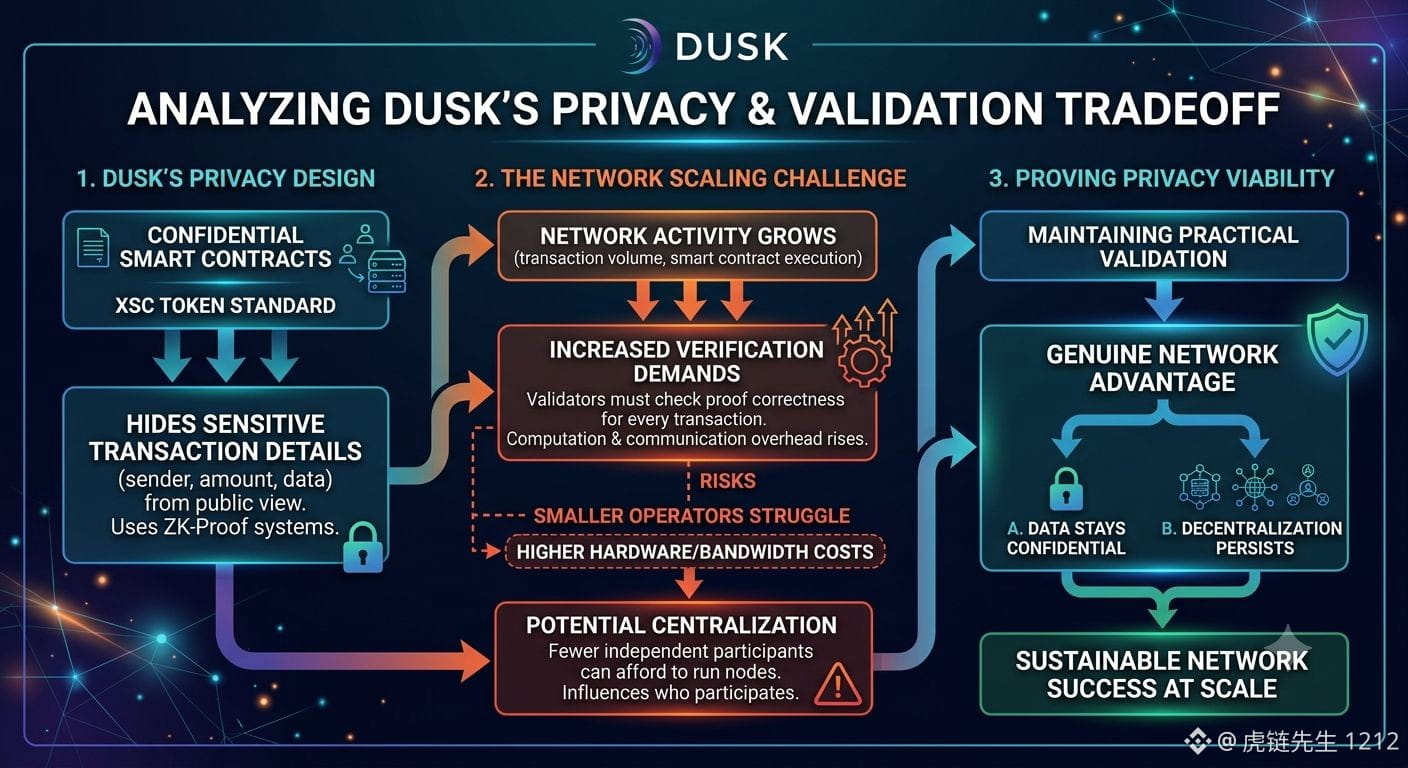
That creates a real tradeoff. If verification becomes more demanding as activity grows, smaller operators may struggle with the extra hardware, bandwidth, or technical overhead. Over time, that can change who is willing to participate and who gets pushed out. For me, this is where Dusk gets interesting. Privacy is not really proven when data simply disappears from public view. It is proven when the network can keep that data confidential while making validation practical for enough independent participants. If Dusk can maintain that balance at scale, the privacy architecture becomes a genuine network advantage rather than just another feature on the roadmap.
I keep coming back to one uncomfortable question with Dusk: does stronger privacy quietly make the network harder to run? Confidential smart contracts and the XSC standard hide sensitive transaction details, which is great for financial privacy, but validators still need enough information to know that everything is behaving correctly.
That creates a real tradeoff. If verification becomes more demanding as activity grows, smaller operators may struggle with the extra hardware, bandwidth, or technical overhead. Over time, that can change who is willing to participate and who gets pushed out. For me, this is where Dusk gets interesting. Privacy is not really proven when data simply disappears from public view. It is proven when the network can keep that data confidential while making validation practical for enough independent participants. If Dusk can maintain that balance at scale, the privacy architecture becomes a genuine network advantage rather than just another feature on the roadmap.