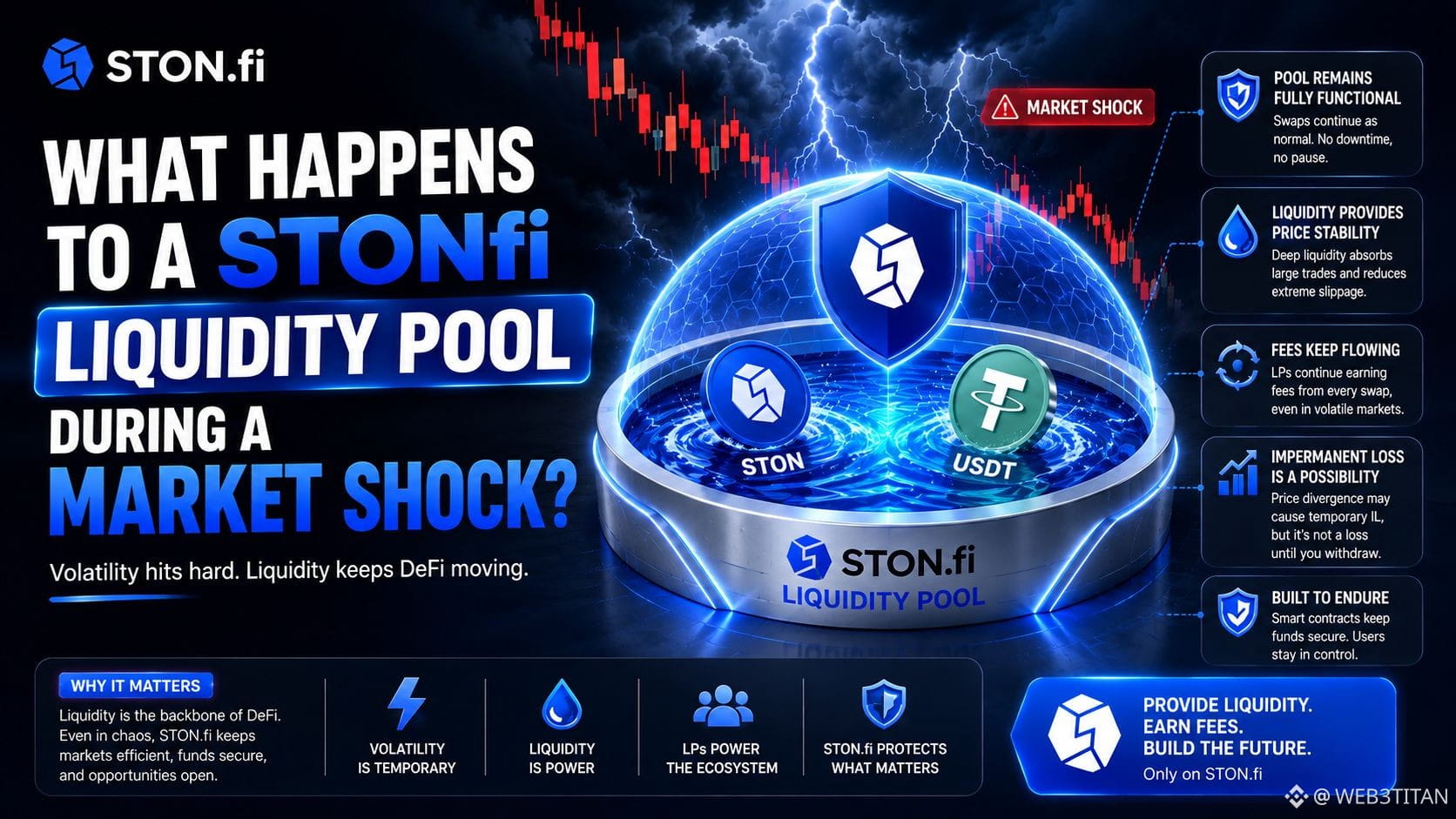
WHAT HAPPENS TO A STONfi LIQUIDITY POOL DURING A MARKET SHOCK?
A big market move doesn't just affect traders. It can quickly change the balance of assets inside a liquidity pool.
PRICE DIVERGENCE STARTS IT
Imagine a TON/USDT pool and TON suddenly drops hard.
The price of TON inside the pool can move away from the wider market. This creates an opportunity for arbitrage traders.
ARBITRAGE REBALANCES THE POOL
Arbitrage traders buy the cheaper asset from the pool and sell it where the price is higher.
As this happens, the pool's token balance changes.
The result can be a pool holding less TON and more USDT after a major TON decline.
WITHDRAWALS CAN CHANGE THINGS FURTHER
During a sharp market move, some liquidity providers may decide to remove their liquidity.
That reduces the amount of liquidity available to traders and can make the pool more sensitive to larger swaps.
THIS IS WHERE IMPERMANENT LOSS MATTERS
Price divergence between the two assets can create impermanent loss for liquidity providers.
Even if the pool earns trading fees, the value of the assets you hold through the pool can differ from simply holding the two tokens separately.
The larger the price movement, the more important this becomes.
THE POOL COMPOSITION CHANGES
This was the part I found most interesting.
A liquidity pool isn't static.
Prices move → arbitrage happens → token balances shift → providers react → liquidity changes.
So during a market shock, the pool can look very different from how it looked before the move.
MY TAKE
A market shock doesn't simply mean prices go down or up.
For liquidity providers, it can mean changing balances, more arbitrage activity, withdrawals, lower liquidity, and higher impermanent loss exposure.
That's why I wouldn't judge a liquidity pool only by its APR.
Before providing liquidity, I want to understand what could happen to the pool when the market moves aggressively.
$XRP $SOL
#GoldReboundsNearly5%
A big market move doesn't just affect traders. It can quickly change the balance of assets inside a liquidity pool.
PRICE DIVERGENCE STARTS IT
Imagine a TON/USDT pool and TON suddenly drops hard.
The price of TON inside the pool can move away from the wider market. This creates an opportunity for arbitrage traders.
ARBITRAGE REBALANCES THE POOL
Arbitrage traders buy the cheaper asset from the pool and sell it where the price is higher.
As this happens, the pool's token balance changes.
The result can be a pool holding less TON and more USDT after a major TON decline.
WITHDRAWALS CAN CHANGE THINGS FURTHER
During a sharp market move, some liquidity providers may decide to remove their liquidity.
That reduces the amount of liquidity available to traders and can make the pool more sensitive to larger swaps.
THIS IS WHERE IMPERMANENT LOSS MATTERS
Price divergence between the two assets can create impermanent loss for liquidity providers.
Even if the pool earns trading fees, the value of the assets you hold through the pool can differ from simply holding the two tokens separately.
The larger the price movement, the more important this becomes.
THE POOL COMPOSITION CHANGES
This was the part I found most interesting.
A liquidity pool isn't static.
Prices move → arbitrage happens → token balances shift → providers react → liquidity changes.
So during a market shock, the pool can look very different from how it looked before the move.
MY TAKE
A market shock doesn't simply mean prices go down or up.
For liquidity providers, it can mean changing balances, more arbitrage activity, withdrawals, lower liquidity, and higher impermanent loss exposure.
That's why I wouldn't judge a liquidity pool only by its APR.
Before providing liquidity, I want to understand what could happen to the pool when the market moves aggressively.
$XRP $SOL
#GoldReboundsNearly5%