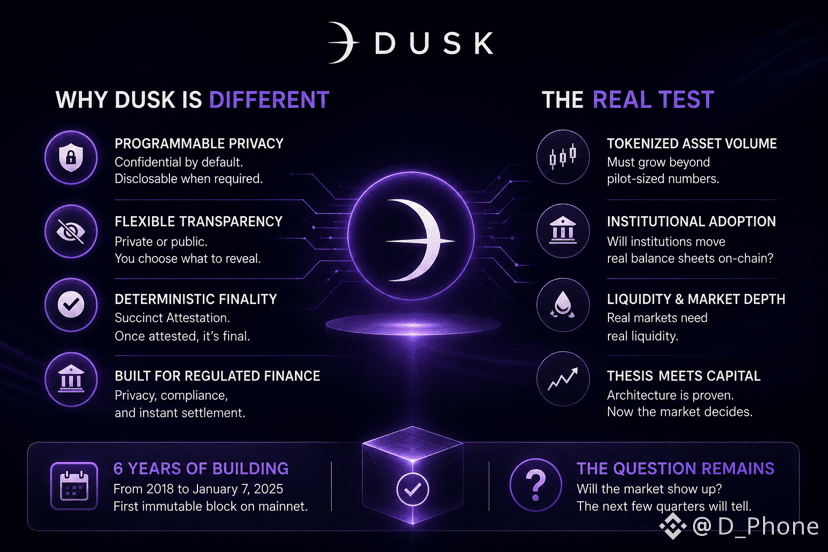
I keep thinking about a conversation I had with a developer last year who wanted to build a lending protocol with private balances. He had two options and neither felt right. Pick a privacy chain and rewrite the whole stack from scratch, or stay on familiar EVM tooling and give up confidentiality entirely. That tradeoff has quietly shaped what gets built in this industry for years.
Dusk Network is closing that gap. DuskEVM lets teams deploy standard Solidity contracts using tools they already know. Nothing exotic to learn on day one. What changes is what sits underneath: DuskEVM settles back to DuskDS, Dusk's base layer built for deterministic finality, and it opens a path to confidential transaction flows through Hedger, the project's dedicated privacy module for EVM applications.
Hedger doesn't rely on zero-knowledge proofs alone. It pairs them with homomorphic encryption, so computations can happen on encrypted values without ever exposing them, while the transaction still proves itself correct. That combination is rare. Most privacy tooling in this space picks one primitive and lives with its limits.
There's a practical layer around this too. Gas on DuskEVM gets paid in DUSK itself, and a new SDK called Dusk Connect recently shipped specifically to make wallet integration less of a headache for teams building on top of all this. Small detail, but it's the kind of unglamorous plumbing that decides whether developers actually stick around after the first demo.
None of this is finished yet, and I think that honesty matters more than hype. Both DuskEVM and Hedger are running on testnet right now, not mainnet. The mainnet is coming, not here. Tooling maturity and real audits stay open questions until it actually ships and gets used.
Still, the direction is clear. A developer shouldn't have to choose between the tools they know and the privacy their users need. Dusk is betting that removing that choice is worth 6 years of infrastructure work.
@Dusk #dusk $BTW $DUSK $ONG
Dusk Network is closing that gap. DuskEVM lets teams deploy standard Solidity contracts using tools they already know. Nothing exotic to learn on day one. What changes is what sits underneath: DuskEVM settles back to DuskDS, Dusk's base layer built for deterministic finality, and it opens a path to confidential transaction flows through Hedger, the project's dedicated privacy module for EVM applications.
Hedger doesn't rely on zero-knowledge proofs alone. It pairs them with homomorphic encryption, so computations can happen on encrypted values without ever exposing them, while the transaction still proves itself correct. That combination is rare. Most privacy tooling in this space picks one primitive and lives with its limits.
There's a practical layer around this too. Gas on DuskEVM gets paid in DUSK itself, and a new SDK called Dusk Connect recently shipped specifically to make wallet integration less of a headache for teams building on top of all this. Small detail, but it's the kind of unglamorous plumbing that decides whether developers actually stick around after the first demo.
None of this is finished yet, and I think that honesty matters more than hype. Both DuskEVM and Hedger are running on testnet right now, not mainnet. The mainnet is coming, not here. Tooling maturity and real audits stay open questions until it actually ships and gets used.
Still, the direction is clear. A developer shouldn't have to choose between the tools they know and the privacy their users need. Dusk is betting that removing that choice is worth 6 years of infrastructure work.
@Dusk #dusk $BTW $DUSK $ONG