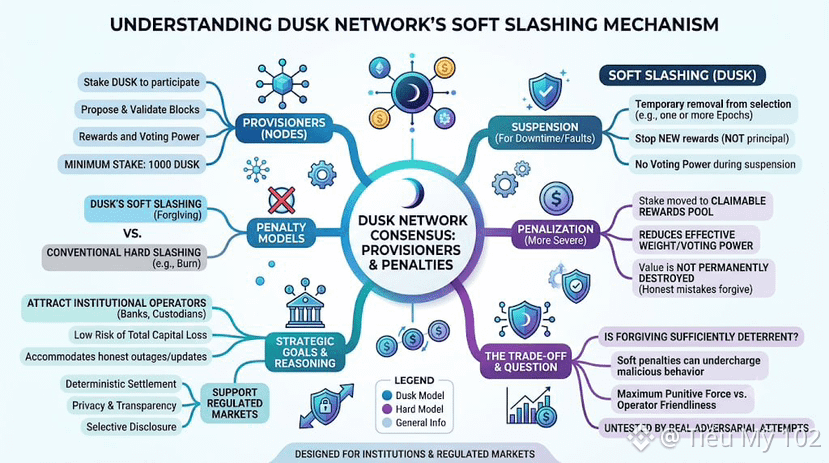
Ask most people how proof of stake punishes bad validators and they will say slashing, meaning your stake gets burned. Dusk Network does something different, and I think the reasoning behind it is underappreciated. Instead of destroying stake outright, the protocol uses what it calls soft slashing.
Provisioners, the nodes that stake DUSK to propose and validate blocks, face two possible penalties for faults or extended downtime. Suspension removes them from selection for one or more epochs, cutting off new rewards without touching their principal. Penalization goes further, moving a portion of their stake into a claimable rewards pool rather than burning it, which reduces their effective weight in the selection process without permanently destroying value. Minimum stake to participate directly sits at 1000 DUSK, with no upper limit for anyone who wants to run larger infrastructure. Stake maturity runs two epochs before new stake becomes active, a short cooldown against rapid churning around consensus rounds.
The intent is clear: punish unreliable behavior hard enough to matter economically, without the kind of permanent, unforgiving burn that can turn an honest operator's bad week, a server outage, a botched update, into total loss. That suits the institutional node operators Dusk is courting, since banks and custodians will not run infrastructure where one misconfigured update destroys real capital. That fits a bigger pattern too, since the whole point underneath it is combining privacy, transparency, selective disclosure and deterministic settlement into something regulated markets can rely on.
My honest question is whether forgiving is the same as sufficiently deterrent. Harder slashing models exist specifically because soft penalties can undercharge for genuinely malicious behavior, not just honest downtime. Dusk is betting operator friendliness matters more at this stage than maximum punitive force, and that bet has not been tested by a real adversarial attempt yet.
@Dusk $DUSK #dusk