#dusk $DUSK @Dusk
What happens to a tokenized asset after it is issued?
Tokenization is often associated specifically with the creation of a digital asset. But for the financial market, issuance is only the beginning of its lifecycle🙄
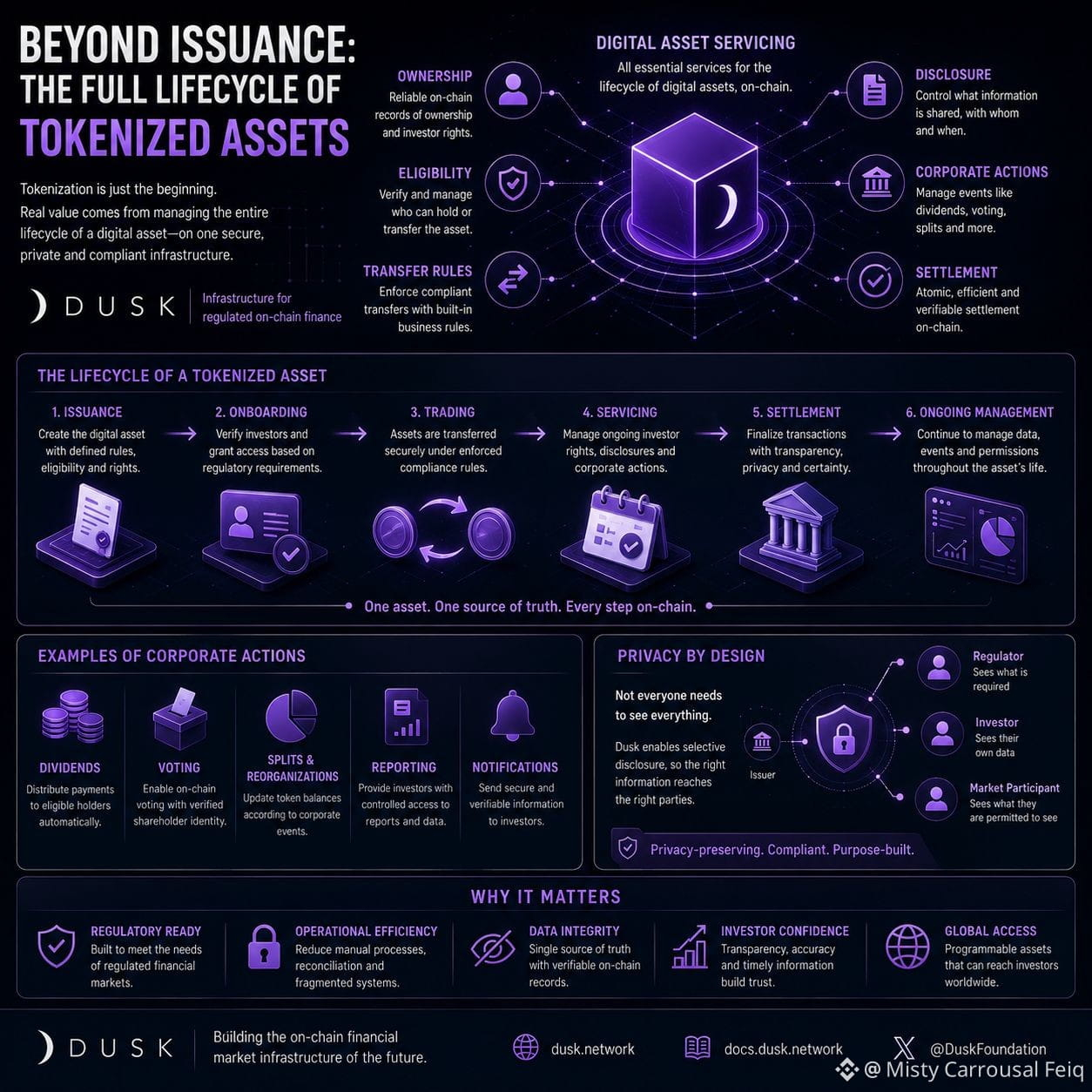
After that, you need to maintain owner registries, process payments, organize voting, send notifications to investors, and handle other corporate events.
@Dusk Foundation views digital asset servicing as a separate part of on-chain infrastructure. The idea is to connect ownership, eligibility, transfer rules, and the necessary disclosure of information around a single asset.
In a traditional system, this information is often spread across different participants and databases. An on-chain model can make this process more consistent: changes in ownership, investors’ rights, and related events are recorded in one environment.
That’s why the real value of tokenization is not only in creating the token, but in the ability to build a complete lifecycle of a digital asset on shared infrastructure. This is the direction that makes $DUSK interesting for regulated on-chain finance👍👍👍
What happens to a tokenized asset after it is issued?
Tokenization is often associated specifically with the creation of a digital asset. But for the financial market, issuance is only the beginning of its lifecycle🙄
After that, you need to maintain owner registries, process payments, organize voting, send notifications to investors, and handle other corporate events.
@Dusk Foundation views digital asset servicing as a separate part of on-chain infrastructure. The idea is to connect ownership, eligibility, transfer rules, and the necessary disclosure of information around a single asset.
In a traditional system, this information is often spread across different participants and databases. An on-chain model can make this process more consistent: changes in ownership, investors’ rights, and related events are recorded in one environment.
That’s why the real value of tokenization is not only in creating the token, but in the ability to build a complete lifecycle of a digital asset on shared infrastructure. This is the direction that makes $DUSK interesting for regulated on-chain finance👍👍👍